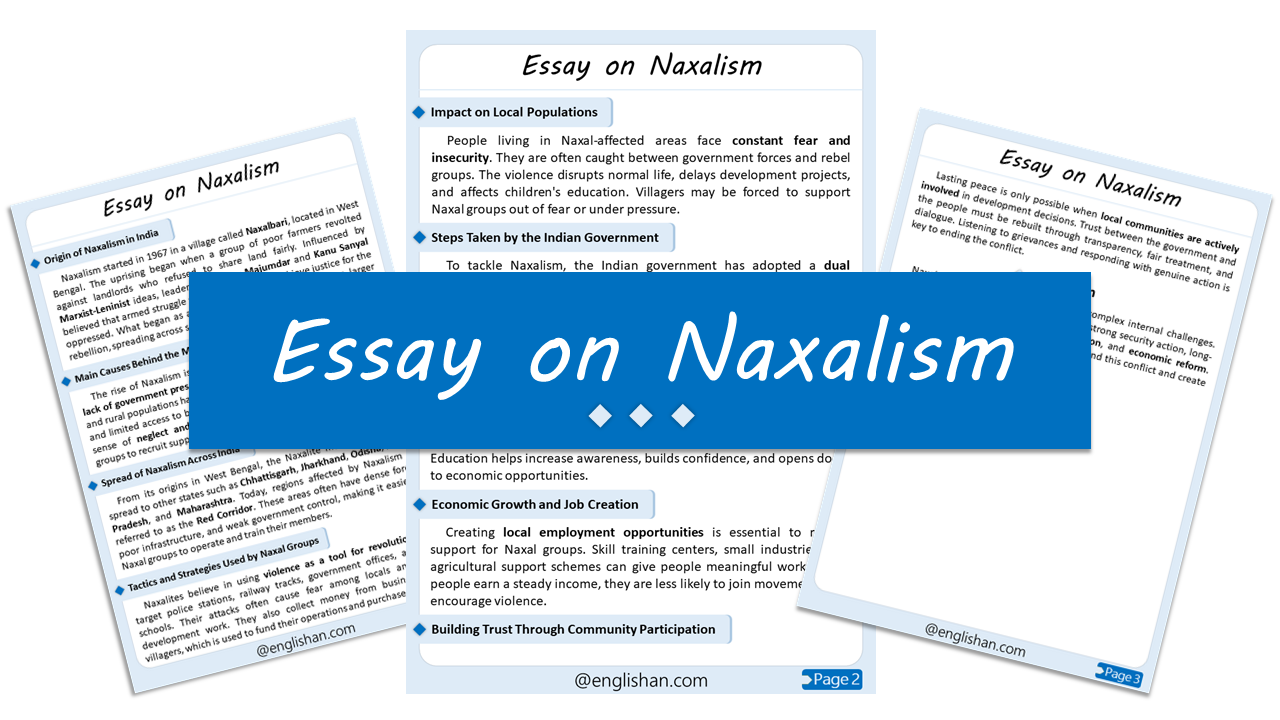
When writing about Naxalism, it’s important to understand why some groups use violence to demand rights for the poor. This essay on Naxalism explains how it started, what it aims for, its effects on society, and the steps taken to stop it. It’s written to help students with homework or exams. You can download this Naxalism essay as a free PDF or image to study or print.
10 Lines Naxalism Essay for Class 2 to Class 5
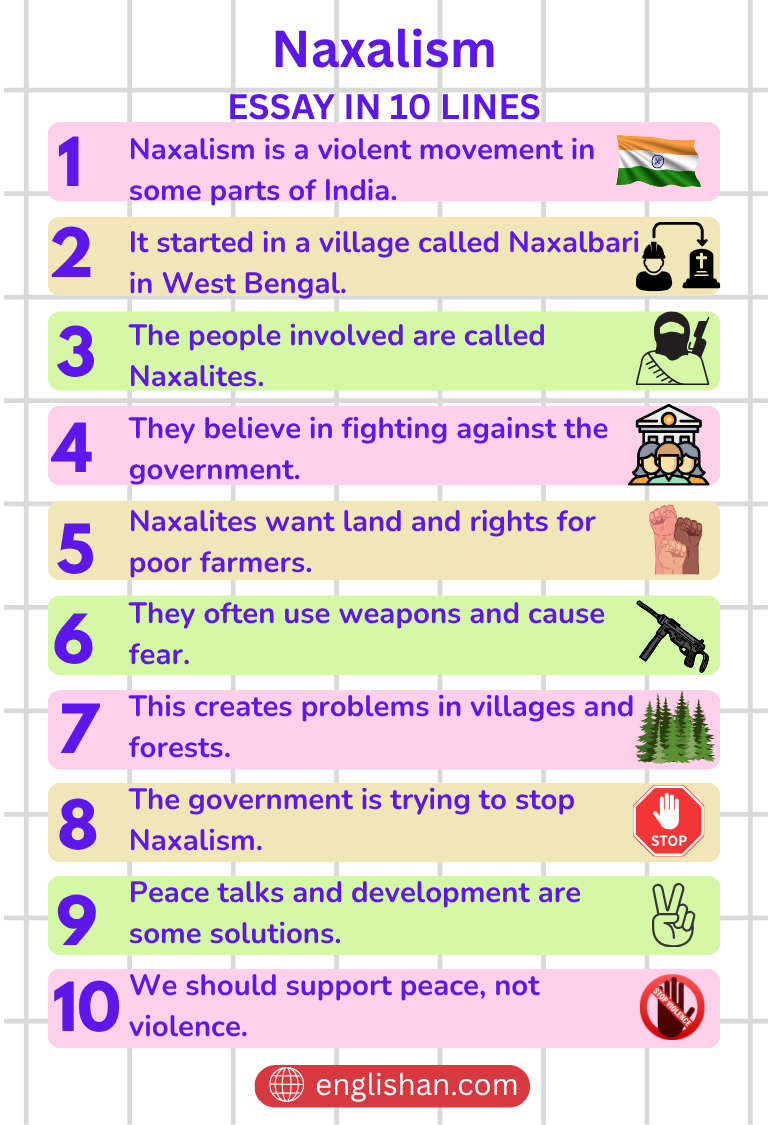
- Naxalism is a violent movement in some parts of India.
- It started in a village called Naxalbari in West Bengal.
- The people involved are called Naxalites.
- They believe in fighting against the government.
- Naxalites want land and rights for poor farmers.
- They often use weapons and cause fear.
- This creates problems in villages and forests.
- The government is trying to stop Naxalism.
- Peace talks and development are some solutions.
- We should support peace, not violence.
250 Words Essay on Naxalism for Middle School
Naxalism is a serious problem in India that involves violence and conflict. It began in 1967 in a small village called Naxalbari in West Bengal. The movement was started by a group of people who believed that poor farmers and landless workers were being treated unfairly. These people, known as Naxalites, chose to fight the government to get land and rights for the poor.
The Naxalites believe in using violence to bring change. They attack government buildings, police forces, and even villages. Many of them live and operate in forest areas and tribal regions. Because of their actions, people in those areas often live in fear. Schools, roads, and hospitals are affected, and development is slowed down.
The government is working hard to stop Naxalism. It uses both police action and peaceful talks. Some states have started special programs to help the poor, improve education, and create jobs so that people do not join the Naxalites.
Some people feel that violence is not the right way to solve problems. Instead, they believe in using education, communication, and law to bring justice.
In conclusion, Naxalism is a big challenge that harms peace and growth. Everyone should work together to create a fair and peaceful society where problems are solved through understanding, not violence.
500 Words Naxalism Essay for Upper Primary and Lower Secondary
Origin of Naxalism in India
Naxalism started in 1967 in a village called Naxalbari, located in West Bengal. The uprising began when a group of poor farmers revolted against landlords who refused to share land fairly. Influenced by Marxist-Leninist ideas, leaders like Charu Majumdar and Kanu Sanyal believed that armed struggle was the only way to achieve justice for the oppressed. What began as a local protest quickly turned into a larger rebellion, spreading across several Indian states.
Main Causes Behind the Movement
The rise of Naxalism is closely linked to poverty, land injustice, and lack of government presence in remote areas. Many tribal communities and rural populations have long suffered from land loss, unemployment, and limited access to basic services like education and healthcare. This sense of neglect and exploitation created fertile ground for Naxal groups to recruit supporters by promising equality and empowerment.
Spread of Naxalism Across India
From its origins in West Bengal, the Naxalite movement gradually spread to other states such as Chhattisgarh, Jharkhand, Odisha, Andhra Pradesh, and Maharashtra. Today, regions affected by Naxalism are referred to as the Red Corridor. These areas often have dense forests, poor infrastructure, and weak government control, making it easier for Naxal groups to operate and train their members.
Tactics and Strategies Used by Naxal Groups
Naxalites believe in using violence as a tool for revolution. They target police stations, railway tracks, government offices, and even schools. Their attacks often cause fear among locals and hinder development work. They also collect money from businesses and villagers, which is used to fund their operations and purchase weapons.
Impact on Local Populations
People living in Naxal-affected areas face constant fear and insecurity. They are often caught between government forces and rebel groups. The violence disrupts normal life, delays development projects, and affects children’s education. Villagers may be forced to support Naxal groups out of fear or under pressure.
Steps Taken by the Indian Government
To tackle Naxalism, the Indian government has adopted a dual approach. On one side, it deploys security forces to control violence. On the other, it implements development programs to improve roads, schools, hospitals, and employment in affected regions. However, challenges such as corruption, lack of coordination, and poor planning have limited the effectiveness of these efforts.
Role of Education in Combating Naxalism
One of the most powerful tools to fight Naxalism is education. By providing quality schooling and skill development, young people in remote areas can find better career options and reject violent paths. Education helps increase awareness, builds confidence, and opens doors to economic opportunities.
Economic Growth and Job Creation
Creating local employment opportunities is essential to reduce support for Naxal groups. Skill training centers, small industries, and agricultural support schemes can give people meaningful work. When people earn a steady income, they are less likely to join movements that encourage violence.
Building Trust Through Community Participation
Lasting peace is only possible when local communities are actively involved in development decisions. Trust between the government and the people must be rebuilt through transparency, fair treatment, and dialogue. Listening to grievances and responding with genuine action is key to ending the conflict.
Conclusion
Naxalism remains one of India’s most complex internal challenges. While violence must be addressed through strong security action, long-term solutions lie in social justice, education, and economic reform. Peaceful development, not force alone, can end this conflict and create a better future for all.

Difficult Words Used in 500 Naxalism Essay
| Word | Meaning |
|---|---|
| Insurgency | Armed rebellion against an established government |
| Exploitation | Treating someone unfairly for personal gain |
| Neglect | Failure to care for or attend to something properly |
| Coordination | The act of organizing people or actions efficiently |
| Empowerment | Giving people more control over their own lives |
| Infrastructure | Basic facilities like roads, schools, and electricity systems |
Naxalism Essay PDF
You May Also Like