When writing about the importance of family, it’s important to understand how love, care, and support help shape a person’s life. This essay on family explains the role of parents, siblings, and grandparents, the values we learn, and how family builds strong emotional bonds. It’s written in 500 words to help students with homework or exams. You can download this importance of family essay as a free PDF or image to study or print.
10 Lines Importance of Family Essay for Class 2 to Class 5
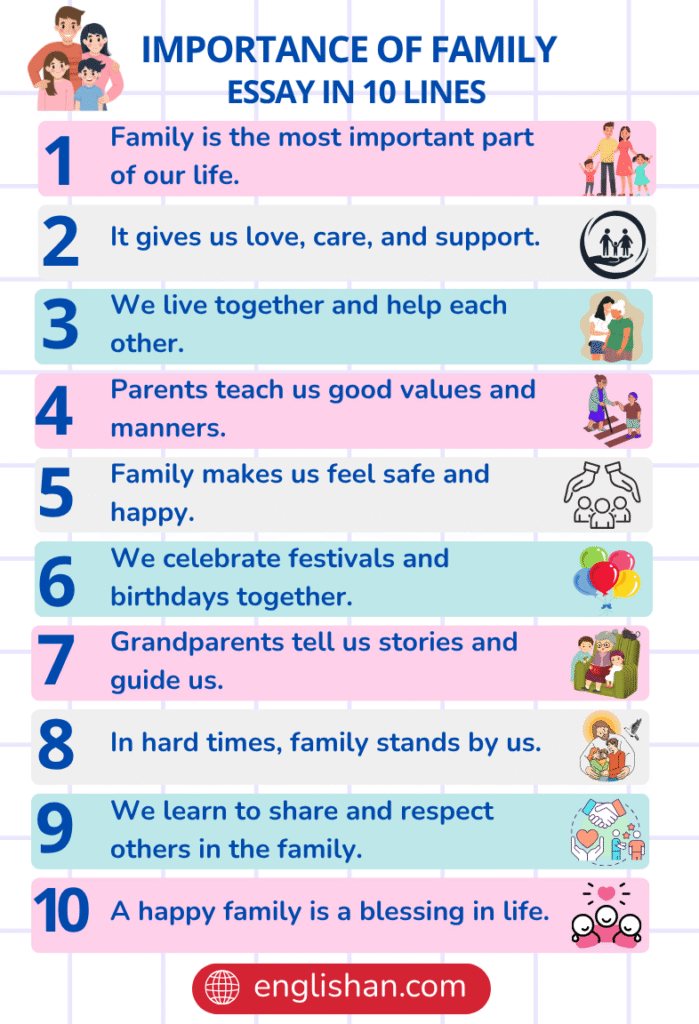
- Family is the most important part of our life.
- It gives us love, care, and support.
- We live together and help each other.
- Parents teach us good values and manners.
- Family makes us feel safe and happy.
- We celebrate festivals and birthdays together.
- Grandparents tell us stories and guide us.
- In hard times, family stands by us.
- We learn to share and respect others in the family.
- A happy family is a blessing in life.
250 Words Essay on Importance of Family for Middle School
Family plays a very important role in everyone’s life. It is the first place where we learn about love, care, support, and values. Our family includes our parents, siblings, and sometimes grandparents, uncles, aunts, and cousins. Living in a family teaches us how to respect others, share things, and help one another.
Parents are the foundation of the family. They guide us in the right direction and teach us good manners and discipline. They also help us in our studies and care for our health. Siblings are our first friends. We play, study, and grow up together, learning teamwork and patience.
Grandparents are also an important part of many families. They share stories and traditions, and their experience helps us learn valuable life lessons. A strong family gives emotional support during sad times and shares happiness in good times.
In a family, we celebrate festivals, birthdays, and special days together, which helps us build strong bonds. The love and support of a family make us feel confident and strong. Even when life gets tough, our family stands with us.
In conclusion, family is a blessing that shapes our character and future. It teaches us how to be good human beings and gives us the strength to face life’s challenges. A caring and united family is the true source of happiness.
500 Words Importance of Family Essay for Upper Primary and Lower Secondary
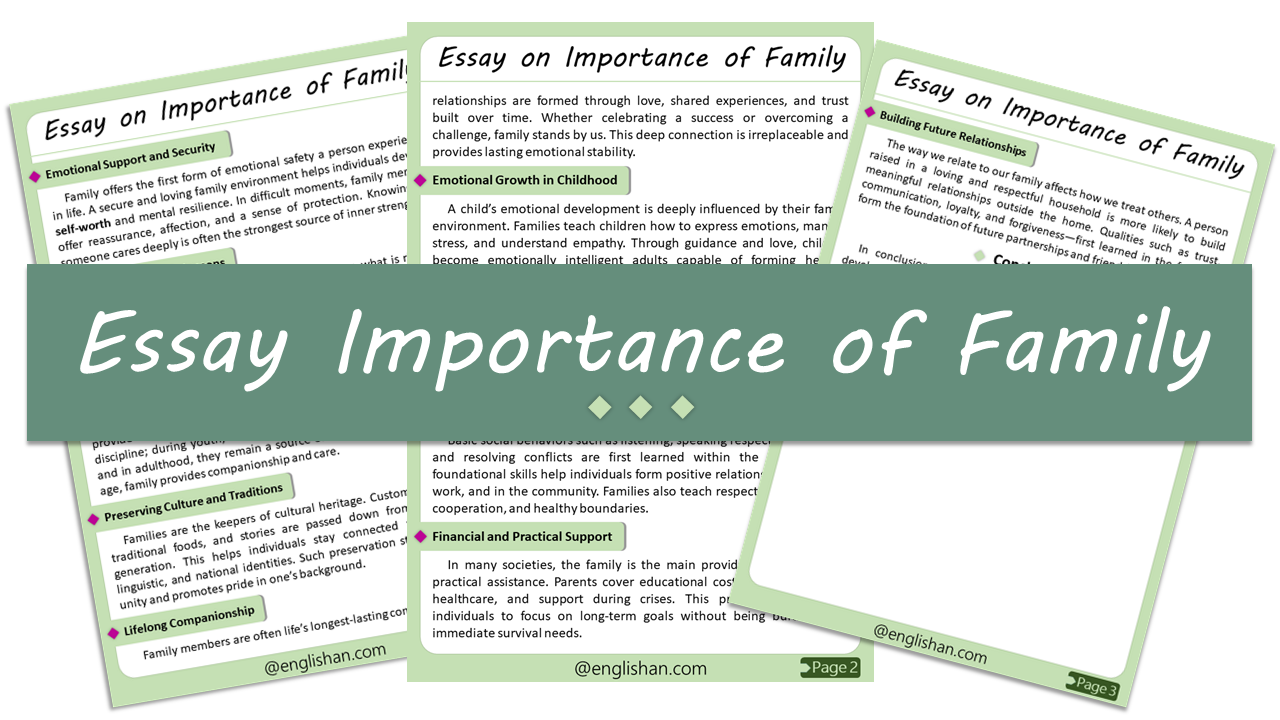
Emotional Support and Security
Family offers the first form of emotional safety a person experiences in life. A secure and loving family environment helps individuals develop self-worth and mental resilience. In difficult moments, family members offer reassurance, affection, and a sense of protection. Knowing that someone cares deeply is often the strongest source of inner strength.
Moral Values and Life Lessons
From early childhood, family is where people learn what is right and wrong. Parents, grandparents, and elders share wisdom through both actions and words. Lessons in honesty, patience, kindness, and responsibility are taught through everyday experiences. These moral values become the guiding principles of a person’s life.
Constant Support Across Life Stages
At every stage—from birth to adulthood and old age—families provide unwavering support. In childhood, they offer care and discipline; during youth, they assist in academic and personal growth; and in adulthood, they remain a source of encouragement. Even in old age, family provides companionship and care.
Preserving Culture and Traditions
Families are the keepers of cultural heritage. Customs, celebrations, traditional foods, and stories are passed down from generation to generation. This helps individuals stay connected to their ethnic, linguistic, and national identities. Such preservation strengthens family unity and promotes pride in one’s background.
Lifelong Companionship
Family members are often life’s longest-lasting companions. These relationships are formed through love, shared experiences, and trust built over time. Whether celebrating a success or overcoming a challenge, family stands by us. This deep connection is irreplaceable and provides lasting emotional stability.
Emotional Growth in Childhood
A child’s emotional development is deeply influenced by their family environment. Families teach children how to express emotions, manage stress, and understand empathy. Through guidance and love, children become emotionally intelligent adults capable of forming healthy relationships.
Motivation for Success
Family acts as a powerful motivator. Parents often push their children to achieve their best through encouragement, discipline, and faith in their potential. A family’s belief in one’s ability can inspire individuals to aim higher and overcome obstacles with confidence.
Learning Social Skills
Basic social behaviors such as listening, speaking respectfully, sharing, and resolving conflicts are first learned within the family. These foundational skills help individuals form positive relationships at school, work, and in the community. Families also teach respect for differences, cooperation, and healthy boundaries.
Financial and Practical Support
In many societies, the family is the main provider of financial and practical assistance. Parents cover educational costs, provide housing, healthcare, and support during crises. This practical help allows individuals to focus on long-term goals without being burdened by immediate survival needs.
Building Future Relationships
The way we relate to our family affects how we treat others. A person raised in a loving and respectful household is more likely to build meaningful relationships outside the home. Qualities such as trust, communication, loyalty, and forgiveness—first learned in the family—form the foundation of future partnerships and friendships.
Conclusion
In conclusion, family is a pillar of emotional, moral, and social development. It provides safety, teaches discipline, and inspires people to become better individuals. Beyond basic needs, family shapes who we are and how we relate to the world. A strong, supportive family creates individuals who contribute positively to society. Without the guidance and love of family, personal growth would be incomplete.

Difficult Words Used in 500 Importance of Family Essay
| Word | Meaning (in English) |
|---|---|
| Resilience | The ability to recover quickly from difficulties or challenges |
| Affection | A gentle feeling of love, care, or fondness |
| Moral | Related to the principles of right and wrong behavior |
| Guiding | Leading or showing the right path or direction |
| Heritage | Cultural traditions, beliefs, and values passed from previous generations |
| Empathy | The ability to understand and share the feelings of another |
| Discipline | Training to follow rules or a code of behavior |
| Foundation | The base or starting point for development or growth |
| Cooperation | The process of working together to achieve a common goal |
| Burdened | Weighted down by problems, responsibilities, or stress |
| Companionship | The feeling of friendship or closeness shared with someone |
| Practical | Concerned with real situations rather than ideas or theories |
| Intelligent | Having the ability to think, learn, and understand things well |
| Unwavering | Strong and steady; not changing or becoming weaker |
| Stability | A state of being steady and unchanging; emotional or financial security |
Importance of Family Essay PDF
You May Also Like