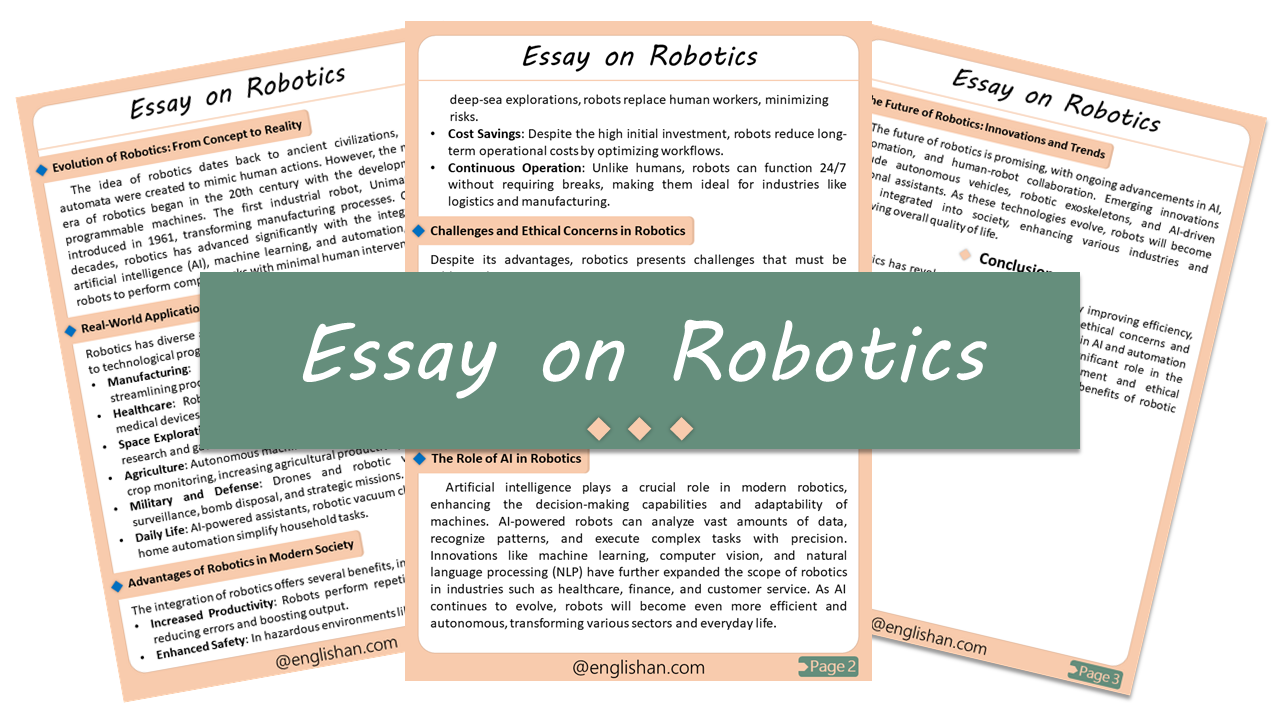
A robotics essay helps students understand machines and how they work in real life. This blog offers sample essays in 10-line, 250-word, and 500-word formats to support different grade levels. Each format is designed to build writing skills and explain robotics clearly. It saves time by giving structured models that fit school topics and classroom needs. These samples are useful for practicing how to write about technology in a way that’s simple and focused.
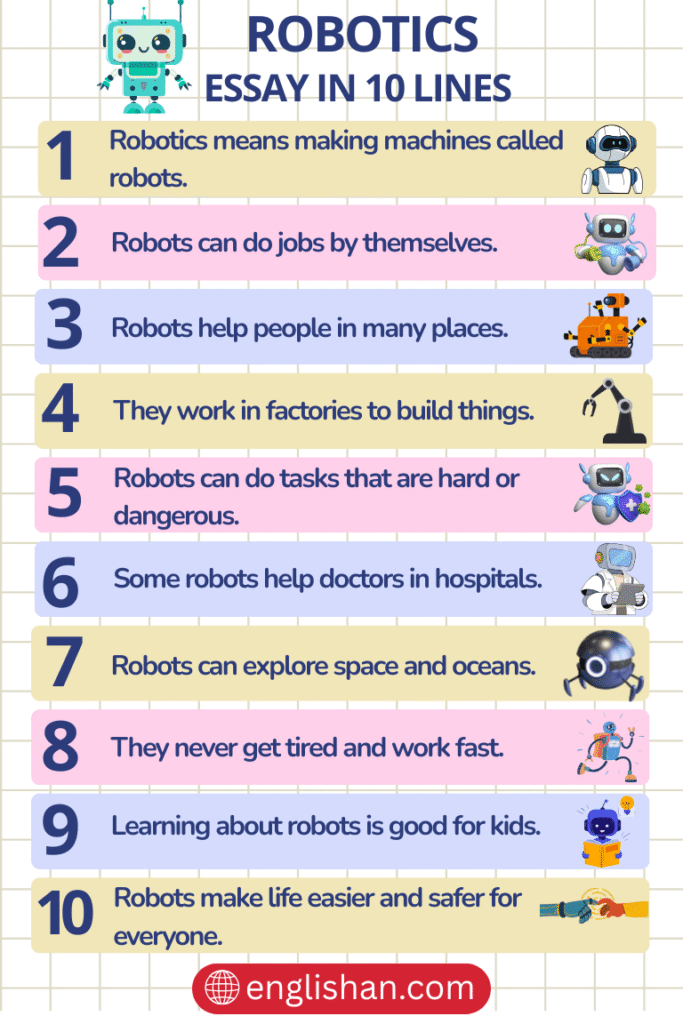
10 Lines Robotics Essay for Class 2 to Class 5
- Robotics means making machines called robots.
- Robots can do jobs by themselves.
- Robots help people in many places.
- They work in factories to build things.
- Robots can do tasks that are hard or dangerous.
- Some robots help doctors in hospitals.
- Robots can explore space and oceans.
- They never get tired and work fast.
- Learning about robots is good for kids.
- Robots make life easier and safer for everyone.
250 Words Essay on Robotics for Middle School
Robotics is the science and technology of designing, building, and using robots. Robots are machines that can perform tasks automatically. They help humans in many areas, such as factories, hospitals, and even space exploration. Robotics makes work easier and faster, especially in dangerous or difficult jobs.
First, robots can do repetitive tasks without getting tired. This saves time and improves quality. For example, robots in factories assemble cars quickly and with precision. Then, robots can work in places that are unsafe for humans, like deep underwater or in space. This helps scientists learn more about these areas without risking lives.
Also, robots are used in hospitals to assist doctors during surgery. They can perform delicate operations with high accuracy. This leads to better health outcomes for patients. Robots also help in education by teaching programming and problem-solving skills to students.
Because of robotics, many jobs have changed, and new ones have been created. People need to learn how to work with robots and understand their functions. That’s why students should learn about robotics early.
In the end, robotics is important because it improves safety, efficiency, and learning. It will continue to grow and play a big role in our future. Learning to write essays about robotics helps students understand these key ideas and prepares them for the technological world ahead.
500 Words Robotics Essay for Upper Primary and Lower Secondary
Evolution of Robotics: From Concept to Reality
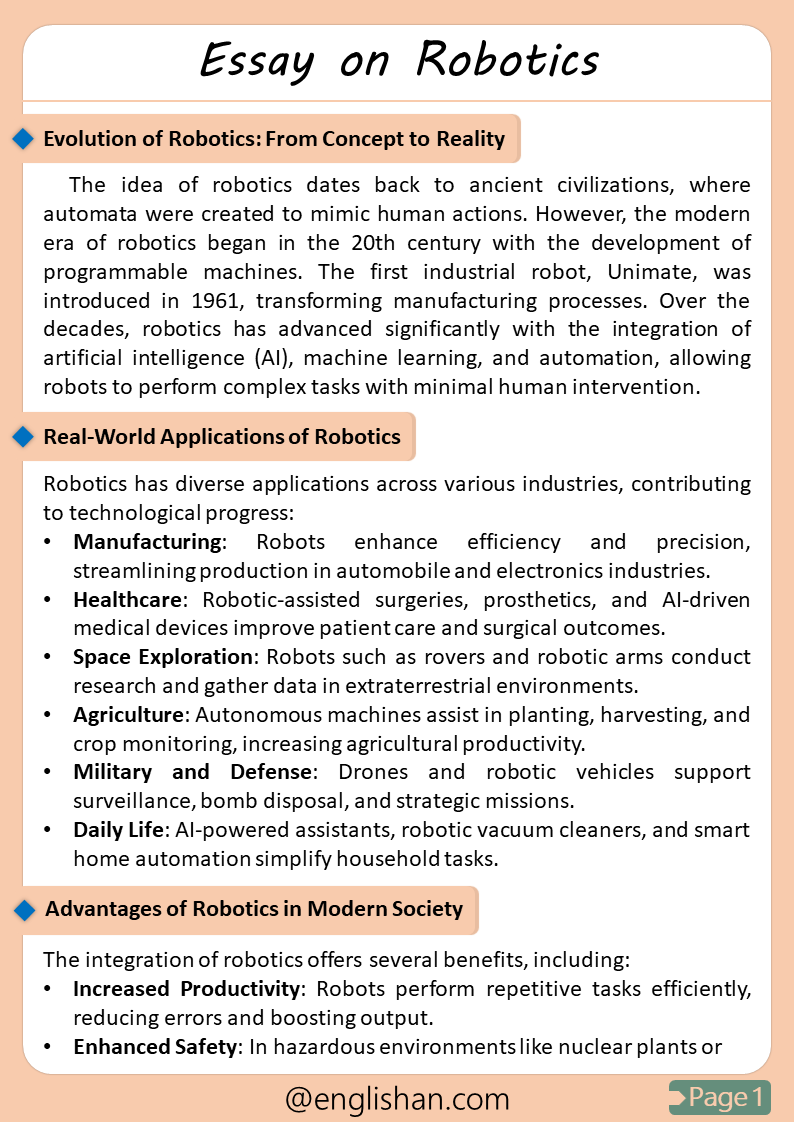
The idea of robotics dates back to ancient civilizations, where automata were created to mimic human actions. However, the modern era of robotics began in the 20th century with the development of programmable machines. The first industrial robot, Unimate, was introduced in 1961, transforming manufacturing processes. Over the decades, robotics has advanced significantly with the integration of artificial intelligence (AI), machine learning, and automation, allowing robots to perform complex tasks with minimal human intervention.
Real-World Applications of Robotics
Robotics has diverse applications across various industries, contributing to technological progress:
- Manufacturing: Robots enhance efficiency and precision, streamlining production in automobile and electronics industries.
- Healthcare: Robotic-assisted surgeries, prosthetics, and AI-driven medical devices improve patient care and surgical outcomes.
- Space Exploration: Robots such as rovers and robotic arms conduct research and gather data in extraterrestrial environments.
- Agriculture: Autonomous machines assist in planting, harvesting, and crop monitoring, increasing agricultural productivity.
- Military and Defense: Drones and robotic vehicles support surveillance, bomb disposal, and strategic missions.
- Daily Life: AI-powered assistants, robotic vacuum cleaners, and smart home automation simplify household tasks.
Advantages of Robotics in Modern Society
The integration of robotics offers several benefits, including:
- Increased Productivity: Robots perform repetitive tasks efficiently, reducing errors and boosting output.
- Enhanced Safety: In hazardous environments like nuclear plants or deep-sea explorations, robots replace human workers, minimizing risks.
- Cost Savings: Despite the high initial investment, robots reduce long-term operational costs by optimizing workflows.
- Continuous Operation: Unlike humans, robots can function 24/7 without requiring breaks, making them ideal for industries like logistics and manufacturing.
Challenges and Ethical Concerns in Robotics
Despite its advantages, robotics presents challenges that must be addressed:
- High Costs: The development, maintenance, and programming of robots are expensive, limiting their accessibility.
- Job Displacement: The automation of tasks raises concerns about employment opportunities for human workers.
- Technical Limitations: Robots lack emotional intelligence and human-like decision-making capabilities, restricting their adaptability.
- Cybersecurity Risks: The increasing use of robotics within the Internet of Things (IoT) makes them vulnerable to hacking and data breaches.
The Role of AI in Robotics
Artificial intelligence plays a crucial role in modern robotics, enhancing the decision-making capabilities and adaptability of machines. AI-powered robots can analyze vast amounts of data, recognize patterns, and execute complex tasks with precision. Innovations like machine learning, computer vision, and natural language processing (NLP) have further expanded the scope of robotics in industries such as healthcare, finance, and customer service. As AI continues to evolve, robots will become even more efficient and autonomous, transforming various sectors and everyday life.
The Future of Robotics: Innovations and Trends
The future of robotics is promising, with ongoing advancements in AI, automation, and human-robot collaboration. Emerging innovations include autonomous vehicles, robotic exoskeletons, and AI-driven personal assistants. As these technologies evolve, robots will become more integrated into society, enhancing various industries and improving overall quality of life.
Conclusion
Robotics has revolutionized multiple sectors by improving efficiency, precision, and safety. While challenges such as ethical concerns and cybersecurity risks exist, continuous advancements in AI and automation ensure that robotics will play an increasingly significant role in the future. As society adapts, responsible development and ethical considerations will be essential to maximizing the benefits of robotic technology.
Difficult Words Used in 500 Robotics Essay
| Word | Meaning |
|---|---|
| Automata | Mechanical devices designed to perform specific tasks. |
| Revolutionizing | Causing a dramatic change in a process or industry. |
| Prosthetics | Artificial devices used to replace missing body parts. |
| Celestial | Related to outer space or heavenly bodies. |
| Cybersecurity | The practice of protecting systems from digital attacks. |
| IoT (Internet of Things) | A network of interconnected devices communicating via the internet. |
| Exoskeletons | Wearable robotic structures that enhance physical capabilities. |
| Ethical | Relating to moral principles and responsible decision-making. |
| Natural Language Processing (NLP) | A branch of AI that enables machines to understand and process human language. |
Robotics Essay PDF
You May Also Like