When writing about World War 1, it’s important to understand how this major war started, who was involved, and its effects on the world. This essay on World War 1 explains the causes, key events, and outcomes of the war in simple words. It’s written in 500 words to help students with homework or exams. You can download this World War 1 essay as a free PDF or image to study or print.
10 Lines World War 1 Essay for Class 2 to Class 5
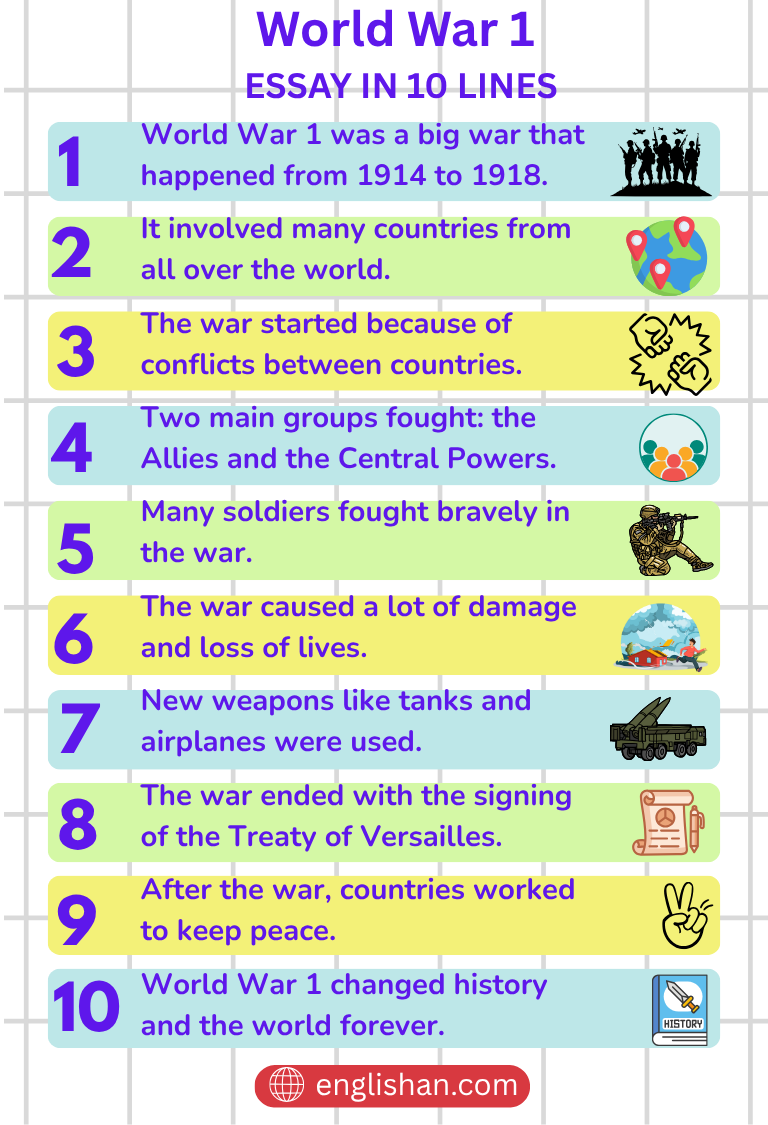
- World War 1 was a big war that happened from 1914 to 1918.
- It involved many countries from all over the world.
- The war started because of conflicts between countries.
- Two main groups fought: the Allies and the Central Powers.
- Many soldiers fought bravely in the war.
- The war caused a lot of damage and loss of lives.
- New weapons like tanks and airplanes were used.
- The war ended with the signing of the Treaty of Versailles.
- After the war, countries worked to keep peace.
- World War 1 changed history and the world forever.
250 Words Essay on World War 1 for Middle School
World War 1, also called the First World War or the Great War, was a major global conflict that lasted from 1914 to 1918. It involved many countries divided into two main groups: the Allies, including Britain, France, Russia, and later the United States, and the Central Powers, mainly Germany, Austria-Hungary, and the Ottoman Empire.
The war started because of tensions between countries, nationalism, and the assassination of Archduke Franz Ferdinand of Austria. This event triggered a chain reaction of alliances and fights. Millions of soldiers fought on battlefields across Europe and other parts of the world. New weapons like machine guns, tanks, and airplanes made the war more deadly.
World War 1 caused massive destruction and loss of life. It affected families, economies, and politics everywhere. The war ended with the signing of the Treaty of Versailles in 1919, which punished Germany and reshaped borders in Europe.
The war taught the world important lessons about peace and the dangers of conflicts. It also led to major political changes and set the stage for World War 2. Remembering World War 1 helps us understand the importance of working together to avoid war in the future.
500 Words World War 1 Essay for Upper Primary and Lower Secondary
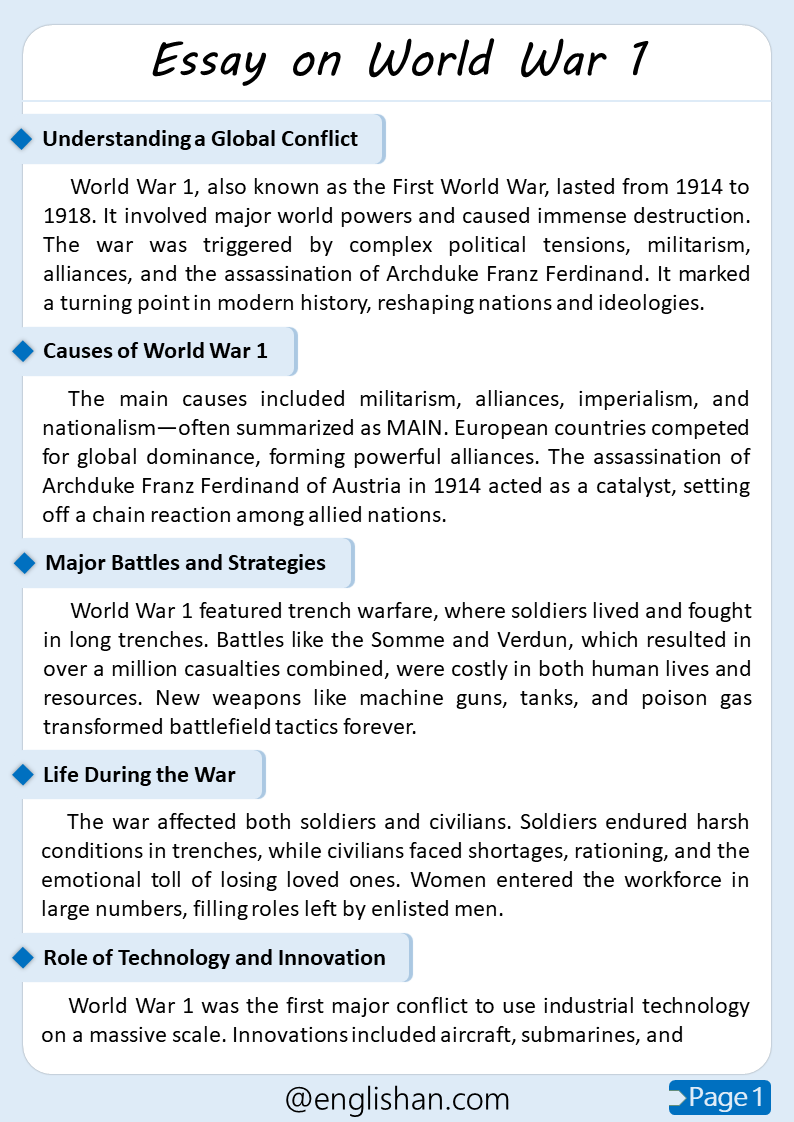
Understanding a Global Conflict
World War 1, also known as the First World War, lasted from 1914 to 1918. It involved major world powers and caused immense destruction. The war was triggered by complex political tensions, militarism, alliances, and the assassination of Archduke Franz Ferdinand. It marked a turning point in modern history, reshaping nations and ideologies.
Causes of World War 1
The main causes included militarism, alliances, imperialism, and nationalism—often summarized as MAIN. European countries competed for global dominance, forming powerful alliances. The assassination of Archduke Franz Ferdinand of Austria in 1914 acted as a catalyst, setting off a chain reaction among allied nations.
Major Battles and Strategies
World War 1 featured trench warfare, where soldiers lived and fought in long trenches. Battles like the Somme and Verdun, which resulted in over a million casualties combined, were costly in both human lives and resources. New weapons like machine guns, tanks, and poison gas transformed battlefield tactics forever.
Life During the War
The war affected both soldiers and civilians. Soldiers endured harsh conditions in trenches, while civilians faced shortages, rationing, and the emotional toll of losing loved ones. Women entered the workforce in large numbers, filling roles left by enlisted men.
Role of Technology and Innovation
World War 1 was the first major conflict to use industrial technology on a massive scale. Innovations included aircraft, submarines, and wireless communication. These advancements not only shaped the war’s outcomes but also set the stage for future conflicts and peacetime technologies.
End of the War and Treaty of Versailles
The war ended in 1918 with the signing of the Armistice on November 11. The Treaty of Versailles in 1919 imposed heavy penalties on Germany, including territorial losses and reparations. These conditions planted the seeds for future unrest and World War 2.
Political and Social Changes Post-War
After the war, empires collapsed, including the Ottoman, Austro-Hungarian, and Russian empires. The League of Nations was formed to promote peace, although it struggled to prevent future conflicts. Socially, there were movements for greater democracy, labor rights, and women’s suffrage.
Impact on Literature and Culture
Writers and artists captured the trauma of war in their works. War poets like Wilfred Owen and Siegfried Sassoon described the horrors of trench warfare. The disillusionment of the post-war generation influenced literature, art, and philosophy.
Long-Term Consequences
World War 1 changed the world’s political and economic order. It led to the decline of monarchies, the rise of totalitarian ideologies, and global movements for independence. The unresolved tensions from the war contributed directly to World War 2.
Involvement of Colonies in the War
Many colonies of European powers played active roles in the war. Troops from British India, French West Africa, and other territories were deployed in key battles. Their contributions, often overlooked, significantly impacted the outcome and led to rising calls for independence.
Economic Impact of the War
World War 1 devastated national economies. The cost of maintaining armies and war production led to massive debts, inflation, and resource shortages. Post-war recovery required years, and the financial strain contributed to political instability in many countries.
Reactions in Asia and Africa
The war had ripple effects in Asia and Africa. Many colonial soldiers returned home with a stronger desire for independence after fighting for European powers. Nationalist movements in India, Egypt, and other regions gained momentum following the war.
Shifts in International Relations
World War 1 reshaped global diplomacy. Former allies drifted apart, while defeated powers sought revision. The United States emerged as a major global force, shifting power dynamics and influencing post-war treaties and organizations.
Conclusion
World War 1 was not just a military conflict but a profound turning point in modern history. It exposed the dangers of unchecked nationalism, rigid alliances, and industrialized warfare. Despite its devastating consequences, it also led to social shifts, such as expanded roles for women and demands for democratic reform. Understanding World War 1 is essential not only for learning history but also for recognizing the importance of diplomacy, cooperation, and peace in an interconnected world.
Difficult Words Used in 500 World War 1 Essay
| Word | Meaning |
|---|---|
| Assassination | The deliberate and planned killing of a prominent figure, usually political. |
| Militarism | A policy of glorifying military power and maintaining a strong armed force. |
| Stagnant | Inactive or not progressing; lacking movement or development. |
| Punitive | Intended to impose punishment, often in a harsh or excessive manner. |
| Disillusionment | A feeling of disappointment resulting from the discovery that something is not as good as believed. |
| Trench | A long, deep ditch used by soldiers as shelter in warfare. |
| Conscription | The compulsory enlistment of individuals into military service. |
| Reassigned | Moved to a different task, post, or position. |
| Suffrage | The legal right to vote in public elections |
World War 1 Essay PDF
You May Also Like