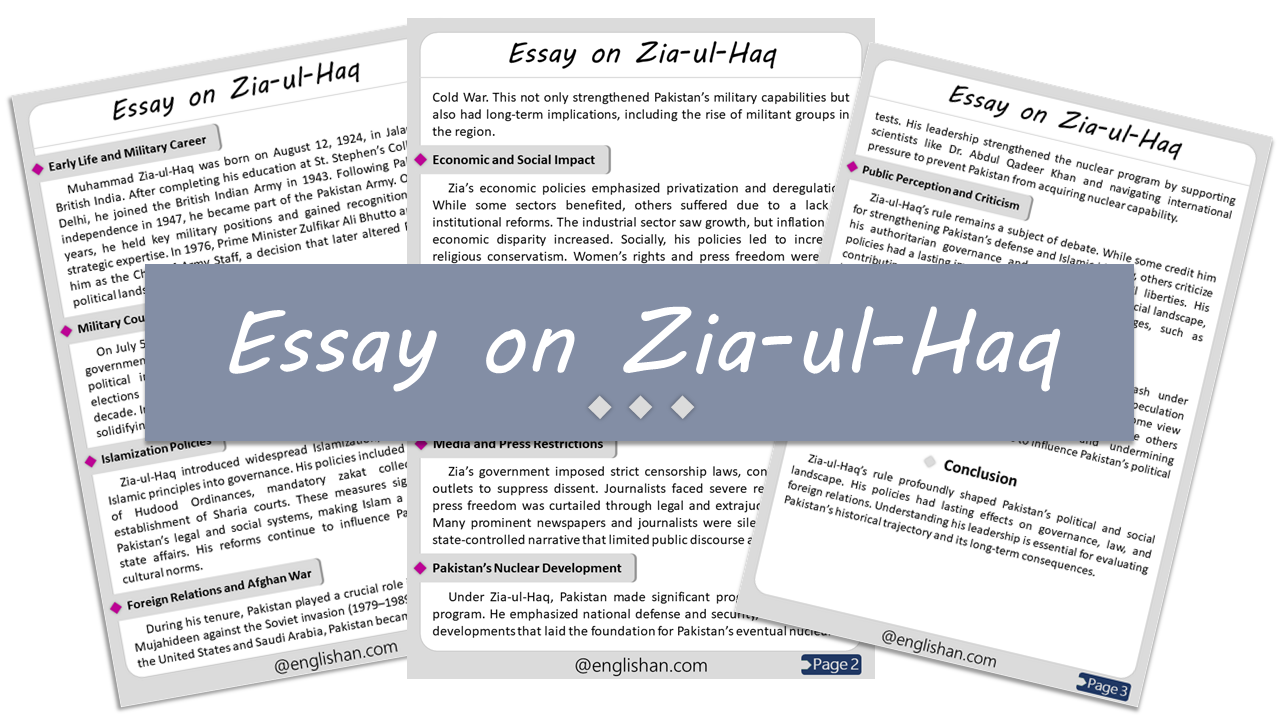
When writing about Zia-ul-Haq, it’s important to understand his role as a leader and how his decisions impacted Pakistan’s history. This essay on Zia-ul-Haq explains his background, rule, key policies, and legacy. It’s written in 250 words to help students with homework or exams. You can download this Zia-ul-Haq essay as a free PDF or image to study or print.
10 Lines Zia-ul-Haq Essay for Class 2 to Class 5
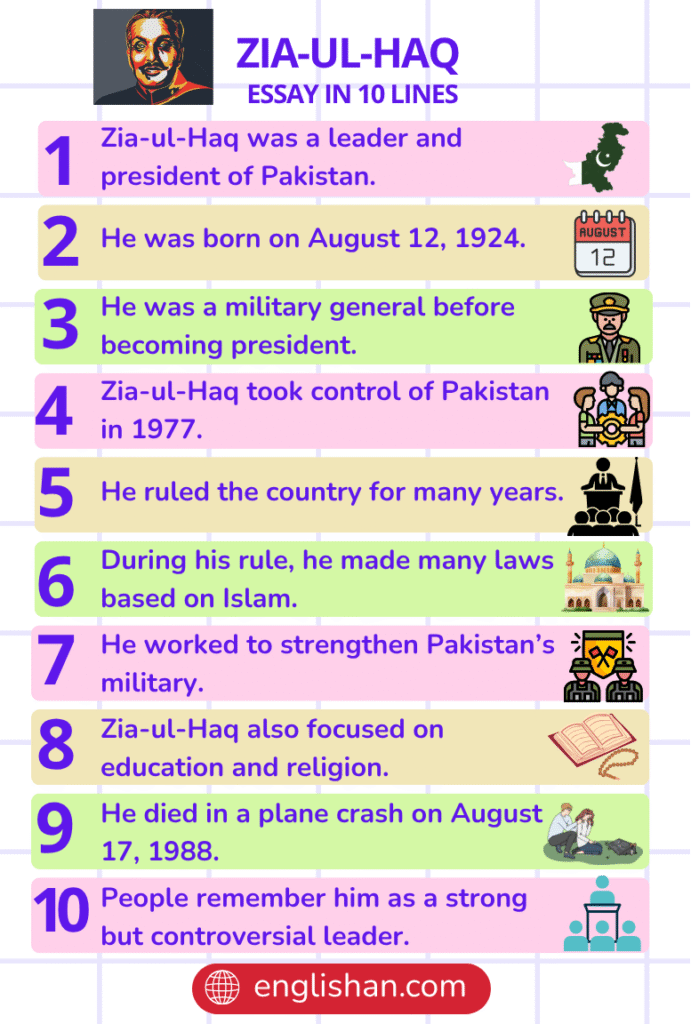
- Zia-ul-Haq was a leader and president of Pakistan.
- He was born on August 12, 1924.
- He was a military general before becoming president.
- Zia-ul-Haq took control of Pakistan in 1977.
- He ruled the country for many years.
- During his rule, he made many laws based on Islam.
- He worked to strengthen Pakistan’s military.
- Zia-ul-Haq also focused on education and religion.
- He died in a plane crash on August 17, 1988.
- People remember him as a strong but controversial leader.
250 Words Essay on Zia-ul-Haq for Middle School
General Muhammad Zia-ul-Haq was a prominent military leader and the sixth President of Pakistan. He was born on August 12, 1924, in Jalandhar, India, before the independence of Pakistan. Zia-ul-Haq joined the Pakistan Army and rose through the ranks due to his dedication and leadership skills.
In 1977, Zia-ul-Haq became the Chief Martial Law Administrator after overthrowing the government of Prime Minister Zulfikar Ali Bhutto in a military coup. Later, he assumed the presidency of Pakistan. During his time in power, Zia introduced many policies based on Islamic laws, which he called Islamization. These laws affected the legal and social systems in Pakistan.
Zia-ul-Haq also focused on strengthening Pakistan’s military, especially during the Soviet invasion of Afghanistan. His government supported the Afghan Mujahideen fighters during this period. Besides military matters, Zia paid attention to education and religious affairs, aiming to promote Islamic values in the country.
His rule lasted for over 11 years until his sudden death in a mysterious plane crash on August 17, 1988. His death shocked the nation and raised many questions. Zia-ul-Haq’s leadership is remembered as strong and influential but also controversial due to his strict policies and use of military power.
Even today, Zia-ul-Haq’s impact on Pakistan’s politics, religion, and society is discussed and debated by scholars and citizens alike.
500 Words Zia-ul-Haq Essay for Upper Primary and Lower Secondary
Early Life and Military Career
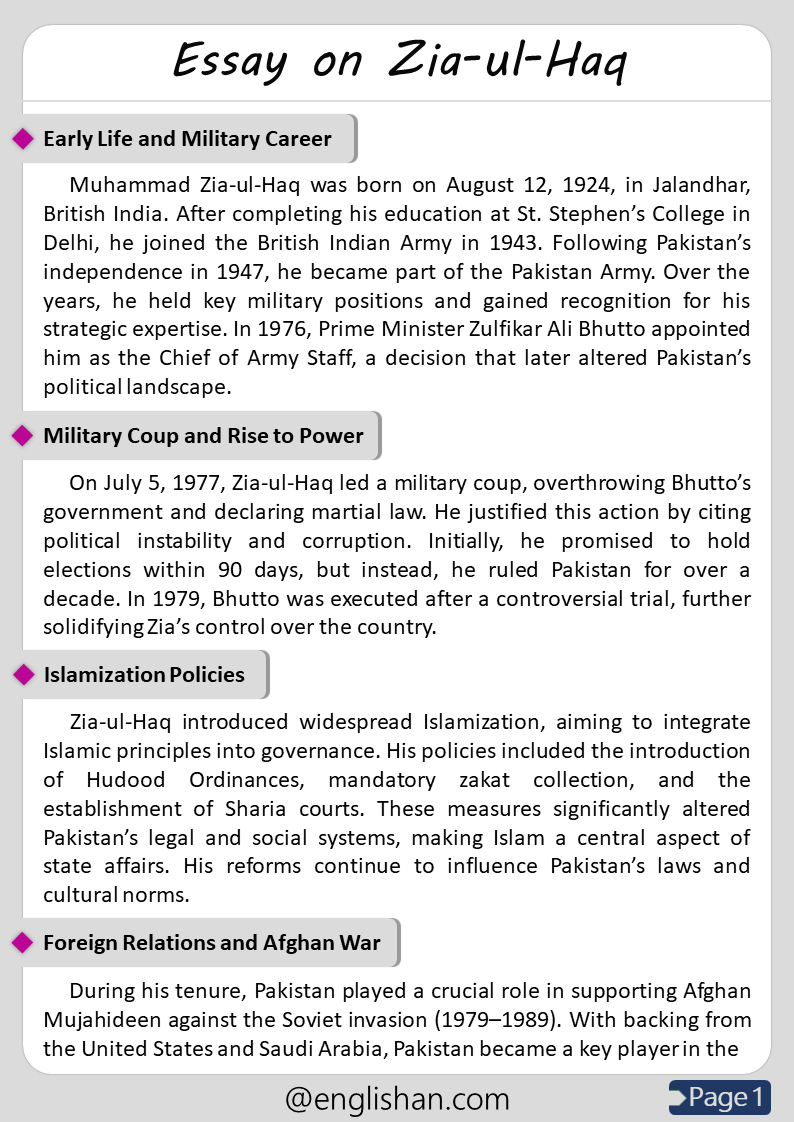
Muhammad Zia-ul-Haq was born on August 12, 1924, in Jalandhar, British India. After completing his education at St. Stephen’s College in Delhi, he joined the British Indian Army in 1943. Following Pakistan’s independence in 1947, he became part of the Pakistan Army. Over the years, he held key military positions and gained recognition for his strategic expertise. In 1976, Prime Minister Zulfikar Ali Bhutto appointed him as the Chief of Army Staff, a decision that later altered Pakistan’s political landscape.
Military Coup and Rise to Power
On July 5, 1977, Zia-ul-Haq led a military coup, overthrowing Bhutto’s government and declaring martial law. He justified this action by citing political instability and corruption. Initially, he promised to hold elections within 90 days, but instead, he ruled Pakistan for over a decade. In 1979, Bhutto was executed after a controversial trial, further solidifying Zia’s control over the country.
Islamization Policies
Zia-ul-Haq introduced widespread Islamization, aiming to integrate Islamic principles into governance. His policies included the introduction of Hudood Ordinances, mandatory zakat collection, and the establishment of Sharia courts. These measures significantly altered Pakistan’s legal and social systems, making Islam a central aspect of state affairs. His reforms continue to influence Pakistan’s laws and cultural norms.
Foreign Relations and Afghan War
During his tenure, Pakistan played a crucial role in supporting Afghan Mujahideen against the Soviet invasion (1979–1989). With backing from the United States and Saudi Arabia, Pakistan became a key player in the Cold War. This not only strengthened Pakistan’s military capabilities but also had long-term implications, including the rise of militant groups in the region.
Economic and Social Impact
Zia’s economic policies emphasized privatization and deregulation. While some sectors benefited, others suffered due to a lack of institutional reforms. The industrial sector saw growth, but inflation and economic disparity increased. Socially, his policies led to increased religious conservatism. Women’s rights and press freedom were also significantly restricted during his rule.
Political Reforms and Governance
Zia-ul-Haq introduced several constitutional amendments to strengthen his rule. He implemented policies that centralized power, limited political opposition, and altered the judicial system to align with his governance approach. His tenure saw increased restrictions on political parties and limited democratic participation, leading to political instability in later years.
Media and Press Restrictions
Zia’s government imposed strict censorship laws, controlling media outlets to suppress dissent. Journalists faced severe restrictions, and press freedom was curtailed through legal and extrajudicial measures. Many prominent newspapers and journalists were silenced, shaping a state-controlled narrative that limited public discourse and criticism.
Pakistan’s Nuclear Development
Under Zia-ul-Haq, Pakistan made significant progress in its nuclear program. He emphasized national defense and security, overseeing key developments that laid the foundation for Pakistan’s eventual nuclear tests. His leadership strengthened the nuclear program by supporting scientists like Dr. Abdul Qadeer Khan and navigating international pressure to prevent Pakistan from acquiring nuclear capability.
Public Perception and Criticism
Zia-ul-Haq’s rule remains a subject of debate. While some credit him for strengthening Pakistan’s defense and Islamic identity, others criticize his authoritarian governance and suppression of civil liberties. His policies had a lasting impact on Pakistan’s political and social landscape, contributing to both stability and long-term challenges, such as increased extremism and restricted democratic freedoms.
Death and Legacy
On August 17, 1988, Zia-ul-Haq died in a plane crash under mysterious circumstances. Sudden death led to widespread speculation about possible sabotage. His legacy remains controversial; some view him as a leader who strengthened Pakistan’s defense, while others criticize his policies for fostering extremism and undermining democratic institutions. His era continues to influence Pakistan’s political trajectory.
Conclusion
Zia-ul-Haq’s rule profoundly shaped Pakistan’s political and social landscape. His policies had lasting effects on governance, law, and foreign relations. Understanding his leadership is essential for evaluating Pakistan’s historical trajectory and its long-term consequences.
Difficult Words Used in 500 Zia-ul-Haq Essay
| Word | Meaning |
|---|---|
| Ordinances | Official rules or laws |
| Strategic | Related to planning for long-term goals |
| Martial Law | Military control over normal governance |
| Hudood | Islamic legal punishments |
| Deregulation | Reduction of government control in industries |
| Conservatism | Preference for traditional values and policies |
Zia-ul-Haq Essay PDF
You May Also Like