Many people confuse foreword and forward because the words sound the same but have very different meanings. Foreword is a noun that refers to a short introductory section at the beginning of a book. Forward usually relates to movement, progress, or sending something onward.
Confusion happens easily because the words are pronounced the same even though their meanings and uses differ. Knowing which one fits the situation prevents mistakes in writing and communication.
In this article, you will learn the difference between foreword and forward, what each word means, and how to remember the correct spelling.
Foreword vs Forward: Quick Answer
Here is the quickest way to tell them apart:
| Word | Main Meaning | Part of Speech | Common Context | Example |
|---|---|---|---|---|
| Foreword | introductory section in a book | noun | books, publishing, editions | She wrote the foreword to the memoir. |
| Forward | ahead, onward, future progress, or send on | adverb, adjective, verb | movement, planning, email, behavior | Please forward the message. |
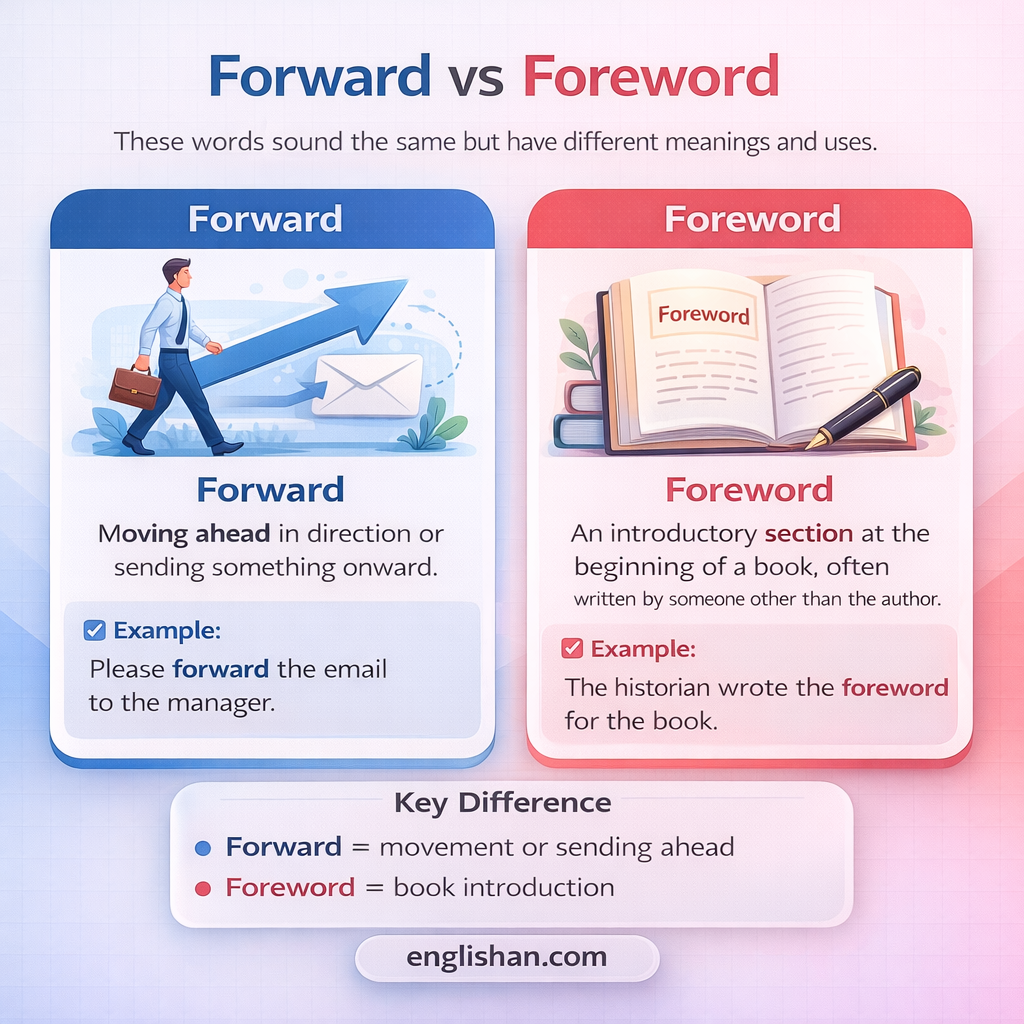
If the word is about a book introduction, use foreword.
If it is about movement, progress, or sending something, use forward.
What Does Foreword Mean?
Foreword is a noun. It means a short introductory piece placed near the beginning of a book. A foreword often gives background, context, praise, or a reason the book matters. In many cases, it is written by someone other than the main author, such as a teacher, editor, expert, or another writer.
A foreword belongs to book and publishing context. It is not normally used as a verb or adjective.
Examples of Foreword
- The historian wrote the foreword to the new biography.
- I read the foreword before starting chapter one.
- Her foreword explained why the book still matters today.
- The editor invited a former student to write the foreword.
A foreword is not the same as a preface or an introduction, but all three can appear near the beginning of a book.
What Does Forward Mean?
Forward has several uses in English. It can function as an adverb, adjective, or verb, depending on the sentence.
It can refer to:
- movement ahead
- progress or future direction
- bold or overly familiar behavior
- sending something on to another person
Examples of Forward
- The discussion moved forward after both sides agreed on the budget.
- We are looking forward to the school event.
- Her forward question caught the guest off guard.
- Please forward the revised schedule to the whole team.
- She forwarded the document to the manager.
This verb is common in emails, workplace messages, files, and shared documents.
Foreword vs Forward: Key Differences
The main difference is the role each word plays.
Foreword belongs to books and publishing. It names a written section that appears near the front of a book.
Forward belongs to movement, progress, direction, behavior, and sending. It is used in many everyday situations, from planning and conversation to email and work.
Another important difference is grammar. Foreword is a noun, while forward can work as an adverb, adjective, or verb.
Why People Confuse Foreword and Forward
These words are easy to confuse because they are homophones in many accents, so they often sound the same in speech. They also look very similar, and the spelling difference is small.
Another reason is that both are valid English words. Because of that, spellcheck may not catch the mistake. The best way to choose the right word is to focus on context, not sound.
If the sentence is about a book’s opening section, the correct word is foreword. If it is about movement, progress, or sending something on, the correct word is forward.
How to Remember Foreword vs Forward
A quick memory tip can help:
- Foreword has word, so think of words at the front of a book
- Forward has ward, which appears in direction-related words such as toward and backward
If it is about a written section in a book, choose foreword. If it is about movement, progress, or sending something, choose forward.
Foreword vs Forward in Sentences
Sentences With Foreword
- The professor wrote the foreword to the revised edition.
- I enjoyed the foreword almost as much as the first chapter.
- The foreword gave useful background on the author’s work.
Sentences With Forward
- The company is moving forward with the new policy.
- Please forward the attachment when you have time.
- Her forward manner surprised the interviewer.
- We look forward to hearing from you soon.
Common Mistakes When Using Foreword and Forward
Using Forward for a Book Introduction
Incorrect:
She wrote the forward to the novel.
Better:
She wrote the foreword to the novel.
Using Foreword for Email or Movement
Incorrect:
Please foreword this message to the office.
Better:
Please forward this message to the office.
Forgetting to Check the Context
To choose the right spelling, ask:
- Is this about a book opening section? Use foreword.
- Is this about movement, progress, or sending something? Use forward.
Summary
Foreword and forward sound alike, but they belong to different contexts in English. Foreword is a noun used for an introductory section at the beginning of a book. Forward usually relates to direction, progress, future action, or sending something on, and it can work as an adverb, adjective, or verb. If you connect foreword with word and forward with movement or sending, the difference becomes much easier to remember.
FAQs
Foreword is a short introductory section at the beginning of a book, often written by someone other than the author. Forward usually means ahead, onward, toward the future, or the act of sending something along.
Yes. Foreword is mainly used for the opening section of a book. It usually appears before the main text and introduces the work or the author.
Yes. Forward can be a verb that means to send something on to another person. People often say they will forward an email, message, file, or document.
The author invited her mentor to write the foreword for the new novel.
Please forward the email to the rest of the team before noon.
You May Also Like