
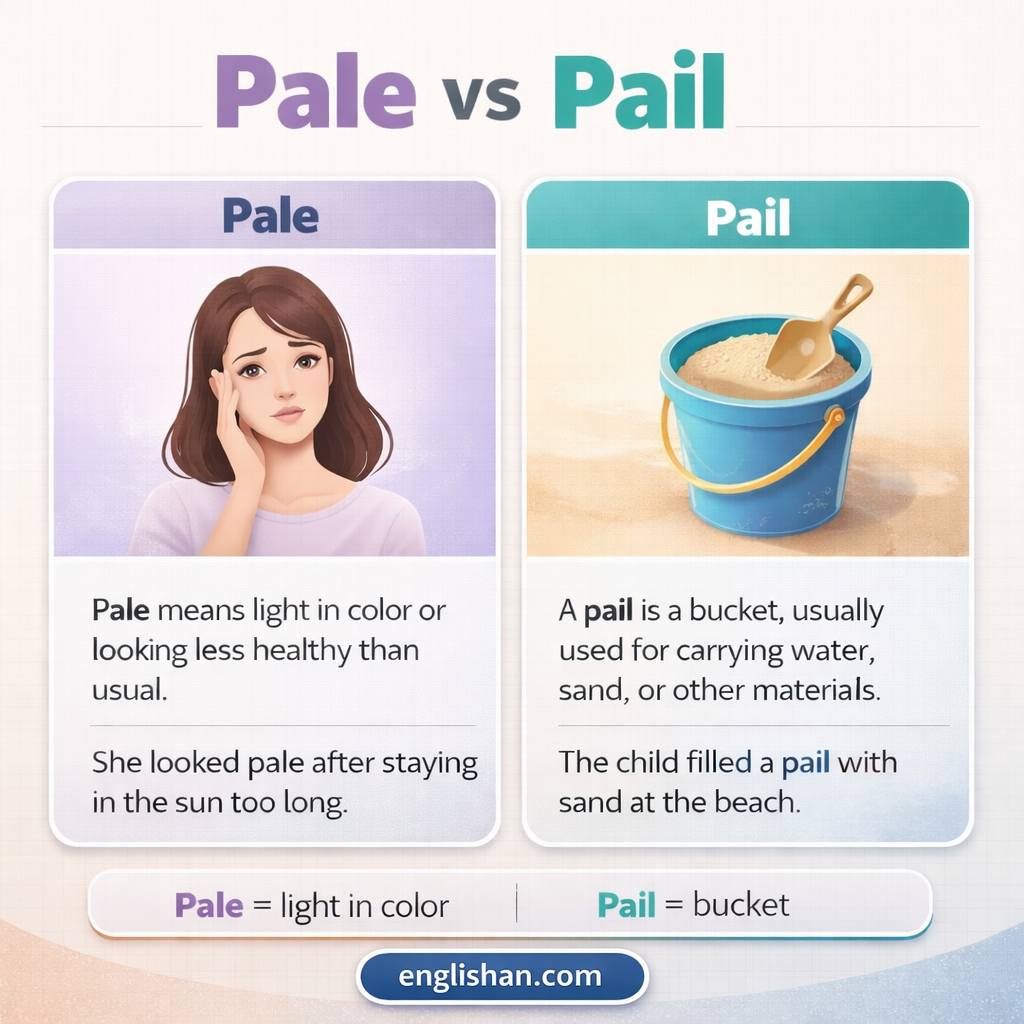
Pail and pale sound the same, but they mean very different things. A pail is a bucket-like container with a handle, while pale describes something light in color, lacking color, or faint.
People often confuse them in writing because pronunciation does not separate them. This article explains what each word means, how each one is used, and how to remember the correct spelling.
Pail vs Pale: Quick Answer
Here is the quickest way to tell them apart:
| Word | Main Meaning | Part of Speech | Example |
|---|---|---|---|
| pail | a bucket or container | noun | a pail of water |
| pale | light in color, lacking color, or fading | adjective, verb | pale skin; the stars paled |
If the word is about holding or carrying something, use pail.
If it is about color, complexion, brightness, or fading, use pale.
What Does Pail Mean?
Pail is a noun that refers to a bucket-like container, often with an open top and a handle. People use pails to carry water, paint, sand, soil, and many other materials.
In many situations, pail and bucket are very close in meaning. Even so, pail can sound slightly more specific or a little more traditional depending on the setting.
You will often see pail in phrases like:
- a pail of water
- a pail of paint
- a metal pail
- a plastic pail
- a sand pail
Examples of Pail
- She carried a pail of water from the well to the garden.
- The child filled a pail with wet sand at the beach.
- A pail of paint stood beside the ladder during the repair.
What Does Pale Mean?
Pale can work as both an adjective and a verb.
As an adjective, it usually means light in color, faint, or lacking strong color. It can also describe a person’s face or skin when they look tired, frightened, shocked, or unwell.
As a verb, pale means to become less bright, less strong, or less important by comparison.
Pale for Color
When pale describes color, it often refers to soft or light shades, such as:
- pale blue
- pale yellow
- pale green
- pale gray
Examples:
- She wore a pale pink dress to the party.
- A pale gray sky hung over the hills.
- Pale sunlight came through the window.
Pale for Skin or Complexion
Pale often describes a person who has little color in the face.
Examples:
- She looked pale after the long trip.
- His face turned pale when he heard the news.
- He seemed pale and tired after the race.
Pale as a Verb
As a verb, pale means to fade or seem weaker by comparison.
Examples:
- The stars paled as the sun began to rise.
- Her earlier worries paled beside the new problem.
- Their complaints paled in comparison to the real damage.
Pale has a wider range of uses than many learners first expect, which is why it is often the trickier word in this pair.
Pail vs Pale: Key Difference
The difference is simple:
- pail is a thing
- pale usually describes color, complexion, or fading
One names a physical container. The other usually describes appearance or change.
Because the two words sound the same, the best way to choose the right spelling is to ask what the sentence is about. If it involves carrying or holding something, the word is pail. If it involves light color, loss of color, or fading, the word is pale.
Why People Confuse Pail and Pale
These words are easy to confuse because they are homophones in standard English. They sound the same even though they have different meanings and spellings.
Because both words are common, they are easy to mistype in everyday writing. That is why the safest way to choose the correct spelling is to focus on context, not sound.
How to Remember Pail vs Pale
A quick memory trick can help:
- pail = something you can fill
- pale = color or fading
Another easy reminder is this:
- You carry water in a pail
- A face can turn pale
If the word is about a container, choose pail. If it is about light color or losing color, choose pale.
Pail and Pale in Sentences
Here are more examples that make the contrast clear.
Sentences With Pail
- He brought a pail of water for the animals.
- The cleaner set a metal pail near the door.
- We found an old pail in the shed behind the house.
Sentences With Pale
- The room was lit by a pale morning light.
- She looked pale after standing in the heat too long.
- The stars began to pale as sunrise approached.
- His small success paled in comparison to hers.
Common Mistakes With Pail and Pale
Using Pale for a Container
Incorrect:
She filled the pale with water.
Better:
She filled the pail with water.
Using Pail for Color
Incorrect:
The walls were painted a soft pail blue.
Better:
The walls were painted a soft pale blue.
Forgetting That Pale Can Be a Verb
Some learners know pale only as a color word, but it can also mean to fade or seem less important.
Correct:
The moonlight paled as the sun rose.
Summary
Pail and pale sound the same, but they mean very different things. Pail is a noun that means a bucket or container. Pale is usually an adjective that describes something light in color or lacking color, and it can also be a verb meaning to fade or become less noticeable. Once you connect pail with carrying and pale with color or fading, the difference becomes much easier to remember.
FAQs
Pail means a bucket or container, often used for carrying water, sand, or other materials. Pale usually means light in color, lacking color, or becoming less bright or less noticeable.
Often, yes. Pail and bucket are very close in meaning, and many people use them the same way. Pail can sometimes sound a little more old-fashioned or specific, especially for a handled container.
You May Also Like