EnglishanEnglishan
  • Home
  • Grammar
    • Parts of speech
    • Tenses
    • Example Sentences
    • Other Ways to Say
  • Vocabulary
    • Picture Vocabulary
      • Parts of Things
      • Animals
      • Insects
      • Foods
      • Fruits
      • Things
    • Vocabulary for Kids
    • Descriptive Words
    • Synonyms
    • Antonyms
    • Confused Words
    • One Word Substitution
    • Phrasal Verbs
    • Positive Words
    • Verbs List
    • Adjectives List
      • Positive Adjectives
  • Words Lists
    • 5 Letter Words
    • Words Start With
    • Long Words
  • Worksheets
    • Kindergarten Worksheets
  • English Composition
    • Applications
    • Essay Writing
    • Letters
    • Comprehension
  • Wishes and Quotes
  • Contact
Reading: Parts of a Cactus: Complete List with Labeled Diagram
Share
Font ResizerAa
EnglishanEnglishan
Font ResizerAa
Search
  • Home
  • Vocabulary
    • Vocabulary for Kids
    • Internet Slangs
    • Synonyms
    • Antonyms
    • Confused Words
    • Descriptive Words
    • Phrasal Verbs
    • One Word Substitution
    • Adjectives List
    • Positive Adjectives
    • Verbs List
    • Positive Words
  • Picture Vocabulary
    • Parts of Things
    • Animals
    • Foods
    • Fruits
    • Insects
    • Things
  • Words List
    • 5 Letter Words
    • Long Words
    • Words Start With
  • Grammar
    • Parts of speech
    • Tenses
    • Example Sentences
    • Other Ways to Say
  • Worksheets
  • Wishes and Quotes
  • Positive Adjectives
Follow US
  • About
  • Contact
  • Privacy Policy
  • Terms of Service
Copyright © 2026 englishan.com All Rights Reserved.
Home > Vocabulary > Picture Vocabulary > Parts of Things > Parts of a Cactus: Complete List with Labeled Diagram
Parts of Things

Parts of a Cactus: Complete List with Labeled Diagram

Amelia Wright
By
Amelia Wright
Last updated: March 26, 2026
5 Min Read
SHARE

Cacti are fascinating plants that can survive in some of the harshest environments on Earth. But have you ever wondered what makes them so unique? In this article, we’ll take a closer look at the different parts of a cactus, from its spines and stems to roots and flowers. With a labeled diagram and simple explanations, you’ll easily understand how each part helps the cactus grow, protect itself, and thrive in the desert.

In This Page
  • List of Cactus Parts With Names
  • Parts of a Cactus Diagram With Names
  • Reproductive Parts
    • Flower
    • Fruits
  • Protective Parts
    • Spines
    • Areoles
  • Structural Parts
    • Stem
    • Arms
    • Pleats
  • Supportive Parts
    • Roots
  • Key Takeaway

List of Cactus Parts With Names

  • Flower
  • Pleats
  • Fruits
  • Spines
  • Stem
  • Roots
  • Areoles
  • Arms

Parts of a Cactus Diagram With Names

Cacti are desert plants designed to survive harsh conditions. The stem stores water and performs photosynthesis, while pleats allow it to expand and contract. Spines protect the cactus, growing from specialized areoles that also produce flowers and arms. Flowers attract pollinators, and fruits carry seeds for reproduction. Arms increase surface area for growth, and roots anchor the cactus while absorbing water and nutrients. Each part works together to help the cactus thrive and reproduce efficiently.
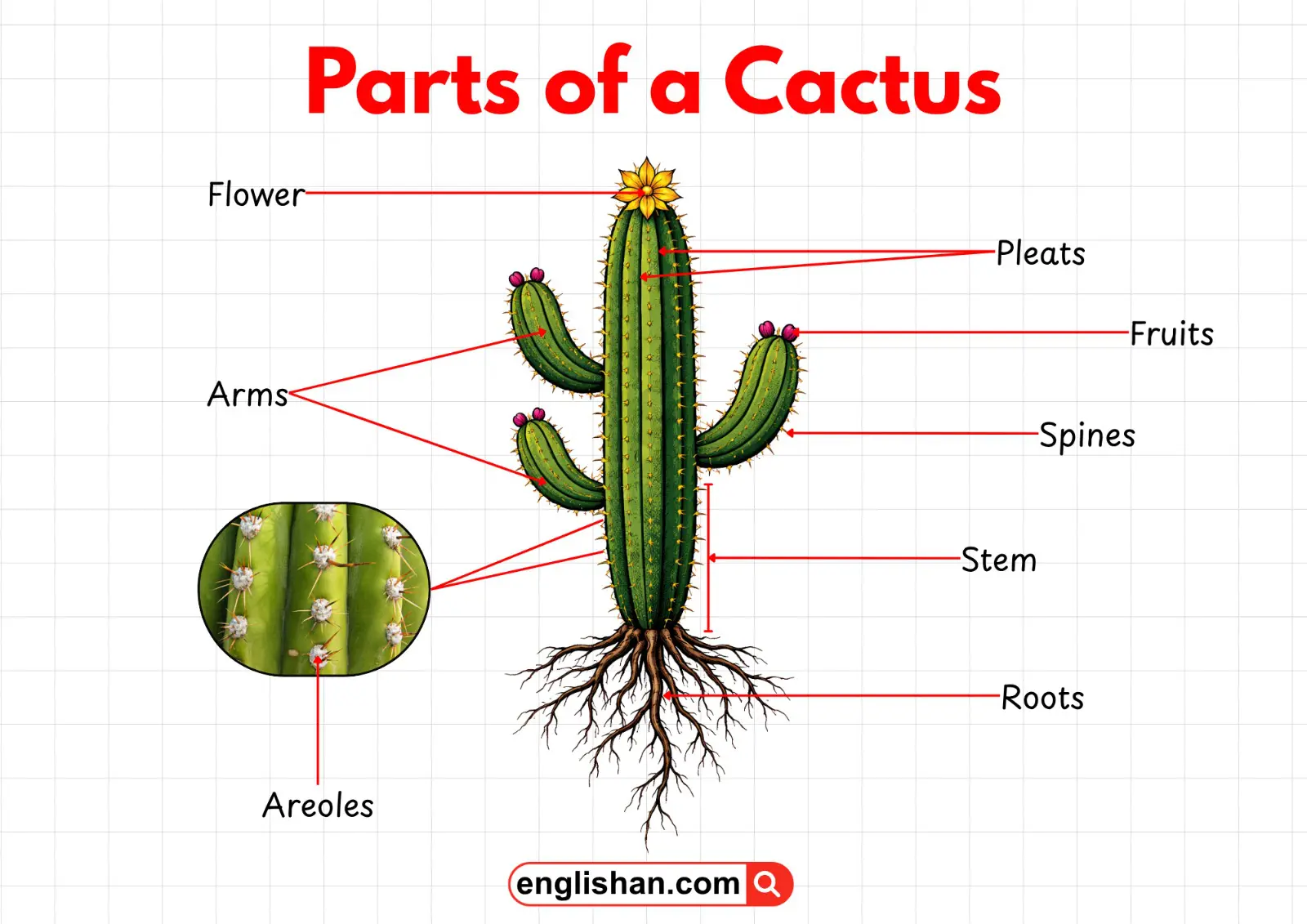
Labeled cactus diagram showing stem, spines, flowers, fruits, roots, pleats, arms, and areoles.
Explore the main parts of a cactus and their functions.
Advertisement

Reproductive Parts

Cacti have special parts that help them reproduce and ensure the survival of their species. These parts attract pollinators, produce seeds, and allow the cactus to grow new plants.

Flower

The flower is the most eye-catching part. It blooms in bright colors like yellow, pink, or red and attracts insects, birds, and other pollinators. Flowers are usually seasonal and short-lived, but they play a crucial role in reproduction by producing pollen.

Fruits

After the flower is pollinated, it develops into a fruit. Cactus fruits contain seeds that can grow into new plants. Some fruits are edible and store water, while others help the seeds disperse by attracting animals that carry them away.

Protective Parts

They live in harsh, dry environments, so they have evolved protective features to survive predators and extreme weather.

Spines

Spines are sharp, needle-like structures that grow from the cactus’s areoles. They protect it from animals that might try to eat it and also help reduce water loss by shading the stem. Spines can vary in size, shape, and density depending on the species.

Areoles

Areoles are small, cushion-like bumps on the stem. They are unique to cacti and act as the growth points for spines, flowers, and even new branches. Think of them as tiny “growth centers” that make it adaptable and resilient.

Structural Parts

These parts give the cactus its shape, store water, and carry out essential life functions like photosynthesis.

Stem

The stem is the main body of it. Unlike most plants, cacti store water in their stems and perform photosynthesis, as they have very few leaves. It can be thick, fleshy, and sometimes ribbed, expanding and contracting depending on water availability.

Arms

Some have arms, which are branched extensions of the main stem. Arms increase the surface area for photosynthesis and help produce more flowers and fruits. They are especially common in iconic cacti like the Saguaro.

Pleats

Pleats are the ridges or folds on the cactus stem. They allow the stem to expand when it absorbs water and contract during droughts. Pleats are like the cactus’s natural water storage system, helping it survive long dry periods.

Supportive Parts

These parts help the cactus stay anchored and absorb vital nutrients.

Roots

Roots anchor the cactus in the soil and absorb water and nutrients. Some have shallow, widespread roots to quickly collect rainfall, while others develop deeper roots to access underground water. Roots are essential for survival, especially in desert conditions.

Key Takeaway

As we learned, each part of a cactus has a special role. Flowers and fruits help the cactus reproduce, spines and areoles protect it, stems, arms, and pleats support growth and water storage, and roots keep it anchored and nourished. Together, these parts allow cacti to thrive in even the toughest environments.

You May Also Like

  • Parts of a Flashlight
  • Parts of a Spider
  • Parts of a Gate

Advertisement
Share This Article
Facebook Pinterest Whatsapp Whatsapp LinkedIn Reddit Copy Link
Amelia Wright
ByAmelia Wright
Follow:
Amelia Wright writes the daily word game challenges at Englishan.com, but she plays far beyond one grid. Most mornings move through a Spelling Bee style word hunt, a quick crossword, a few anagram rounds, and a Scrabble like rack in her head, words turning over while the coffee is still hot. And then there is Wordle, her favorite, the small five square heartbeat that sets the tone for the day. She notices what people can recall on the clock, where near spellings and double letters trigger doubt, and which everyday words still feel fair. Readers come for wins that feel earned: familiar vocabulary, steady difficulty, and none of the gotcha tricks that make a puzzle feel smug.
270KLike
82KPin
- Advertisement -

You Might Also Like

Parts of a Motherboard: Complete Guide with Diagram

9 Min Read

Parts of the Heart: Anatomy, Functions, and Diagram Explained

10 Min Read
Parts of Watch with their Types
Parts of Things

Parts of Watch with their Types

14 Min Read
Parts of Tooth With their Functions
Parts of Things

Parts of Tooth With their Functions

17 Min Read
Englishan-Logo-resized Englishan-Logo-resized

Englishan.com is a blog for better writing, speaking, and study results. We publish grammar and vocabulary posts, plus worksheets, word lists, and example sentences for practice.

Important Pages

  • About
  • Contact
  • Privacy Policy
  • Terms of Service

Get in Touch for Queries

Got any questions - Reach us out at
  • contact@englishan.com
  • +971561449880
  • About
  • Contact
  • Privacy Policy
  • Terms of Service
Welcome Back!

Sign in to your account

Username or Email Address
Password

Lost your password?