A porch is more than just an entrance to your home – it’s a space that adds charm, comfort, and functionality. Understanding the different parts of a porch can help you appreciate its design, plan renovations, or even build one from scratch. In this article, we’ll walk you through all the main components of a porch, explain their names, and show what role each part plays in making your porch sturdy and attractive.
List of Porch Parts With Names
- Roof
- Fascia
- Door
- Stair
- Foundation
- Rafter
- Beam
- Column Capital
- Column
- Column Base
- Newel
- Tread
- Riser
- Stringer
- Plate
- Decking
- Joist
- Pier
- Bottom Rail
- Top Rail
- Baluster
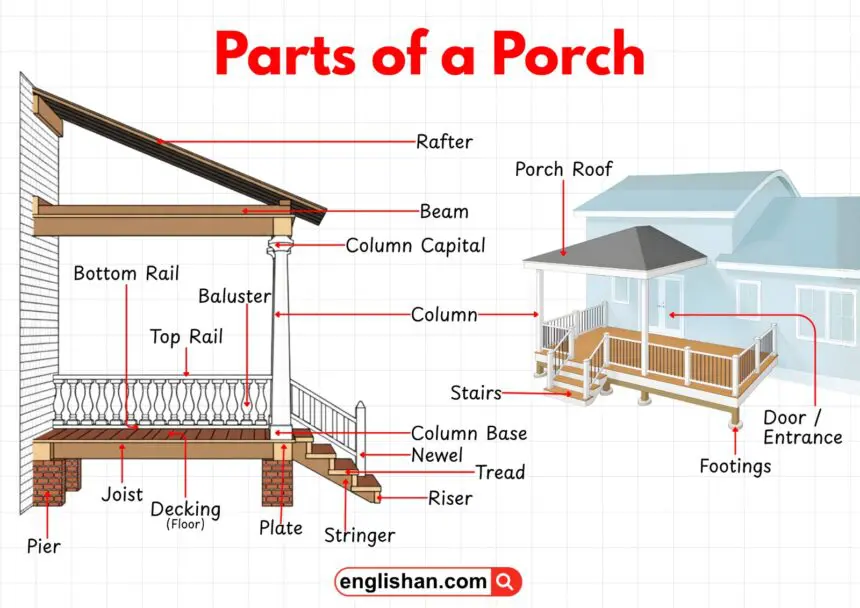
Parts of a Porch Diagram With Names
A porch is made up of several parts that work together to make it functional, safe, and visually appealing. The floor and decking form the base that supports everyone walking on it, while the posts or columns hold up the roof and give the structure stability. Railings, including the top rail, bottom rail, and balusters, provide safety and define the space, and steps with treads and risers make it easy to access the porch from the ground. Additional parts like the roof, fascia, beams, and decorative elements add protection from the weather, enhance durability, and give the porch its overall style. Each component plays an important role in making the porch safe, comfortable, and attractive for everyday use.
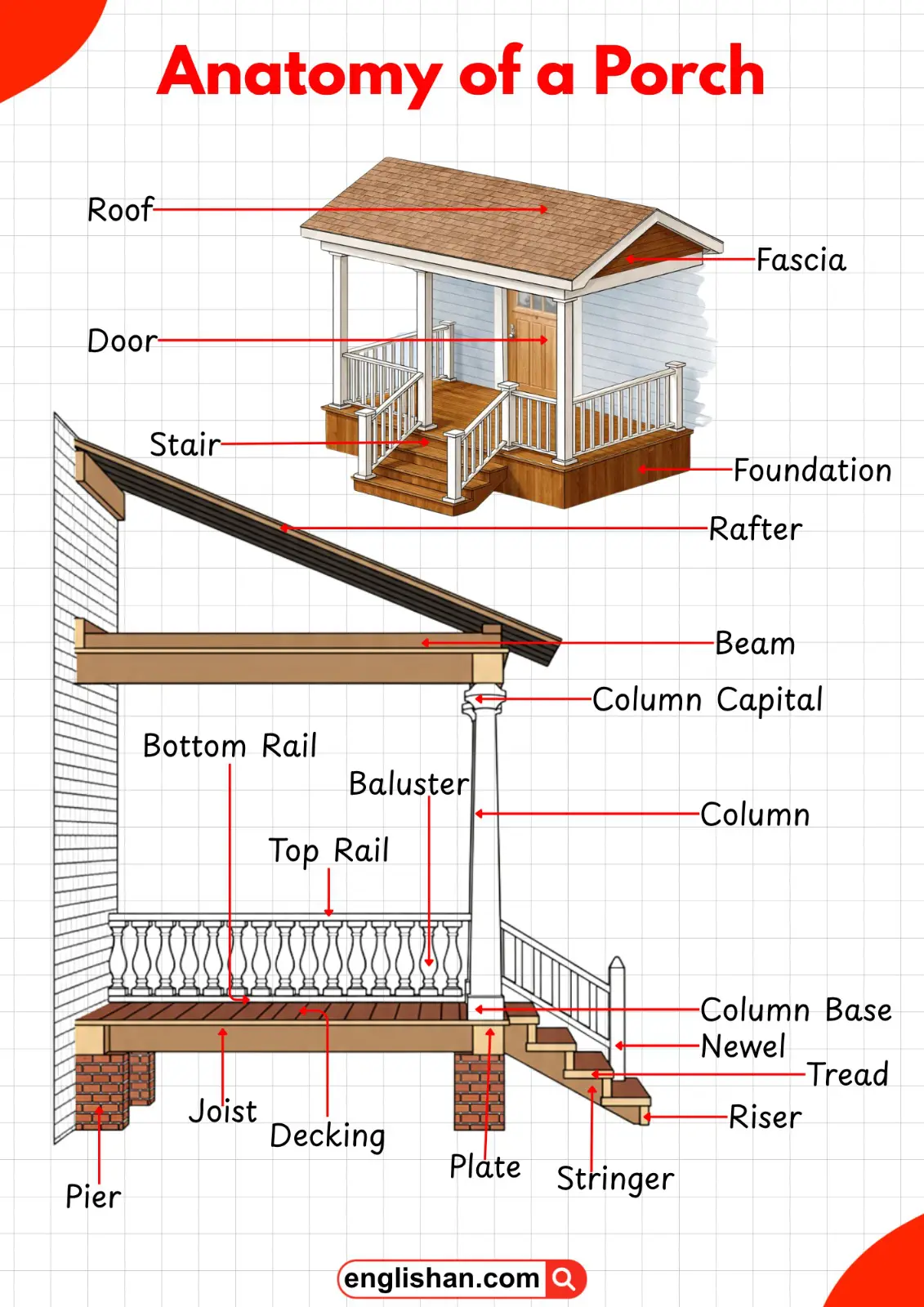
Roof Structure
The roof structure is the top framework of a house that protects it from weather elements.
Roof
The roof is the topmost covering of a building that protects the interior from weather elements like rain, snow, wind, and sunlight. Roofs come in various shapes such as gable, hip, flat, and shed, and they play a crucial role in the overall aesthetic and structural integrity of a house. The roof also helps in insulation and water drainage.
Fascia
Fascia is the horizontal board that runs along the edge of the roof, typically where the gutters are attached. It provides a finished look, hides the ends of the rafters, and protects the roof and interior from weather damage. It also acts as a support for gutters, ensuring proper water drainage.
Rafter
Rafters are sloping beams that extend from the roof ridge to the walls, forming the framework of the roof. They support the roof covering and help distribute the roof load to the walls. Rafters are usually made of wood or steel and are a key structural element of pitched roofs.
Beam
A beam is a horizontal structural element that supports loads from the roof or upper floors. In roof structures, beams work with rafters to bear weight and maintain the building’s stability. Beams can be made of timber, steel, or reinforced concrete, depending on the design and load requirements.
Support Columns
Support columns are vertical structures that carry loads from the roof or upper floors to the foundation.
Column
A column is a vertical structural element that transfers loads from the roof or upper floors down to the foundation. Columns can be decorative or purely structural and are often made from concrete, steel, or wood.
Column Capital
The column capital is the topmost part of a column. It serves both a decorative and functional purpose by widening the area of the column that meets the load-bearing structure above, distributing weight more effectively. Capitals can be plain or intricately designed, depending on architectural style.
Column Base
The column base is the bottom part of a column, where it meets the floor or foundation. The base helps distribute the column’s load evenly and prevents structural damage to the floor or foundation. Bases can be simple or elaborately molded in classical architecture.
Staircase Elements and Parts
Stairs are a series of steps that allow movement between different levels of a building.
Stair
A stair is a series of steps that allows movement between different levels of a building. Stairs consist of multiple components like treads, risers, stringers, and handrails, all designed to provide safe and comfortable access.
Tread
The tread is the horizontal part of a step where the foot is placed. Tread depth and width are crucial for safety and comfort. Materials for treads can include wood, concrete, stone, or metal, depending on the stair design.
Riser
The riser is the vertical part of a step that connects one tread to the next. Risers provide height between steps and contribute to the stair’s overall stability and structural support. Closed risers are solid, while open risers leave a gap between steps.
Stringer
A stringer is the inclined support that runs along the side of a stair, holding the treads and risers in place. Stringers can be cut from wood or fabricated from metal and are essential for the stair’s structural integrity.
Newel
A newel is a sturdy vertical post that supports the handrail at the start, end, or turn of a staircase. It provides structural stability and can also serve as a decorative feature, often carved or embellished.
Deck/Floor Structure
Deck or floor structures provide the horizontal surface for walking and support the weight above.
Decking
Decking refers to the horizontal surface of a floor or deck that people walk on. It can be made from wood, composite materials, or concrete and must be durable and weather-resistant if used outdoors.
Joist
Joists are horizontal structural members that support the decking or flooring above. They are spaced at regular intervals and transfer loads to beams or the foundation. Joists are critical for ensuring the floor does not sag or bend under weight.
Plate
A plate is a horizontal timber or steel member that sits on top of a wall or beam, providing a base for floor joists or roof rafters. Plates help distribute structural loads evenly and stabilize the framework.
Pier
A pier is a vertical support column used to elevate and support floors, decks, or other structures above the ground. Piers are typically made of concrete or masonry and are designed to handle vertical loads safely.
Foundation
The foundation is the lowest part of a building, transferring loads from the structure to the ground. It provides stability, prevents settling, and protects against moisture and ground movement. Foundations can be shallow (footings) or deep (piles) depending on the soil and building requirements.
Railing System Components
Railings are safety barriers consisting of horizontal and vertical elements to prevent falls.
Top Rail
The top rail is the uppermost horizontal component of a railing system. It provides support for people using the stairs or deck and contributes to the safety and aesthetics of the railing.
Bottom Rail
The bottom rail is the horizontal element at the base of a railing. It connects the vertical balusters, keeping them aligned and secure, and ensures structural stability of the railing.
Baluster
Balusters are the vertical posts between the top and bottom rails of a railing. They provide safety by preventing people, especially children, from falling through gaps. Balusters can be simple or decorative, made of wood, metal, or composite materials.
Other Essential Fixtures
Doors are movable barriers that provide entry, exit, and security for a building.
Door
A door is a movable barrier that allows entry and exit from a room or building. Doors provide security, privacy, and protection from the elements. They come in various types like panel, flush, sliding, or folding, and can be made of wood, metal, glass, or composite materials.
Key Takeaway
A porch is a functional and decorative extension of a house where each part plays an important role. The roof structure, including rafters, beams, and fascia, provides shelter and protects the porch from weather. Support columns and their capitals and bases carry the weight of the roof while adding structural stability and aesthetic appeal. Stairs, with their treads, risers, stringers, and newels, allow safe and comfortable access to the porch. The deck or floor structure, consisting of decking, joists, plates, piers, and foundation, forms the walking surface and distributes loads evenly. Railings, made up of top rails, bottom rails, and balusters, ensure safety while enhancing the visual design. Finally, elements like doors provide access to and from the porch. Altogether, these parts combine to create a stable, safe, and inviting porch space.
You May Also Like