Steam locomotives combine motion, heat, and mechanics into one powerful machine, making them a lasting subject in classrooms, museums, and railway history. Knowing the core structure helps students, readers, and hobbyists talk about engines with accuracy, whether the context is learning transport history or building strong subject vocabulary tied to railways.
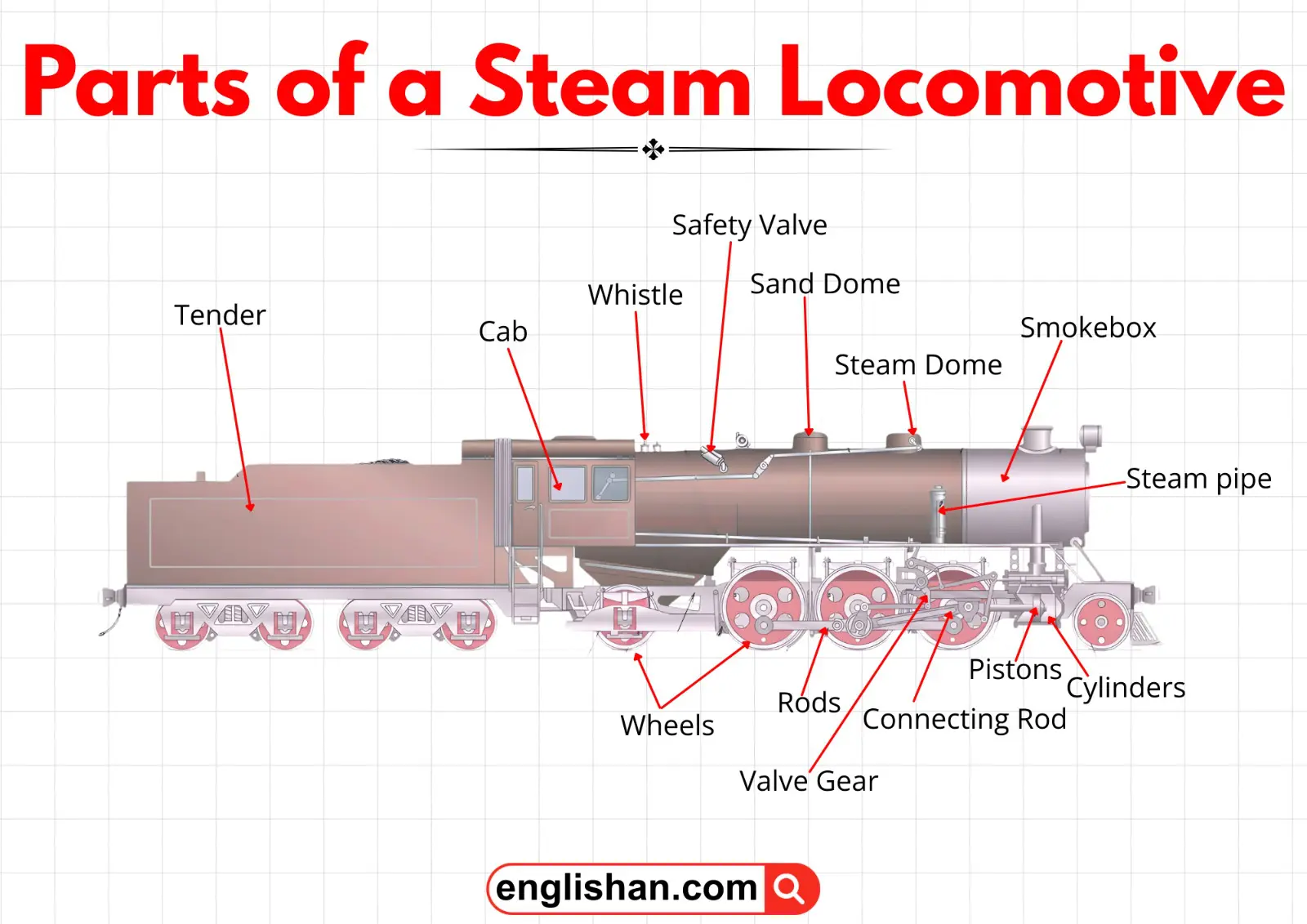
In this blog post, we explain how a steam locomotive is arranged, beginning with the boiler and firebox, then moving through the smokebox, chimney, cylinders, driving wheels, connecting rods, cab, and tender. We focus on the most common design first, since names can differ by type and era. The labeled diagram that follows helps connect each word to its exact position with confidence.
Steam Locomotive Parts Diagram With Names
Within the system, a steam locomotive converts heat into pressurized steam and then into motion. Each named part performs a fixed mechanical or thermal role, and together they form a continuous path from fuel burning to wheel rotation.
Front End Parts
Acting as the intake and exhaust section, this area manages airflow, exhaust release, and forward signaling. The main functions work together as follows:
- Guiding smoke and exhaust gases away.
- Supporting steady draft for combustion.
- Providing forward visibility signals.
As a result, airflow and visibility remain controlled during operation.
Boiler And Steam Parts
Serving as the pressure and containment section, these parts handle steam creation and regulation. Their roles connect in sequence:
- Heating water into steam.
- Holding steam under pressure.
- Regulating steam flow toward power components.
Within the system, steam control stabilizes power delivery.
Cab And Crew Area
Operating as the control section, this space contains the operating interfaces. These elements work together to manage movement:
- Valves that admit or restrict steam.
- Levers that adjust motion.
- Gauges that indicate pressure and speed.
In turn, operational control remains centralized.
Wheels And Rods
Functioning as the motion transfer section, these parts convert force into rotation. The process depends on:
- Rods carrying force from pistons.
- Wheels turning that force into travel.
- Timed movement between connected parts.
As a result, mechanical linkage keeps motion synchronized.
Smokestack
Handling exhaust release, this part vents smoke and gases upward. Its role centers on:
- Releasing spent steam.
- Maintaining draft flow.
In turn, exhaust discharge supports combustion balance.
Smokebox
Acting as the exhaust chamber, this section gathers gases before release. Airflow behavior here affects:
- Draft strength.
- Smoke movement.
As a result, draft regulation shapes internal flow.
Boiler
Serving as the pressure vessel, this part holds water while heat converts it into steam. Its operation depends on:
- Continuous heat input.
- Strong containment under pressure.
Within the system, steam generation remains constant.
Steam Dome
Within the pressure system, this chamber collects steam before delivery. Its function relies on:
- Separating moisture.
- Supplying drier steam onward.
As a result, steam quality stays consistent.
Safety Valve
Operating as a pressure relief device, this valve opens automatically when limits are exceeded. Its action includes:
- Releasing excess steam.
- Reducing internal pressure.
In turn, pressure protection prevents damage.
Whistle
Using released steam, this part produces sound for signaling. The process involves:
- Controlled steam release.
- Sound production through vibration.
As a result, audible signaling defines its role.
Sand Dome
Supplying dry sand, this part supports wheel grip during movement. Its function depends on:
- Storing dry sand.
- Feeding sand when needed.
In turn, traction support stabilizes motion.
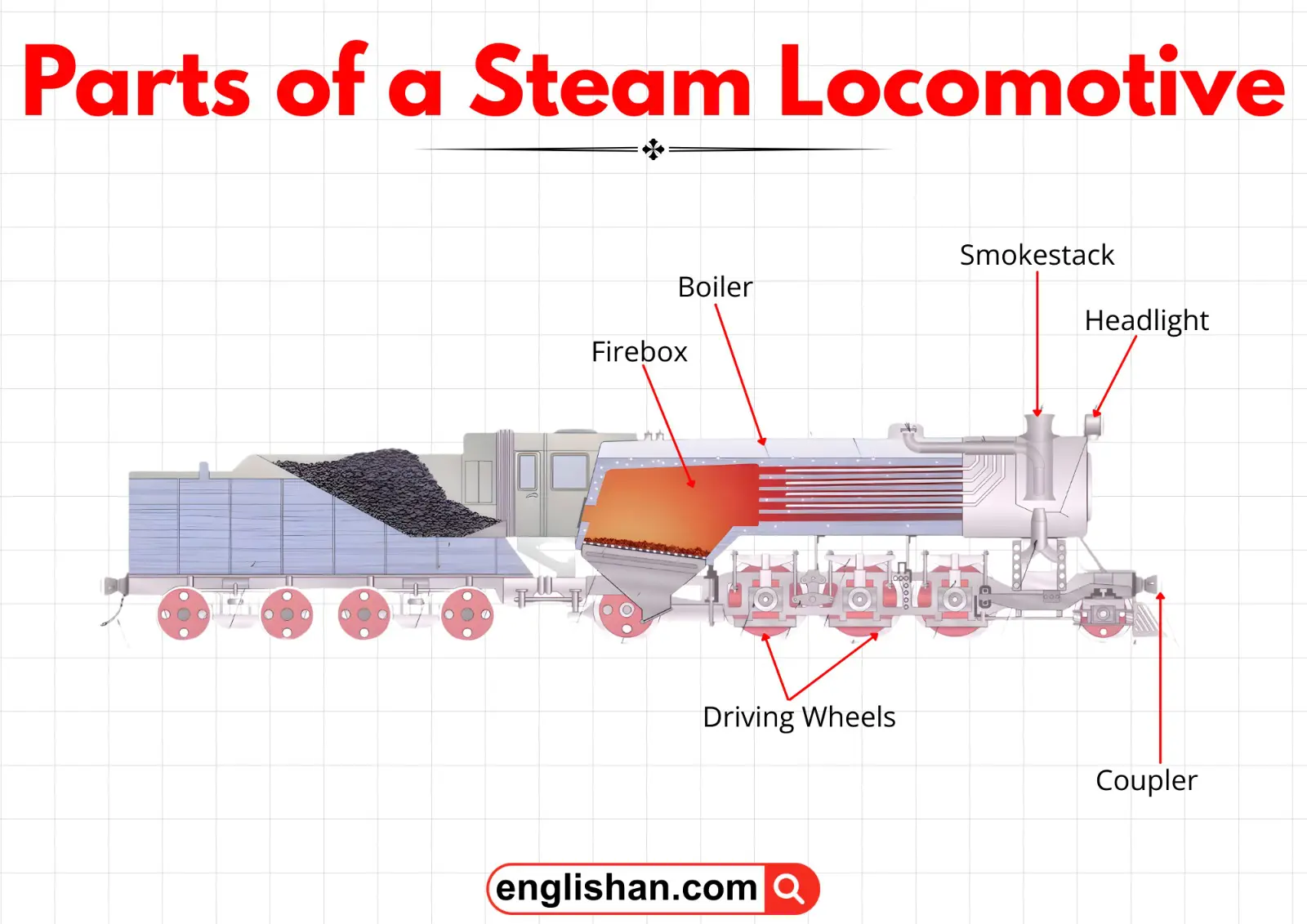
Firebox
Serving as the heat source, this chamber holds burning fuel. Its role centers on:
- Fuel combustion.
- Heat transfer to the boiler.
As a result, combustion heat drives steam creation.
Cab
Acting as the operator enclosure, this space contains instruments and controls. The enclosed systems allow:
- Monitoring pressure.
- Adjusting speed and braking.
In turn, control access remains direct.
Headlight
Providing forward illumination, this component improves visibility. Its operation depends on:
- Continuous power supply.
- Focused light output.
As a result, signal lighting stays steady.
Cylinders
As power chambers, these parts receive steam and convert pressure into force. Their operation includes:
- Steam entry.
- Expansion against internal surfaces.
In turn, force output initiates motion.
Pistons
Moving back and forth within cylinders, these parts respond directly to steam pressure. Motion here involves:
- Linear travel.
- Repeated cycles.
As a result, reciprocating action stays precise.
Valve Gear
Controlling steam timing, this mechanism directs steam entry and exit. Its role depends on:
- Coordinated movement.
- Accurate timing.
In turn, steam timing governs performance.
Connecting Rod
Linking pistons to wheels, this part transfers force into rotation. The connection ensures:
- Continuous motion transfer.
- Synchronized movement.
As a result, power transfer remains uninterrupted.
Driving Wheels
Receiving force from rods, these wheels convert motion into travel. Performance depends on:
- Wheel size.
- Contact with rails.
In turn, tractive motion moves the locomotive.
Coupler
Acting as the linking device, this part joins rail cars together. Its function includes:
- Mechanical locking.
- Load transmission.
As a result, train connection stays secure.
Tender
Serving as the supply unit, this car carries fuel and water. Its role supports:
- Continuous fuel supply.
- Ongoing water storage.
In turn, resource storage keeps steam production active.
Key Takeaways
A steam locomotive functions as a heat driven machine built around steam creation, motion transfer, and controlled release. The boiler creates steam, the cylinders and valves convert pressure into force, the rods and wheels turn force into motion, the cab manages control, and the tender supplies fuel and water. Steam moves from generation through timed delivery into mechanical action, then exits as exhaust. Some variation exists in valve systems and wheel layouts. We summarize the parts of a steam locomotive as one chain where steam pressure becomes forward motion.
You May Also Like