Zippers are something we use every day, from jackets and bags to shoes and tents, but have you ever thought about how they actually work? A zipper is not just one piece; it is made up of several small parts that all work together to open and close smoothly. In this article, we’ll explore the different parts of a zipper and how each one works.
List of Zipper Parts With Names
- Crown
- Body
- Throat
- Top Stop
- Teeth (Elements)
- Slider
- Pull Tab
- Chain
- Zipper Tape
- Bottom Stop
- Retainer Box
- Insertion Pin
Parts of a Zipper Diagram With Names
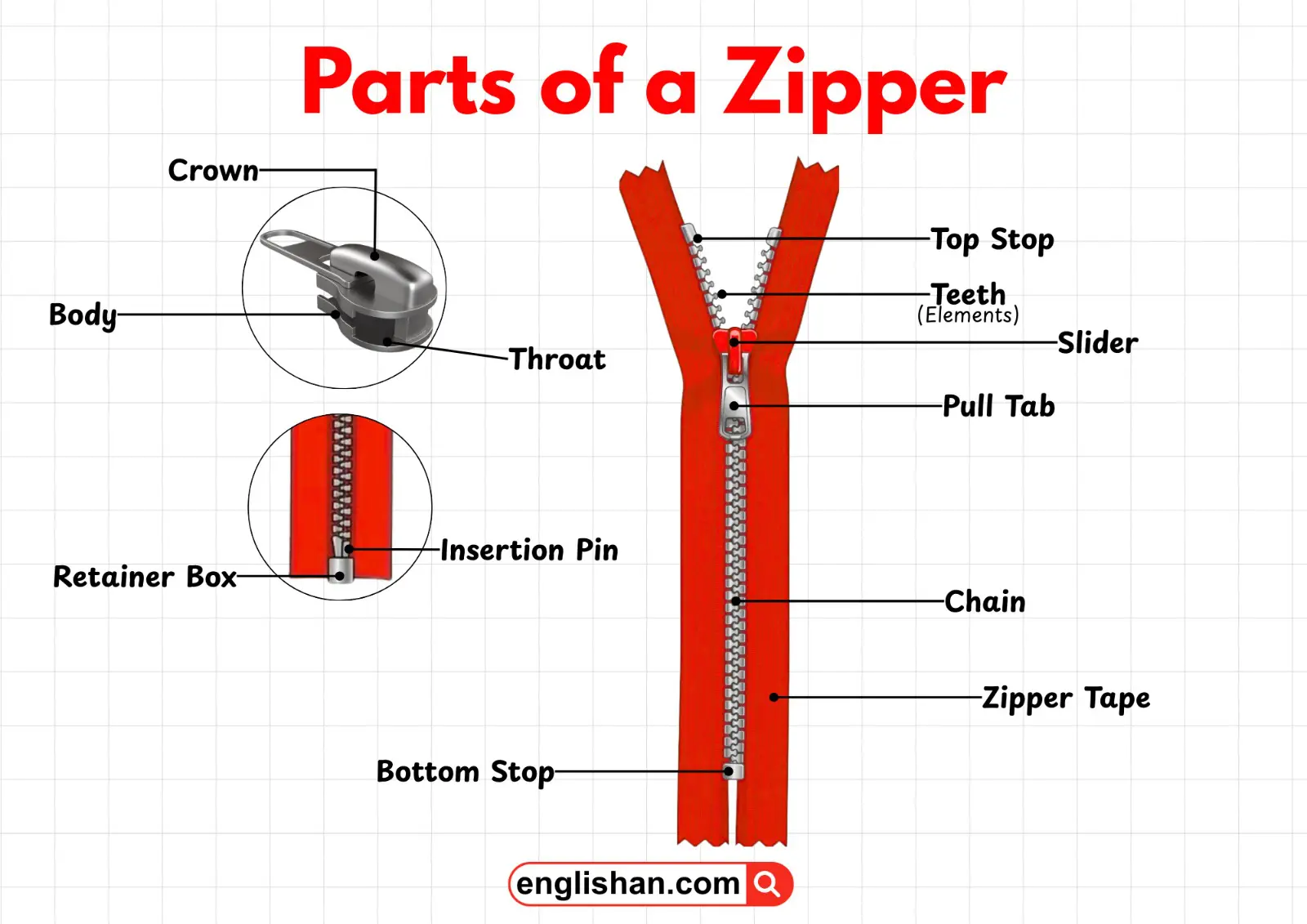
Zippers are everyday items that help fasten clothes, bags, and other products quickly and securely. It is made up of several parts that work together to open and close smoothly. Components like the teeth and chain interlock to hold the zipper closed, while the slider moves along them to either join or separate the sides. The pull tab allows you to easily move the slider, and the crown, body, and throat guide the teeth into place. Other parts, such as the top and bottom stops, prevent the slider from coming off, while the retainer box and insertion pin help reconnect the two halves of a separating zipper. Each part, from the zipper tape to the smallest stop, plays an important role in making the zipper function reliably and efficiently.
Slider Components
The slider is the moving part of the zipper that opens and closes it. Each part of the slider has a specific function:
Crown
The crown is the topmost part of the slider. It often has a decorative or structural role and sometimes houses the mechanism for attaching the pull tab. It provides stability to the slider’s structure.
Body
The body is the main part of the slider, usually made of metal or plastic, which encloses the internal channel that guides the teeth together or apart. It’s the part you actually move along the chain.
Throat
The throat is the channel inside the slider where the teeth enter and exit. Its precise shape ensures the teeth align properly when the zipper is zipped or unzipped.
Pull Tab
This is the part you grasp with your hand to move the slider along the zipper. Pull tabs can be simple rings, levers, or decorative pieces, but their main purpose is to provide leverage for smooth operation.
Slider
The slider as a whole is the mechanism that connects the teeth when moving in one direction and separates them when moving in the opposite direction. The combined action of the crown, body, throat, and pull tab makes this possible.
Fastening Components
These parts are responsible for holding it together when closed:
Teeth (Elements)
The individual interlocking pieces along the chain. They can be made of metal, plastic, or nylon, and their design ensures they fit securely and hold it closed.
Chain
This is the continuous row of teeth attached to the tape. It forms the backbone of the zipper and determines how flexible or strong the zipper will be.
Structural / Fabric Components
These parts connect the zipper to the material it’s meant to fasten:
Zipper Tape
The fabric strip to which the teeth or chain is attached. Its tape is sewn into garments, bags, or other products and provides the stability and flexibility required for the zipper to function properly.
Limiting Components (Stops)
Stops prevent the slider from moving beyond the ends of the zipper chain:
Top Stop
A small metal or plastic piece at the top that prevents the slider from coming off the zipper when fully closed.
Bottom Stop
A piece placed at the end to stop the slider from sliding off when opening the zipper. In separating zippers (like jackets), the bottom stop is replaced by a retainer box and insertion pin.
Connecting / Locking Components
These parts are used in separating zippers (such as on jackets) to reconnect the two halves:
Retainer Box
A small metal or plastic box at the bottom of a separating zipper. The insertion pin fits into it to align and lock the zipper halves together.
Insertion Pin
A metal or plastic pin attached to the opposite side of the retainer box. When starting, the pin slides into the retainer box, ensuring both sides of the zipper join correctly before the slider moves up.
Key Takeaway
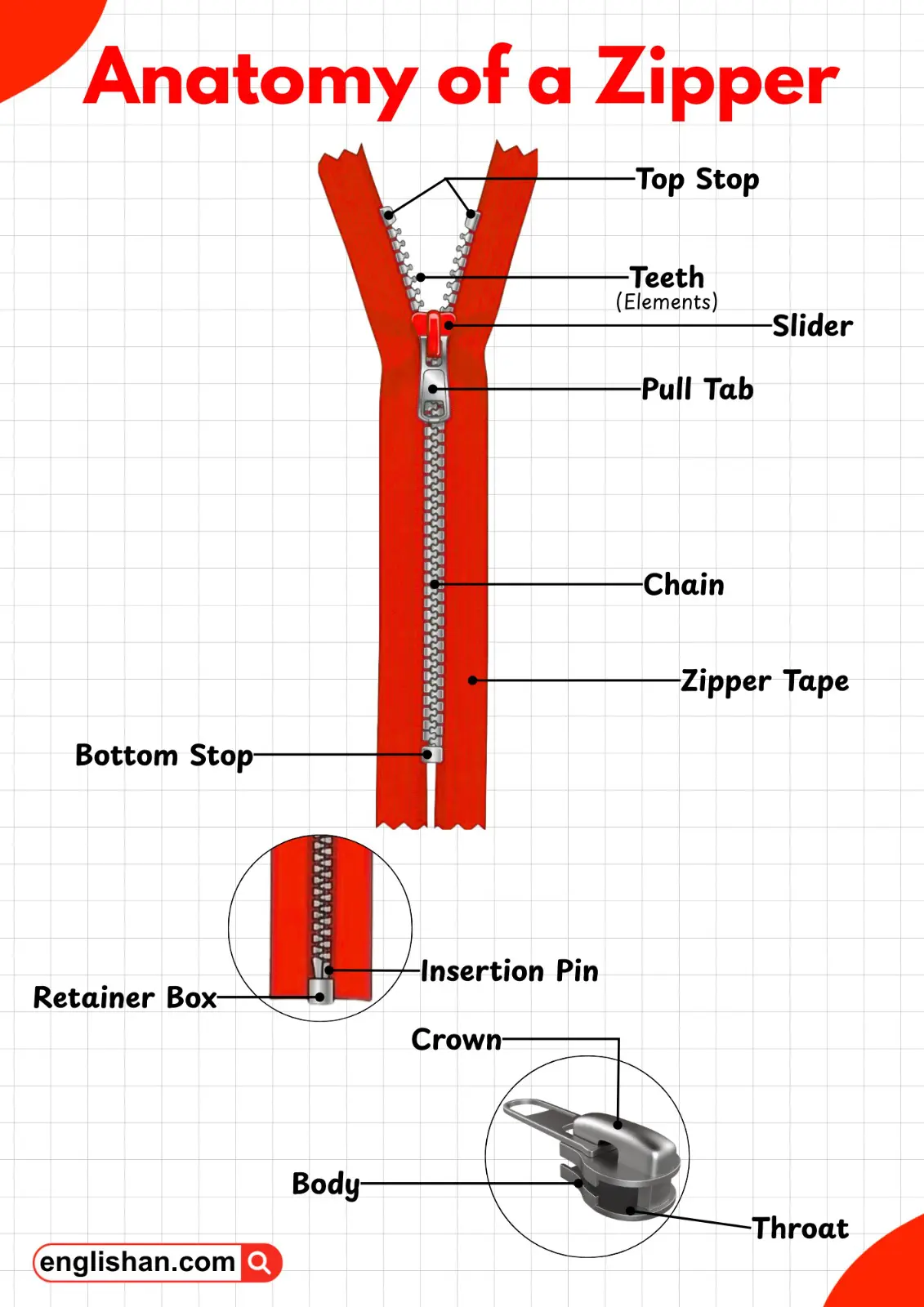
As we learned, a zipper is made up of several key components that work together to make it function smoothly. The slider, consisting of the crown, body, throat, and pull tab, moves along to open or close it. The teeth and chain interlock to hold the zipper securely when closed, while the zipper tape attaches the whole mechanism to the garment or product. Top and bottom stops prevent the slider from coming off the ends, ensuring safety and stability. In separating zippers, like those on jackets, the retainer box and insertion pin connect both sides to allow to start properly and stay aligned. Each part has a specific role, and together they ensure the zipper operates efficiently and reliably.
You May Also Like