Some rocks form when lava cools. Others build up slowly from layers of small materials over time. These are grouped into igneous, sedimentary, and metamorphic rocks, based on how they form and where they are found.
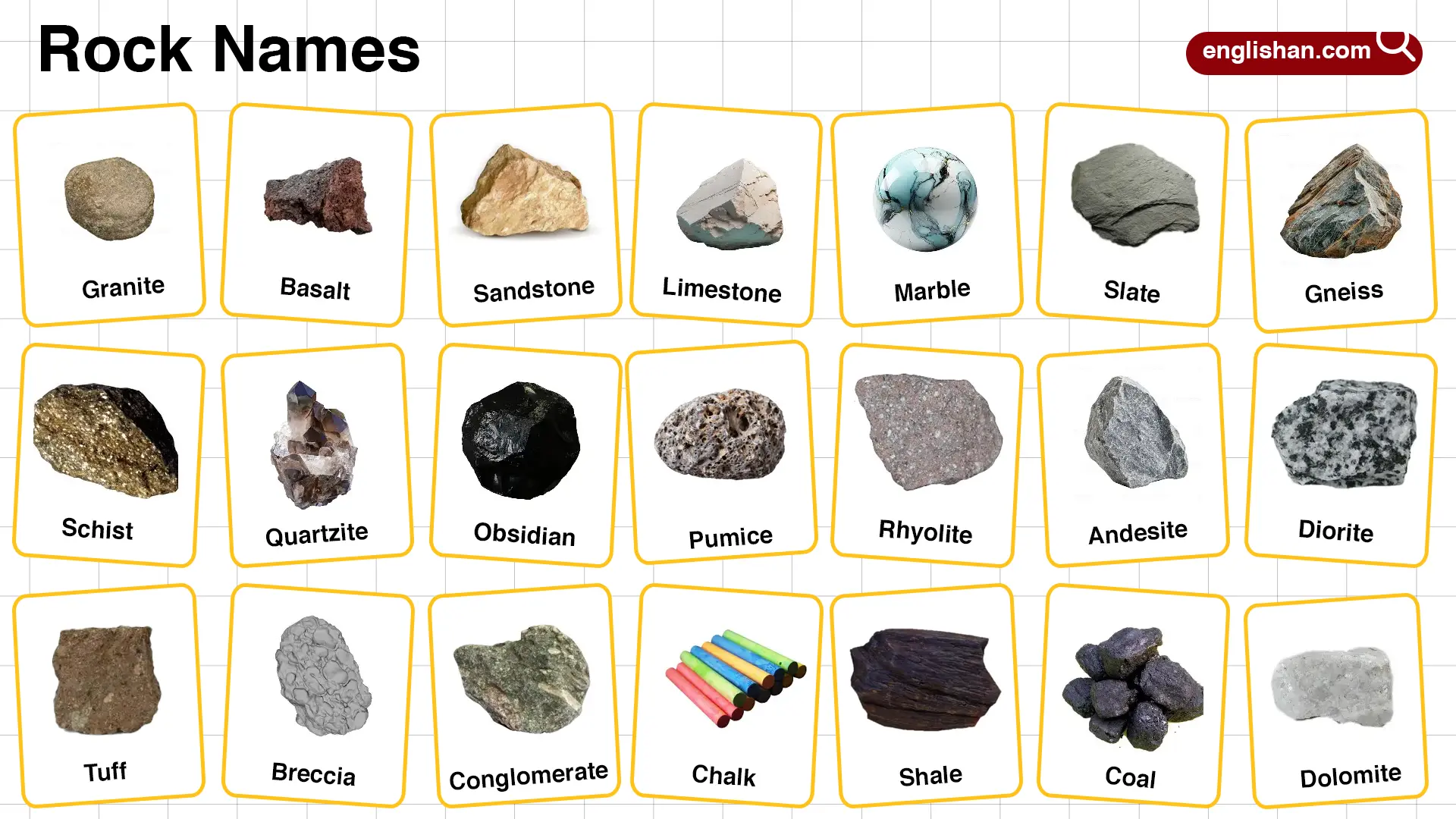
This post shares rock names in English with categorized pictures so you can build science-related vocabulary and learn how rocks are named and sorted.
List of Rock Names in English
Learning the full names of rocks builds basic recognition and scientific vocabulary. These names help categorize rocks by their appearance, structure, and geological origin. It also makes classroom and fieldwork discussions easier to follow.
- Granite
- Basalt
- Sandstone
- Limestone
- Marble
- Slate
- Gneiss
- Schist
- Quartzite
- Obsidian
- Pumice
- Rhyolite
- Andesite
- Diorite
- Tuff
- Breccia
- Conglomerate
- Chalk
- Shale
- Coal
- Dolomite
- Flint
- Pegmatite
- Phyllite
- Travertine
- Hornfels
- Serpentinite
- Scoria
- Anorthosite
- Tonalite

Types of Rocks by Formation
Rocks form in different ways depending on natural conditions like heat, pressure, and layering. This section explains how each formation process shapes a rock’s structure, texture, and appearance, helping students understand Earth’s dynamic changes over time.
Igneous Rocks
Igneous rocks are formed from cooled lava or magma. Recognizing these names helps students connect rock texture and color to volcanic activity. These rocks are also common in science lessons and geography texts.
Below are some well-known igneous rock names:
- Granite: Coarse-grained, often speckled, and forms deep underground from slow cooling.
- Basalt: Dark-colored and dense, forms from lava on Earth’s surface.
- Obsidian: Shiny and glassy black rock with sharp edges, formed from rapid cooling.
- Pumice: Very light, full of air holes, and can float on water.
- Rhyolite: Pale volcanic rock, fine-grained and often pink or gray.
- Andesite: Medium-gray rock found in volcanic areas, usually fine-grained.
- Diorite: Speckled black and white rock with medium-sized grains.
- Tuff: Formed from volcanic ash and dust, often soft and crumbly.
- Scoria: Dark and hole-filled rock formed during explosive eruptions.
- Pegmatite: Extremely coarse-grained, often contains quartz and feldspar.
- Anorthosite: Mostly made of plagioclase feldspar, often light-colored.
- Tonalite: Similar to granite but with more quartz and less potassium feldspar.
Sedimentary Rocks
Sedimentary rocks are made from layers of particles or remains that were pressed over time. Learning their names helps in understanding Earth’s history and fossil layers.
Here are some common sedimentary rock names:
- Sandstone: Formed from compacted sand grains, usually tan or reddish.
- Limestone: Made of calcium carbonate, often contains fossil bits.
- Chalk: Soft white limestone made from tiny sea creatures.
- Shale: Fine layers of mud and clay, splits easily into thin sheets.
- Coal: Black rock formed from ancient plant matter, burns for fuel.
- Breccia: Made of broken fragments stuck together in a cement-like mix.
- Conglomerate: Similar to breccia but with rounded pieces.
- Dolomite: Contains calcium and magnesium, looks like limestone but reacts slowly to acid.
- Flint: Hard, dark rock used in tools, often found inside chalk or limestone.
- Travertine: Creamy rock made in hot springs, forms bands or layers.
Metamorphic Rocks
Metamorphic rocks form when existing rocks change due to heat, pressure, or chemical action. Their names help students recognize changed textures and patterns.
Here is a useful list of metamorphic rock names:
- Marble: Formed from limestone, smooth and used in sculpture and tiles.
- Slate: Fine-grained rock from shale, splits into thin sheets.
- Gneiss: Banded rock with dark and light stripes, very hard.
- Schist: Shiny and flaky rock, often sparkles due to mica.
- Quartzite: Hard rock from sandstone, breaks across grains.
- Phyllite: Slightly shiny rock between slate and schist.
- Hornfels: Hard, tough rock formed by heating from magma.
- Serpentinite: Green, waxy rock made from altered mantle rock.
Physical Properties of Rocks
This section focuses on the physical traits that help identify rocks, such as hardness, color, texture, and grain. Understanding these properties helps students classify rocks like soft chalk or hard quartzite in science lessons and real-world contexts.
Soft and Hard Rock Names
Some rocks are easier to scratch or shape, while others are extremely hard. These differences are important in construction, carving, and scientific testing.
Soft Rocks
- Chalk: Very soft and crumbles easily. Teachers used it to write before whiteboards became common.
- Shale: It breaks into thin sheets. Not very strong, but it helps study ancient mud and fossils.
- Coal: Soft, black rock used as fuel. When burned, it releases heat for homes and power stations.
- Tuff: Light and porous, made from volcanic ash. Builders in some places use it because it’s easy to shape.
- Talc: Known as one of the softest minerals. It feels smooth and is used in powders and soapstone.
- Claystone: Made from hardened clay. It crumbles when dry and becomes slippery when wet.
Hard Rocks
- Quartzite: Very hard and tough. It’s stronger than sandstone and resists scratches, used in heavy-duty surfaces.
- Granite: Hard and speckled, often used in countertops. It lasts long even in outdoor buildings.
- Gneiss: Hard with wavy bands, great for construction. It can survive strong weather without breaking down.
- Basalt: A hard, dark rock formed from lava. It’s often crushed and used in making roads and cement.
- Marble: Smooth and shiny but also strong. It’s used in sculpture, tiles, and building interiors.
- Slate: Breaks into thin sheets but still tough. Used in roofing, chalkboards, and sometimes floors.
- Diorite: Speckled and solid. Its strength makes it suitable for tiles and heavy construction.
- Obsidian: Though it looks glassy, it’s hard. But it breaks with sharp edges like broken glass.
Rocks in Human Use
This section explains how different types of rocks are used in daily life, construction, and decoration. From building materials like granite to decorative stones like jade, learners will see how rocks play a vital role in human activity.
Rocks Used in Jewelry and Decoration
Some rocks are not just useful but also beautiful. These are polished and cut for jewelry and decorations. Learning their names builds both vocabulary and understanding of value.
Here are rocks often used for decoration or ornaments:
- Marble: Used in floors, statues, and tiles for its shine and smoothness.
- Obsidian: Polished for beads and blades, black and glossy.
- Quartzite: Used in buildings and as decorative stone for its hardness.
- Slate: Made into roofing tiles or wall stones.
- Schist: Sometimes shiny with mica, adds sparkle to design work.
- Gneiss: Patterned stripes look good in polished counters.
- Travertine: Often used for flooring, walls, and fancy tiles.
- Serpentinite: Green color makes it useful in carvings.
Rocks Used in Building Materials
These rocks are found in roads, houses, schools, and tools. Learning their names helps connect classroom science with things students see every day.
Common building and utility rocks:
- Granite: Used in countertops, pavements, and buildings.
- Limestone: Mixed in cement, used in blocks and powder form.
- Slate: Used for roof tiles and chalkboards.
- Sandstone: A strong building stone, often carved or shaped.
- Marble: Floors, bathroom walls, and fine sculptures.
- Gneiss: Roadbeds and foundations.
- Quartzite: Strong surfaces and crushed stone.
- Basalt: Road stones, crushed base layers, and monuments.
- Travertine: Flooring in public buildings or religious structures.
Conclusion
Learning rock names in English helps students describe science and nature better. From chalk to quartzite, each name shows how rocks form. With practice, students can recall types easily and use them confidently in class, reading, and outdoor activities.
FAQs About Rock Names
The three main types are igneous, sedimentary, and metamorphic. They form in different ways through heat, pressure, or layering.
Look at its texture and layers. Igneous rocks are often grainy, sedimentary rocks have layers, and metamorphic rocks show banding or shine.
Granite is a rock made of multiple minerals like quartz, feldspar, and mica. It forms from cooled magma.
Rocks like pumice or scoria have holes because gas was trapped during lava cooling, creating empty spaces inside.
You May Also Like