
The types of moths on this planet outnumber butterflies by a staggering margin. With over 160,000 known species worldwide and roughly 11,000 across North America alone, moths represent one of the most diverse groups in the insect world. Yet most people only picture the small brown ones circling a porch light at dusk.
That picture barely scratches the surface. Moths span an extraordinary range, from micro-moths no bigger than a grain of rice to the Atlas moth, whose wingspan stretches nearly 10 inches across. Some are vivid pink and yellow. Others are leaf-green with elegant trailing wings. A few fly during the day and hover at flowers exactly like hummingbirds.
You’ll find each moth profiled here by family, with real identification traits, wingspan measurements, habitat notes, and the behaviors that make each species worth knowing.
What Are Moths?
Moths are winged insects belonging to the order Lepidoptera, the same group that houses butterflies. The name Lepidoptera comes from the Greek words for “scale” and “wing,” and both moths and butterflies carry thousands of tiny overlapping scales on their wings and bodies.
What separates moths from butterflies isn’t a single feature but a combination of traits. Moths make up the overwhelming majority of Lepidoptera, with roughly 160,000 species compared to about 18,000 butterfly species. They’ve been found on every continent, from tropical rainforests to the sub-Antarctic Kerguelen Islands.
Every moth passes through four life stages: egg, larva (caterpillar), pupa, and adult. The caterpillar stage drives most of the feeding, while many adult moths survive only long enough to reproduce. Ecologically, moths are critical nighttime pollinators, and they form a massive part of the food chain for bats, birds, spiders, and small mammals.
Most moth species fall into five major families: Saturniidae (giant silk moths), Sphingidae (hawk moths), Arctiidae (tiger moths), Geometridae (geometrid moths), and Noctuidae (the largest family, with over 25,000 species).
Moth Vs. Butterfly: How To Tell Them Apart
The fastest way to distinguish a moth from a butterfly is to look at the antennae. Moth antennae are feathery, saw-edged, or tapered to a fine point. Butterfly antennae are thin and straight with a rounded club at the tip. This holds true across nearly all species and works even at a distance.
Beyond antennae, body shape tells the story. Moths tend to have thicker, sturdier bodies covered in dense, fur-like scales. Butterflies carry a more slender, streamlined frame. When resting, most moths spread their wings flat against the surface they’re sitting on, while butterflies fold their wings upright over their backs.
Activity period is another reliable clue. The vast majority of moths are nocturnal, drawn to light sources after dark, while butterflies fly during the day. That said, some moths break this rule entirely, and you’ll meet a few of those later in this guide.
| Feature | Moths | Butterflies |
|---|---|---|
| Antennae | Feathery, saw-edged, or tapered. | Thin with a rounded club at the tip. |
| Wing resting position | Wings spread flat against the surface. | Wings folded upright over the back. |
| Body shape | Stout and covered in dense, hair-like scales. | Slender and smooth. |
| Activity period | Mostly nocturnal (active at night). | Mostly diurnal (active during the day). |
| Pupa covering | Cocoon spun from silk. | Chrysalis with a hard, smooth shell. |
One more detail worth noting: moths spin silk cocoons around their pupae, while butterflies form a hard, exposed chrysalis. Both structures protect the insect during metamorphosis, but the texture and material are noticeably different.
Giant Silk Moths (Saturniidae)
The Saturniidae family produces the largest and most visually dramatic moths on the planet. These are the moths that stop people in their tracks, with wingspans reaching 10 inches, bold eyespot markings, and soft, velvety wings in shades of green, yellow, brown, and russet.
One defining trait of this family is that adult silk moths have no functional mouthparts. They don’t eat at all. Their entire adult life, lasting roughly one to two weeks, is devoted entirely to mating and laying eggs. All their energy comes from fat reserves stored during the caterpillar stage.
Males detect females through pheromones, often from distances of several miles. Their large, feathery antennae are finely tuned chemical receptors, making them among the most sensitive scent detectors in the animal kingdom.
Luna Moth
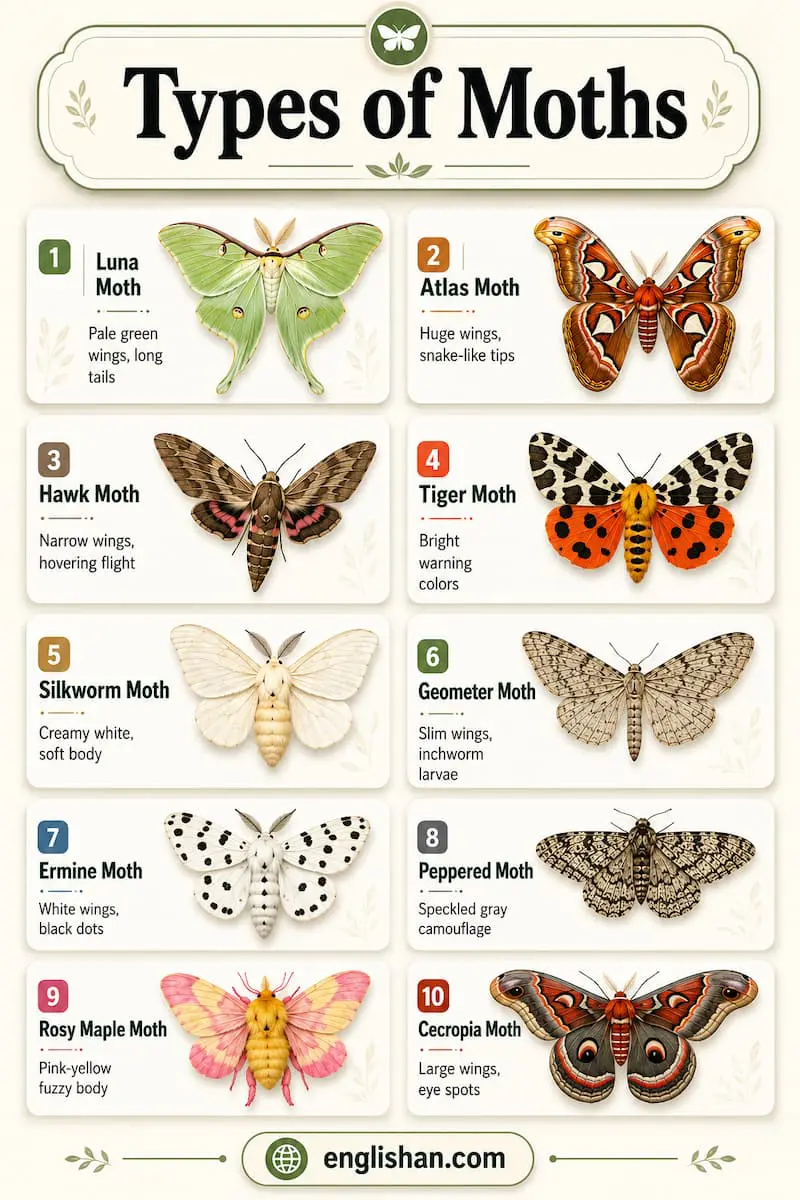
The Luna moth (Actias luna) is arguably the most recognized moth in North America. Its four lime-green wings carry small, transparent eyespots, and the hindwings trail long, graceful tails that spin in flight to confuse echolocating bats.
Adults reach a wingspan of 3.5 to 4.5 inches (9 to 11.5 cm) and live only about 7 to 10 days. They’re found throughout eastern North America, from Florida north into southern Canada, primarily in deciduous forests rich in hickory, walnut, birch, and sweetgum trees, which feed the caterpillars.
Luna moths are strongly nocturnal and drawn to artificial light, which is where most people encounter them.
Atlas Moth
The Atlas moth (Attacus atlas) ranks among the largest moths on earth, with a wingspan that reaches 9.5 to 10 inches (24 to 25 cm) in the biggest females. Native to the tropical and subtropical forests of Southeast Asia, from India through Malaysia and Indonesia, this moth’s size alone makes it unmistakable.
Its wings display rich chestnut-brown tones with white, triangular markings, and each wingtip curves into a shape that closely resembles a snake’s head. That resemblance isn’t accidental; it’s believed to deter predators when the moth is at rest. Like all Saturniidae adults, the Atlas moth doesn’t feed and survives solely on larval fat reserves.
Cecropia Moth
The Cecropia moth (Hyalophora cecropia) holds the title of the largest native moth in North America, with wingspans reaching 5 to 7 inches (13 to 18 cm). Its wings carry bands of red, brown, white, and tan, along with distinctive crescent-shaped spots.
Cecropia moths are found from the Rocky Mountains eastward across the United States and into Canada. Their caterpillars feed on a wide range of host trees, from maple and cherry to birch, apple, and willow, making them one of the more adaptable silk moth species.
Polyphemus Moth
Named after the one-eyed giant of Greek mythology, the Polyphemus moth (Antheraea polyphemus) carries a large, conspicuous eyespot on each hindwing, ringed in yellow, blue, and black. The forewings are reddish-brown to yellowish-brown, and the full wingspan reaches 4 to 6 inches (10 to 15 cm).
This moth is widespread across North America and feeds as a caterpillar on oak, willow, maple, and birch. The older caterpillars are known to chew through an entire leaf and then cut the leaf stem at the base, dropping it to the ground to hide evidence of their feeding from predators.
Rosy Maple Moth
Small for a silk moth but hard to miss, the Rosy Maple moth (Dryocampa rubicunda) wears vivid pink and yellow across its woolly body and wings. Adults measure just 1.25 to 2 inches (3 to 5 cm) across, making them compact and almost toy-like in appearance.
They’re common throughout the eastern United States and into southeastern Canada, wherever maple trees grow. Their caterpillars, known as green-striped mapleworms, feed exclusively on maple leaves. Adults are nocturnal and regularly turn up around porch lights and windows.
Comet Moth
The Comet moth (Argema mittrei), also called the Madagascan moon moth, is endemic to the rainforests of Madagascar and currently classified as vulnerable. Its bright yellow wings carry rust-colored eyespots, and the hindwings extend into long, dramatic tails that reach 6 inches (15 cm) on their own, giving the moth a total length of over 8 inches.
Males use their enormous tails and feathery antennae during nighttime mating flights. The cocoons of the Comet moth are perforated with tiny holes, which prevent water from collecting inside during Madagascar’s heavy rains.
Io Moth
The Io moth (Automeris io) stands out for the bold, owl-like eyespots on its hindwings, ringed in black and bright blue against a yellow or orange background. When threatened, the moth flashes these eyespots by lifting the forewings, startling birds and other predators.
Adults have a wingspan of 2.5 to 3.5 inches (6 to 9 cm). Males are bright yellow on top, while females lean toward reddish-brown. Found across the eastern United States and southern Canada, the Io moth’s caterpillars are covered in venomous spines that deliver a painful sting on contact, so they are best admired from a distance.
Hawk Moths (Sphingidae)
The Sphingidae family earns its reputation through speed and agility. Hawk moths are built like jet fighters among insects: narrow wings, a streamlined abdomen, and flight muscles powerful enough to sustain hovering and rapid forward flight. Some hawk moths reach speeds of 30 mph (48 km/h), making them among the fastest-flying insects on record.
Many species in this family use a long, coiled proboscis to extract nectar from deep, tubular flowers while hovering in mid-air. That hovering behavior, combined with their fast wingbeats, causes them to be mistaken for hummingbirds more than any other moth group.
Hawk moth caterpillars are just as recognizable, thanks to the characteristic “horn” on their rear end. Gardeners know them as hornworms, and they feed on tomatoes, tobacco, grapes, and a wide range of deciduous trees.
Hummingbird Clearwing Moth
The Hummingbird Clearwing (Hemaris thysbe) is a day-flying hawk moth that genuinely looks and behaves like a tiny hummingbird. It hovers at garden flowers, its wings beating so fast they blur into transparency, and its thick, olive and burgundy body adds to the illusion.
Adults have a wingspan of 1.5 to 2.25 inches (4 to 5.5 cm) and are active during the warmest part of the day. They’re found across eastern North America and visit honeysuckle, phlox, bee balm, and clover. Unlike most moths, they have no interest in artificial light and are strictly daytime pollinators.
Elephant Hawk Moth
Bright pink and olive-green coloring makes the Elephant Hawk moth (Deilephila elpenor) one of the most striking European moth species. Adults have a wingspan of 2 to 2.75 inches (5 to 7 cm) and fly at dusk, visiting honeysuckle and rhododendron blossoms.
The caterpillar gives the moth its name. When threatened, the larva retracts its head and swells the front of its body, revealing large eyespots that mimic a snake. The effect is convincing enough to startle birds and other small predators. Elephant Hawk moths are found across Europe, parts of Asia, and into northern Africa.
White-Lined Sphinx Moth
The White-Lined Sphinx (Hyles lineata) is one of the most widespread hawk moths in North America, found from coast to coast and well into Central America. Adults hover at flowers during both dusk and dawn, feeding through a long proboscis that uncoils to reach deep into trumpet-shaped blossoms.
The forewings are dark olive-brown with a bold white stripe running from base to tip, and the hindwings flash a vivid pink band when the moth takes flight. Wingspan ranges from 2.5 to 3.5 inches (6 to 9 cm). During good years, White-Lined Sphinx caterpillars appear in large numbers and are often spotted crossing roads in desert and semi-arid regions.
Death’s-Head Hawk Moth
Perhaps the most famous hawk moth in popular culture, the Death’s-Head Hawk moth (Acherontia atropos) carries a skull-shaped marking on its thorax that has inspired superstition for centuries. When handled or disturbed, it produces a loud squeaking sound by forcing air through its proboscis, a behavior rare among moths.
Adults are large, with wingspans reaching 4 to 5 inches (10 to 13 cm). They’re native to Europe and Africa and are known to raid beehives for honey, using a chemical camouflage that mimics the scent of bees to avoid being stung.
Oleander Hawk Moth
The Oleander Hawk moth (Daphnis nerii) is considered one of the most visually refined hawk moths. Its forewings display an intricate camouflage pattern of pink, green, white, and lavender that blends beautifully against tropical foliage.
Native to Africa and parts of Asia, this species has spread widely into the Mediterranean and occasionally reaches northern Europe as a migrant. Adults reach a wingspan of 3 to 4.5 inches (8 to 12 cm), and the caterpillars feed primarily on oleander, a toxic plant. The larvae tolerate oleander’s toxins and incorporate them into their own bodies as a defense.
Tiger Moths And Woolly Bears (Arctiidae)
The Arctiidae family takes a different survival strategy than the camouflage-dependent moths above. Tiger moths are loud, visually. Their bold wing patterns of red, orange, black, and white serve as a direct warning to predators: don’t eat me, I taste terrible.
That warning is honest. Many tiger moth caterpillars feed on toxic host plants and store those plant-derived alkaloids in their bodies. The toxins persist through metamorphosis into the adult moth, making both caterpillar and adult genuinely unpalatable. Predators that ignore the warning and bite into a tiger moth quickly learn to avoid anything with those same bright colors.
Garden Tiger Moth
The Garden Tiger moth (Arctia caja) pairs chocolate-brown and white forewings with bright orange hindwings spotted in black. When disturbed, it raises those forewings to flash the vivid orange underneath, startling potential threats.
Adults reach a wingspan of 1.8 to 2.6 inches (4.5 to 6.5 cm) and are found across Europe, North America, and temperate Asia. The caterpillars are the familiar “woolly bears,” covered in dense black and russet-brown tufts. Though related to the Isabella Tiger Moth’s woolly bear, the Garden Tiger’s larva is larger and more distinctly banded.
Cinnabar Moth
The Cinnabar moth (Tyria jacobaeae) is a day-flying species with jet-black wings marked by two red spots on the forewings and red-edged hindwings. Adults have a wingspan of about 1.2 to 1.6 inches (3 to 4 cm) and fly actively in open meadows and waste ground during the warmest hours.
This moth has been deliberately introduced in several countries as a biological control agent for common ragwort (Senecio jacobaea), a toxic weed harmful to livestock. The caterpillars, banded in bright orange and black, feed voraciously on ragwort and absorb its pyrrolizidine alkaloids, making themselves poisonous to birds.
Isabella Tiger Moth
Most people have held the caterpillar of the Isabella Tiger moth (Pyrrharctia isabella) without knowing its name. The larva is the classic banded woolly bear caterpillar, black at both ends with a russet-brown band in the middle, often seen crossing sidewalks in autumn.
A long-standing folk tradition claims the width of the brown band predicts the severity of the coming winter. Wider brown bands supposedly signal milder weather. There’s no scientific basis for this, but the tradition endures across rural North America. The adult moth is a plain, tawny orange-brown with a few scattered dark spots, with a wingspan of about 2 inches (5 cm).
Bella Moth
The Bella moth (Utetheisa ornatrix), also known as the Rattlebox Moth, is a small, day-flying species found across the eastern and southern United States. Its forewings carry an intricate pattern of pink, yellow, and black, and the hindwings are pale pink with dark borders.
Adults have a wingspan of just 1.2 to 1.6 inches (3 to 4 cm). The caterpillars feed on Crotalaria (rattlebox) plants and consume the toxic pyrrolizidine alkaloids from the seed pods, incorporating the poison into their own tissues. Males transfer these toxins to females during mating, and the females pass them into the eggs, giving even the next generation a chemical defense before hatching.
Geometrid Moths (Geometridae)
With more than 15,000 species, Geometridae forms the second-largest moth family worldwide. The name translates to “earth-measurers,” a reference to the distinctive way their caterpillars move. Geometrid larvae lack the middle pairs of prolegs found on most caterpillars, so they travel by arching their body into a loop and extending forward, an inching motion that earned them the common names inchworms and loopers.
Adult geometrid moths tend to be medium-sized, with broad, delicate wings and relatively slender bodies. Many species are cryptically colored in bark tones and lichen patterns, relying on camouflage rather than warning colors.
Peppered Moth
The Peppered moth (Biston betularia) has become one of the most cited examples of natural selection in action. In its original form, this moth has pale, speckled wings that blend almost perfectly against lichen-covered tree bark.
During the Industrial Revolution, heavy soot and pollution killed lichen on trees in British cities, darkening the bark. The dark, melanistic form of the Peppered moth, once rare, suddenly gained a survival advantage on soot-darkened trunks, while the pale form became easy prey. As pollution was later reduced and lichen returned, the pale form recovered. This shift between pale and dark forms remains a textbook case of directional selection driven by environmental change.
Adults have a wingspan of about 1.8 to 2.4 inches (4.5 to 6 cm) and are found across Europe and North America.
Winter Moth
The Winter moth (Operophtera brumata) is unusual for its activity period: adults emerge and fly in late autumn and early winter, often between October and January. Males are pale brown and fully winged, while females are nearly flightless, with small, vestigial wings.
This moth is a significant pest of deciduous trees and fruit orchards, with caterpillars feeding on oak, maple, apple, and blueberry leaves in spring. Native to Europe, the Winter moth has become an invasive pest in northeastern North America, where it causes widespread defoliation in years of heavy infestation.
Emerald Moth
The Emerald moth (Geometra papilionaria) is one of the few genuinely green geometrid species in Europe. Its wings are a soft, jade-green marked with pale transverse lines, and the body is equally green, making it nearly invisible against fresh leaves.
Adults fly from June to August and have a wingspan of 1.6 to 2.2 inches (4 to 5.5 cm). They’re found across Europe and into temperate Asia, favoring birch, hazel, and beech woodland. The green pigmentation fades to pale yellow in preserved specimens, which makes fresh observations all the more striking.
Noctuidae: The Largest Moth Family
Noctuidae contains over 25,000 described species, making it the single largest moth family on earth. These moths dominate garden and agricultural landscapes worldwide, yet most go unnoticed because their drab, bark-toned coloring blends into every surface they land on.
Despite their muted appearance, noctuids are ecologically enormous. Their caterpillars, known by names like cutworms, armyworms, and fruitworms, feed on crops and wild plants alike, and the adults serve as a primary food source for insectivorous bats across every temperate and tropical region.
Underwing Moths
Underwing moths (genus Catocala) are the noctuids with a surprise. At rest, their dull gray or brown forewings blend seamlessly against tree bark. When startled, they flash brightly colored hindwings, typically vivid red, orange, or pink banded with black.
This flash-and-hide defense startles predators just long enough for the moth to land somewhere new and vanish again. More than 200 Catocala species exist worldwide, and many of them reach wingspans of 2 to 4 inches (5 to 10 cm). They’re found across North America, Europe, and Asia.
Spongy Moth (Formerly Gypsy Moth)
The Spongy moth (Lymantria dispar) is one of the most destructive invasive moth species in North America. Introduced accidentally from Europe in 1869, its caterpillars defoliate millions of acres of hardwood forest each year, targeting oak, birch, aspen, and willow.
Males are light brown with darker brown markings and fly actively. Females are white with dark chevron markings but are flightless, laying large egg masses covered in a sponge-like, tan-colored material, which gave the species its revised common name. The egg masses, cemented to tree trunks, rocks, and outdoor furniture, are one of the easiest ways to identify a Spongy moth infestation before the caterpillars emerge.
Cabbage Moth
The Cabbage moth (Mamestra brassicae) is a common garden pest across Europe and Asia, with caterpillars that feed on brassicas like cabbage, broccoli, kale, and cauliflower. Adults are mottled gray-brown with kidney-shaped wing markings and a wingspan of about 1.5 to 1.8 inches (4 to 4.5 cm).
The caterpillars vary from green to brown and are most active at night, burrowing into the heads of cabbages and leaving behind frass and feeding damage. Because they feed hidden inside the plant, they’re often not noticed until the crop is harvested.
Moths In The House: Pest Species To Recognize
Not all moths stay outdoors. A handful of species have adapted to human homes, where their larvae feed on stored food or natural fibers. Recognizing which moth you’re dealing with determines where to look for the source and what’s being damaged.
The three most common household pest moths look different, target different materials, and show up in different parts of the home.
| Species | Size | Appearance | What larvae damage | Where typically found |
|---|---|---|---|---|
| Common Clothes Moth | 6 to 8 mm | Pale gold, narrow wings, no markings. | Wool, silk, fur, feathers, cashmere. | Closets, drawers, under furniture. |
| Indian Meal Moth | 8 to 10 mm | Two-toned wings: pale gray near the head, coppery bronze at the tips. | Grains, flour, cereal, dried fruit, nuts, pet food. | Pantries, kitchen cupboards. |
| Brown House Moth | 8 to 14 mm | Dark buff-brown, three faint spots on forewings. | Wool, feathers, leather, and sometimes stored food. | Closets, attics, storage areas. |
Clothes Moth
The Common Clothes moth (Tineola bisselliella) is small, plain gold, and avoids light, which makes it easy to overlook until the damage is done. Adults don’t feed at all. The larvae are the problem, spinning silken tubes and tunnels as they chew through wool, cashmere, silk, fur, and feathers.
They’re drawn to areas that are dark, undisturbed, and slightly humid. A neglected wool sweater stored at the back of a wardrobe is an ideal breeding ground. The telltale signs are small, irregular holes in fabric and fine, sandy frass near the damaged material.
Indian Meal Moth
The Indian Meal moth (Plodia interpunctella) is the most widespread pantry pest moth in the world. Adults have a distinctive two-toned wing pattern: pale gray at the base, shifting to a reddish-bronze at the wing tips.
The larvae spin sticky silk webbing inside food containers, and you’ll often notice the webbing clinging to the surface of flour, oats, rice, or dried fruit before spotting the larvae themselves. Infestations typically begin from contaminated food brought in from stores or warehouses. Storing dry goods in sealed, hard-sided containers is the most effective prevention.
Brown House Moth
The Brown House moth (Hofmannophila pseudospretella) is slightly larger than the Clothes moth and more of a generalist. Its larvae feed on wool, feathers, leather, cork, and sometimes dried food, making it a scavenger that thrives in older homes with plenty of organic material.
Adults are dull brown with three faint, dark spots on each forewing. They tend to stay in dark, low-traffic areas such as attics, storage rooms, and the backs of closets. They’re less specialized than Clothes moths but more versatile, which allows them to persist in homes even when one food source is removed.
Day-Flying Moths Worth Knowing
Most moths emerge after dark, but a noteworthy group breaks that pattern entirely. Day-flying moths are active during the warmest hours, visiting flowers, defending territories, and mating under full sunlight.
You’ve already met a few of them earlier. The Hummingbird Clearwing hovers at garden blooms in broad daylight, the Cinnabar moth patrols ragwort meadows at noon, and the Bella moth flies freely across open fields.
Beyond these, the Six-Spot Burnet (Zygaena filipendulae) is one of Europe’s most recognizable day-flying moths, with metallic black-green forewings marked by six vivid red spots. It feeds on clover and bird’s-foot trefoil and flies through open meadows in June and July. Despite being a moth, its bright coloring and daytime habits lead many observers to mistake it for a butterfly at first glance.
Another notable species is the Buck moth (Hemileuca maia), a late-autumn flier found in the eastern United States. Males patrol oak woodlands during the day in October and November, their black-and-white banded wings making them easy to spot against bare autumn branches.
How To Identify A Moth You’ve Found
When you encounter an unfamiliar moth, a few observations go a long way toward narrowing the species.
Start with the antennae. Feathery or comb-like antennae point toward silk moths and some geometrids. Thread-like, tapered antennae are more common among hawk moths and noctuids.
Next, estimate the wingspan. A moth wider than your palm is likely a silk moth or large hawk moth. One smaller than a thumbnail is probably a micro-moth or household pest species.
Look at wing color and pattern. Green wings with trailing tails signal a Luna moth. Pink and yellow coloring points to a Rosy Maple moth. Dull brown forewings that reveal bright red or orange hindwings when disturbed suggest an underwing moth.
Note the time and location. A moth hovering at flowers during the day is very likely a clearwing or burnet. One resting on tree bark at night with wings spread flat fits the classic noctuid or geometrid profile. A small, pale moth fluttering in a dark closet is almost certainly a Clothes moth.
Body shape finishes the identification. A thick, furry body suggests a silk moth or tiger moth. A streamlined, narrow-bodied moth with fast, direct flight is a hawk moth. A slender, fragile body with broad, thin wings fits most geometrids.
FAQs
Scientists have identified roughly 160,000 moth species worldwide, with around 11,000 of those native to North America. That makes moths about ten times more numerous than butterflies, and new species continue to be described each year from tropical regions.
The vast majority of moth species are completely harmless. Most never enter homes, and many serve as pollinators and food sources for birds and bats. The only species that cause household damage are a handful of textile and pantry pests, specifically Clothes moths and Indian Meal moths, whose larvae feed on fabrics and stored food.
Moths navigate using the moon and stars as fixed reference points, and artificial lights disorient that system. When a moth encounters a nearby bright light, it spirals toward it because it’s trying to maintain a constant angle to what it perceives as a distant celestial source. This behavior is called positive phototaxis.
The Atlas moth (Attacus atlas) holds the record for the largest total wing surface area, with wingspans reaching nearly 10 inches (25 cm). The White Witch moth (Thysania agrippina) holds the wingspan record at up to 12 inches tip-to-tip, while the Hercules moth (Coscinocera hercules) of Australia has the largest wing area of any moth measured.
Adult moths do not bite. Most species either drink nectar through a coiled proboscis or have no functional mouthparts at all. No moth species possesses biting jaws in its adult form. Some caterpillars, such as the Io moth larva, have venomous spines that sting on contact, but this is a larval defense, not a bite.
Both belong to the order Lepidoptera, but they differ in antennae shape (feathery in moths, clubbed in butterflies), wing resting position (flat in moths, upright in butterflies), body build (stout in moths, slender in butterflies), and activity period (mostly nocturnal for moths, diurnal for butterflies). The comparison table earlier in this guide breaks down each trait side by side.
You May Also Like
- 100 Insects Names In English With Pictures
- Insects Names For Kids With Pictures
- Insects And Arthropods That Start With M
- Insects That Start With P In English
- Insects That Start With O In English
- Flying Animals Names In English With Pictures
Types of Moths Quiz
Types of Moths
Which moth does the picture show?
The picture shows a hawk moth.
Read the picture before reading the options.
The picture shows a hawk moth.
Which moth family hovers at flowers like a hummingbird?
Powerful narrow wings let them hover while feeding through a long proboscis.
Hawk moths are built like fighter aircraft.
A hummingbird hawk moth is regularly mistaken for a bird.
Which moth is farmed for the fibre its caterpillar produces?
The cocoon is unwound into a single continuous thread.
The silk comes from the cocoon, not from the adult.
One cocoon can yield close to a kilometre of thread.
Name the mouthpart.
The long coiled tube a moth feeds through is called a ___.
It uncoils to reach nectar and rolls away under the head when not in use.
Moths and butterflies share this feeding tube.
The proboscis uncoiled into the flower.
Why do many moths gather around lights?
Holding a fixed angle to a distant light works; to a nearby bulb it spirals inward.
The behaviour is a navigation error, not an attraction.
A distant moon gives a steady bearing; a lamp does not.
Which moth is a household pest?
The larvae eat keratin in wool and other animal fibres; the adults do no damage.
The larva does the damage, not the moth you see flying.
Holes in wool are the work of clothes moth larvae.
Roughly how do moth and butterfly species compare in number?
Butterflies are a small, brightly coloured minority of the order.
Butterflies are the exception within Lepidoptera, not the rule.
Around nine in ten Lepidoptera species are moths.
Turn on JavaScript for the interactive quiz. The full practice set is shown above.