Someone adds a short note to a message to pass along a detail that might help. It is not a request and not a warning, just information shared so everyone stays on the same page. Without the right tone, that same note can land sharp instead of helpful.
Online, FYI is used to introduce for your information in a calm, neutral way. It often comes before updates, reminders, or extra details. Depending on tone, it can feel helpful, polite, or slightly firm. In quick chats, it lands lightly. In emails, it carries more weight. The same words, different feel.
This guide will teach you exactly what fyi means and how people use it in everyday conversations, messages, and emails. By the end, you will know when it fits naturally and how it sounds to others. You will also know how to use it so shared information feels useful rather than sharp.
What Does FYI Mean?
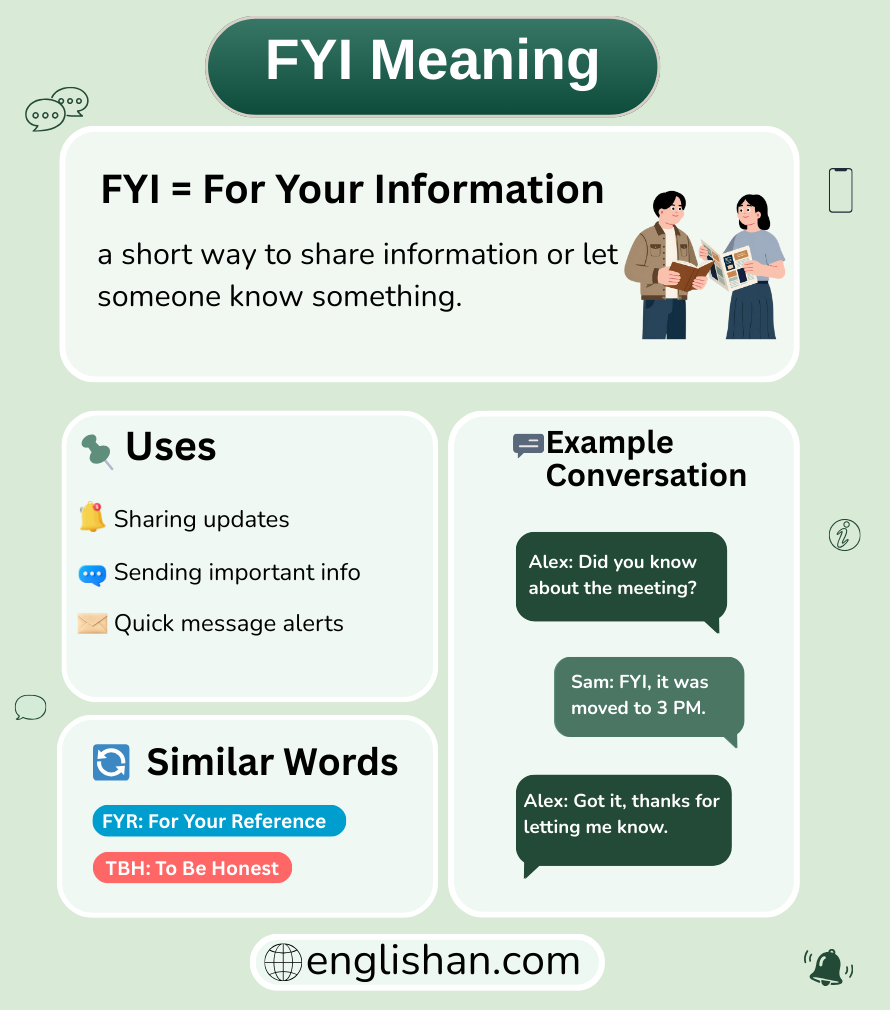
The acronym FYI indicates that the accompanying message is intended solely for knowledge rather than immediate action. It signals to the receiver that they should read the information to stay updated but do not need to perform a task. Senders use it to pass along interesting facts, status updates, or side notes without creating pressure.
What Does FYI Stand For
This abbreviation stands strictly for For Your Information. While it is almost always written as three capital letters, some casual writers use lowercase in informal texts. It functions as a phrase that precedes a statement or an attached document to define the purpose of the communication.
How And Where FYI Is Used
People use this term when forwarding emails or sharing news that does not require a specific response. It acts as a context label to tell the reader they are being kept in the loop purely for awareness. You will often see it in the subject line of emails or at the start of a quick text message.
FYI In Work Messages And Group Chats
In professional settings, this tag helps managers distribute broad announcements or news articles to their teams efficiently. It prevents the receiver from worrying about hidden assignments or implied tasks within the message. In casual group chats, friends use it to share dates, locations, or random trivia without interrupting the flow of conversation.
Does FYI Need A Reply
You generally do not need to reply to a message marked with this tag. Since the sender explicitly labeled it for information only, a silence is usually acceptable and expected. However, a simple “thanks” or “noted” is polite if you want to confirm you saw the update.
FYI Examples And Conversations
These dialogues demonstrate how colleagues and friends use the term to share updates without expecting a full conversation.
Mark: I just forwarded you the client’s feedback on the new design draft.
Sarah: I saw the email pop up. Do you need me to change anything right now?
Mark: No, just FYI so you know what they are thinking for next week.
Jessica: FYI, the gym is closing early tomorrow for maintenance.
Emily: Oh, thanks for telling me. I would have driven all the way there for nothing.
Jessica: No problem, I saw the sign on the door today.
Manager: FYI, the break room refrigerator is being cleaned out on Friday afternoon.
Employee: Noted. I will make sure to take my lunch container home.
Manager: Great, we just don’t want to throw away anyone’s good tupperware.
FYI Origin
This common abbreviation dates back to mid-20th century journalism and corporate memo culture. It became a standard notation in inter-office physical mail to route documents to colleagues who needed to see them but not act on them. The term naturally transitioned into email and digital messaging as a staple of business communication.
FYI Vs For Your Reference
While both terms share information, “For Your Reference” (FYR) specifically implies the content is data or documentation to be saved for later use. FYI is broader and covers news, updates, or verbal statements. You use FYR when sending a file or manual that the person might need to look up in the future.
Common FYI Confusions
A frequent mistake is confusing this informational tag with For Your Action (FYA). If a sender uses FYA, they definitely expect you to do something specific with the message. Mixing these up can lead to missed deadlines or wasted effort on tasks that were not assigned to you.
Other Related Slang Words
These acronyms also help categorize the intent of a message in professional and casual contexts.
- FYA: For Your Action. Used when the recipient must do something.
- FYR: For Your Reference. Used when sending documents to be kept on file.
- NRN: No Reply Needed. Explicitly tells the receiver not to write back.
- JIC: Just In Case. Used when sharing info that might be useful later.
Key Takeaways
We can conclude that this acronym is an essential tool for filtering communication by signaling that a message is purely informational. It saves time by clarifying that no immediate task or lengthy response is expected from the recipient. Whether used in a corporate subject line or a quick text to a friend, the term effectively manages expectations. Always remember to use FYI to keep others informed without adding to their workload.
FAQs
Yes, it is widely accepted in professional environments. It efficiently categorizes the email so the recipient knows no action is required.
Yes, you should usually write it in all capital letters. This makes it stand out clearly in subject lines or short texts.
Yes, people often say the letters F-Y-I aloud. You might say “Just FYI, I’m leaving early” to inform a coworker.
Mostly, it implies no reply is necessary. However, acknowledging important news with a quick “thanks” is never wrong.
No, PS (Postscript) adds a thought after a message. FYI labels the main intent of the information itself.
The term is typically neutral, but it can sound passive-aggressive if used during an argument. If someone uses it to point out a mistake or restate an obvious rule, it may feel condescending. In normal daily use, such as sharing a schedule change, it is perfectly polite and functional.
You May Also Like