

Ever wondered if someone is being polite or just low-key arguing when they drop an IMO in your messages? I have spent time tracking how digital slang shifts to show you that “in my opinion” is a common way to share a thought without sounding like you are bossing someone around.
In a fast-moving group chat, this acronym helps you give a suggestion, but in a direct message or a work email, it can sometimes feel like a quiet way to disagree. Whether you are reading social media comments or texting a classmate, the person you are talking to changes how the message feels.
I have looked into exactly how this phrase works across different apps so you don’t have to guess the vibe. Read on to see clear examples of how it looks in chat and learn when it signals respect versus when it sounds a bit firm.
What Does IMO Mean?
IMO is a common acronym used in digital communication to state a personal belief or preference. Users type these three letters to clarify that a statement is their own view rather than a proven fact. It signals that the following words represent a subjective perspective.
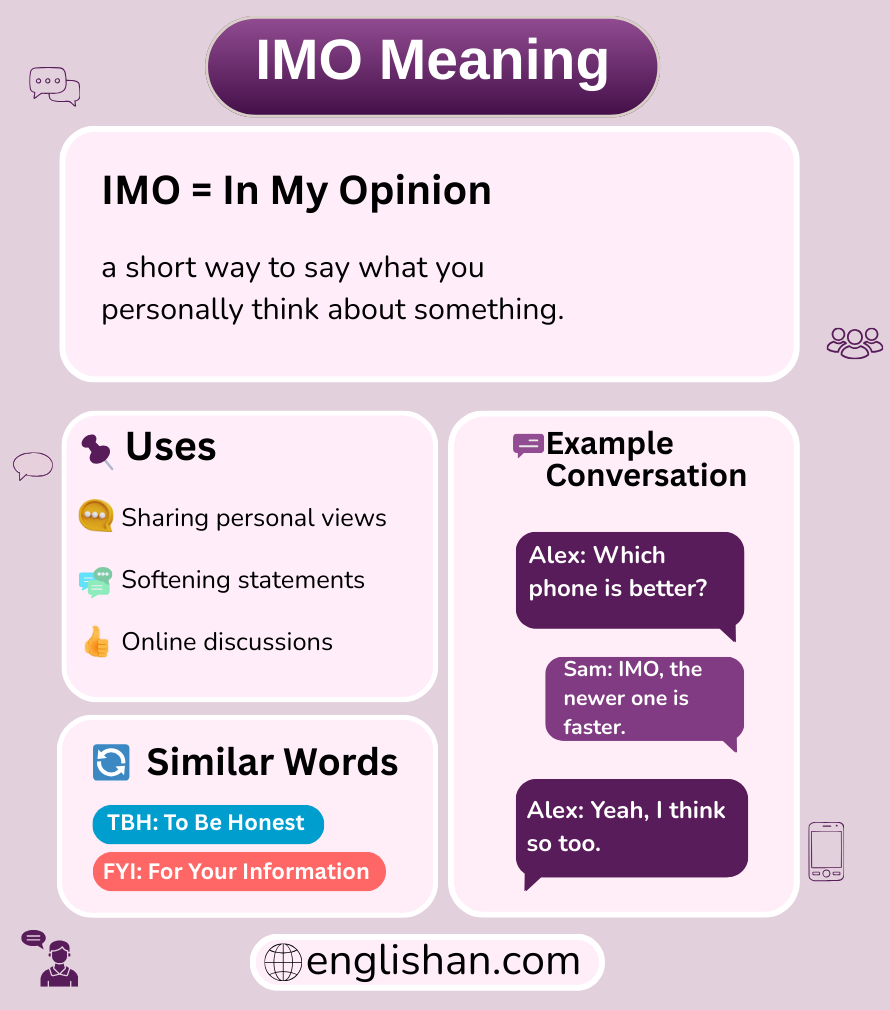
IMO Stands For
This widely used short code stands for the phrase In My Opinion. It functions as a direct substitute for the full sentence, allowing for faster typing in text-based conversations. The abbreviation instantly frames the message as a personal thought rather than a universal truth.
When To Use IMO
People generally use this term when offering advice, debating a topic, or sharing a preference. It fits well in both casual chats with friends and semi-formal discussions where polite disagreement is needed. It helps avoid sounding bossy or arrogant when stating a case.
IMO In Text Messages
In direct messages, this term often appears when friends are discussing plans or tastes, like movie choices. It serves to soften the statement, making sure the other person knows it is just a suggestion. This prevents a simple preference from sounding like a command.
IMO In Comments And Posts
On public feeds, users include this acronym to share hot takes or reviews without inviting heavy argument. It acts as a verbal shield, reminding readers that the post is just one person’s perspective. This is common in debates about sports, politics, or pop culture.
IMO In Group Chats
In busy group conversations, typing this code allows a user to contribute to a decision without dominating the room. It signals that they are casting a vote or offering an idea for the group to consider. It keeps the tone democratic and open.
IMO In Professional Settings
Unlike many slang terms, this acronym is sometimes acceptable in relaxed business chats to offer feedback. Employees use it to share ideas tentatively without overstepping their authority. However, it is still best to avoid it in formal client emails or official reports.
IMO Tone And Politeness
Using this term generally creates a tone of humility and respect for other viewpoints. It indicates that the speaker admits they might be wrong or that others may disagree. This makes discussions smoother and less likely to turn into arguments.
IMO Example Conversations
Here are a few ways friends and colleagues use this short form to share their views.
Jordan: Which color should we paint the living room?
Casey: IMO the blue one looks much better than the grey.
Sam: Do you think we should launch the product on Friday?
Taylor: No, IMO it is too risky to launch before the weekend.
Alex: That movie was honestly the worst one in the series.
Jamie: Really? IMO it had the best ending of them all.
IMO Origin
The term originated in early internet newsgroups and chat rooms during the late 1980s and early 1990s. It developed as a standard way to distinguish facts from arguments in text-heavy discussions. It has remained a staple of online etiquette for decades.
IMO Vs IMHO
While both terms serve the same purpose, IMHO stands for “In My Humble Opinion.” This variation adds an extra layer of politeness or modesty to the statement. IMO is more direct and standard, while IMHO is slightly more deferential.
IMO Key Takeaways
We have explored how this useful acronym helps distinguish facts from beliefs in digital talk. IMO stands for In My Opinion and allows users to share thoughts politely without sounding demanding. It remains a crucial tool for keeping online debates civil and respectful.
IMO FAQs
In texting, IMO stands for In My Opinion and marks a personal belief.
No, it is polite because it clarifies you are not stating a hard fact.
It is okay in casual internal chats, but avoid it in formal documents.
IMHO adds the word “Humble,” making the opinion sound less aggressive.
Rarely; people usually say the full phrase “In my opinion” when speaking.
You May Also Like