Someone shares vacation photos, gets a surprise day off, lands a new job, or posts a dreamy dinner date, and a reply appears underneath: MBN. In most online conversations, it means must be nice, a short reaction to someone else’s good situation.
The phrase sounds easy on the surface, but the tone can shift fast. Sometimes it feels like light teasing. Sometimes it sounds like playful envy. Sometimes it carries sarcasm or a sharper edge, especially when the person saying it feels left out, irritated, or unimpressed.
That is why MBN meaning is not just about the letters themselves. To understand it properly, you need the definition, the mood behind it, and the kind of situation where people use it.
What Does MBN Mean?
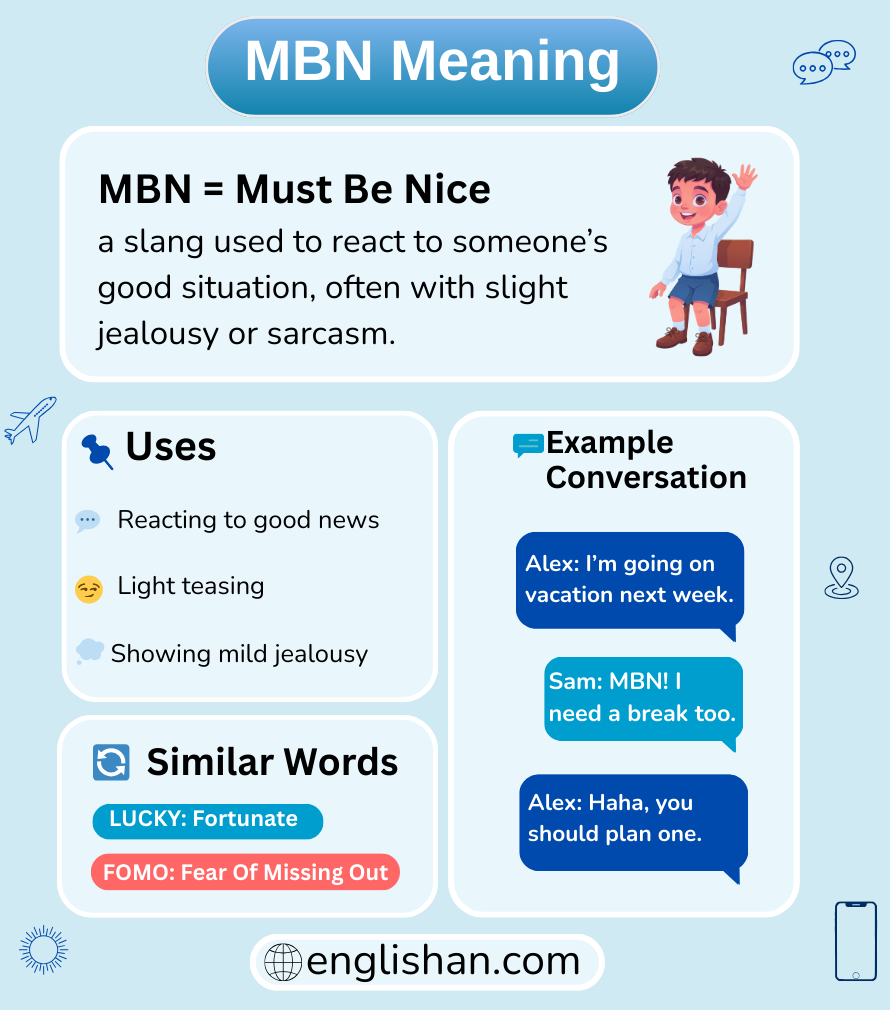
MBN means “must be nice.” People use it when reacting to something that looks good, lucky, comfortable, or desirable.
It often appears after someone shares:
- good news
- a trip or vacation
- extra money or free time
- a nice meal or gift
- a relationship moment
- a lucky break
In plain English, MBN often sounds like:
- lucky you
- wish that were me
- that sounds nice
- must be nice for you
- wow, that would be nice
The exact feeling depends on the moment. The same three letters can sound warm, funny, jealous, dry, or passive-aggressive.
MBN Meaning at a Glance
Basic meaning: MBN stands for must be nice.
Usual tone: playful envy, teasing, admiration, or light sarcasm.
Sharper tone: bitterness, irritation, or passive-aggressive shade.
Most common use: replying to someone else’s good situation, lucky moment, or enviable update.
What Does MBN Stand For?
MBN stands for must be nice. It is a shortened way of reacting to something another person has, gets, or enjoys.
Unlike some slang terms that stay neutral, MBN almost always carries attitude. That attitude may be soft and joking, or it may sound pointed. Context decides which one the reader hears.
MBN Tone and Intent
MBN works because it leaves room for emotion without saying too much. A person can send it as a joke, as a compliment, as a little complaint, or as a subtle jab.
When it sounds playful.
If a friend says they got Friday off and you reply MBN, it often sounds like harmless envy. You are not attacking them. You are just reacting to their good luck.
When it sounds admiring.
Sometimes MBN is close to saying, “That actually sounds great.” In this kind of use, the speaker is not bitter. They are just acknowledging that the situation looks good.
When it sounds sarcastic.
MBN can turn sarcastic when the message feels dry, clipped, or loaded with frustration. If someone is constantly showing off, MBN may come across as a way of calling that out without saying more.
When it sounds passive-aggressive.
This usually happens when the situation involves money, privilege, free time, or comfort, and the person replying feels annoyed rather than amused. In that case, MBN can sound less like a joke and more like resentment.
Is MBN Always Sarcastic?
No. That is one of the biggest misunderstandings around the term.
MBN can be sarcastic, but it is not sarcastic by default. A lot of the time, it is just a short reaction that mixes:
- mild jealousy
- admiration
- teasing
- casual envy
For example, if your friend texts, “My boss let me leave early,” and you answer MBN, that can sound light and normal. But if someone posts a constant stream of brag-heavy content and gets MBN in the comments, the same letters may sound colder.
The safest way to read it is to ask what the relationship feels like and what came just before it.
Can MBN Be Positive?
Yes. MBN can be friendly, funny, and even affectionate.
Among friends, it often works as a soft way of saying:
- I am happy for you
- I wish I had that too
- you are lucky
- that looks amazing
It becomes more positive when the rest of the message supports that tone.
For example:
- MBN lol, that trip looks amazing
- mbn, I need a weekend like that
- MBN, you really won today
Those versions feel much warmer than a flat, standalone MBN.
How MBN Is Used in Texts and Comments
MBN usually appears as a reaction, not as a full conversation starter. People use it after someone shares something that sounds comfortable, attractive, lucky, or out of reach.
Common situations include:
- a friend posting travel photos
- someone talking about getting paid early
- a person showing off a gift
- someone saying they are off work tomorrow
- a post about a happy relationship moment
- an update about getting tickets, upgrades, or special treatment
It works best when the situation is easy to understand without much explanation. MBN is short, so it depends on the context already being obvious.
What MBN Means on Social Media
On social media, MBN often appears in comments, captions, and replies where people react fast.
Under a vacation post, MBN may mean the person is jealous in a playful way. Under a luxury post, it may sound like admiration mixed with distance. Under a relationship post, it may mean, “That looks nice, I wish I had that.”
People also use MBN in self-aware captions. Someone might post a bad or ironic situation and write mbn to mock the idea that their life is going well.
That is why the phrase can move in two directions:
- reacting to someone else’s nice situation
- joking about your own lack of one
How MBN Sounds in Plain English
Sometimes the best way to understand slang is to translate it into normal speech.
Depending on tone, MBN can sound like:
- Lucky you
- Wish that were me
- That sounds nice
- Good for you, I guess
- Must be nice for you
- Wow, okay, nice life
Those are not exact replacements in every situation, but they help show why the tone can shift. Some versions sound friendly. Some sound flat. Some clearly carry annoyance.
How to Reply to MBN
The best reply depends on how the message feels.
If it sounds playful, you can keep it light.
Examples:
- I know, I got lucky
- this never happens, trust me
- your turn next
- I wish you were here too
If it sounds friendly, a humble reply works well.
Examples:
- I needed this, honestly
- it was a nice surprise
- I am not complaining
- it worked out for once
If it sounds sarcastic, you can either soften the moment or leave it alone.
Examples:
- fair enough
- I get you
- yeah, I know how that sounds
- no worries if you are joking
If it sounds rude, you do not have to force a response. Sometimes the best move is to ignore it and move on.
When MBN Sounds Rude or Dismissive
MBN can land badly when someone has worked hard for what they are sharing.
If a person announces:
- a promotion they earned
- exam results they worked for
- a personal milestone
- something meaningful they struggled to achieve
and the reply is just MBN, the reaction may feel minimizing. It can make the achievement sound like pure luck instead of effort.
That is why MBN works better around casual good fortune than serious accomplishment. It usually fits:
- a random upgrade
- a free day
- a lucky moment
- a fun post
It fits less well when the other person is sharing something deeply personal or earned through hard work.
MBN Examples in Everyday Use
Friend: I got upgraded to business class.
Reply: MBN.
This sounds like light envy.
Friend: My manager told me not to come in tomorrow.
Reply: MBN, I need that kind of luck.
This feels playful and friendly.
Post: Weekend in Santorini with no emails and no alarms.
Comment: MBN.
This could sound admiring, jealous, or slightly sarcastic depending on who says it.
Friend: I finally got the scholarship.
Reply: MBN.
This one is riskier. It may sound like the achievement is being brushed off.
MBN vs MB
These two are easy to confuse, but they mean very different things.
MB usually means my bad. It is an apology or admission of fault.
MBN means must be nice. It is a reaction to someone else’s good situation.
That one extra letter changes the whole tone. One takes responsibility. The other comments on luck, comfort, or advantage.
Other Meanings of MBN
Outside casual texting and social media, MBN can have other meanings in specialized settings, such as business, health, or organization names. But in everyday online conversation, MBN almost always means must be nice.
For general readers, the slang meaning is the one that matters most.
Key Takeaway
MBN means must be nice. People use it in texts, comments, captions, and replies when reacting to something that looks lucky, enjoyable, or enviable.
The important part is not only the definition. It is the tone. MBN can sound playful, admiring, jealous, sarcastic, or passive-aggressive depending on the relationship, the situation, and the way it is written. Once you read those signals together, the meaning becomes much easier to understand.
FAQs
Not always. It can sound friendly or playful, but it can also sound rude if the tone is bitter or if it dismisses something the other person worked hard for.
In text, MBN means must be nice. People use it to react to someone else’s good situation, luck, or comfort.
No. It can be sarcastic, but it can also sound playful, admiring, or lightly jealous.
Yes, in some contexts it can. If the tone is warm, it can act like a casual compliment mixed with envy.
On TikTok or Instagram, MBN usually means must be nice in comments or replies to posts that look lucky, attractive, fun, or enviable.
The core meaning stays the same. It still means must be nice. What changes is the tone of the conversation, not the gender of the sender.
You May Also Like