

A teammate stops replying, and someone says they went MIA, leaving you unsure how serious it sounds. The phrase comes from the military and means missing in action, used for a person not accounted for during service, duty, or deployment. Over time, it moved into everyday talk, where it points to someone who suddenly disappears from work, school, or a group chat.
In this article, we explain MIA meaning first, then how people use gone MIA in email, meetings, deadlines, and casual chat. We follow with short message examples so you can read the tone and use it naturally when someone drops out of sight.
What Does MIA Mean?
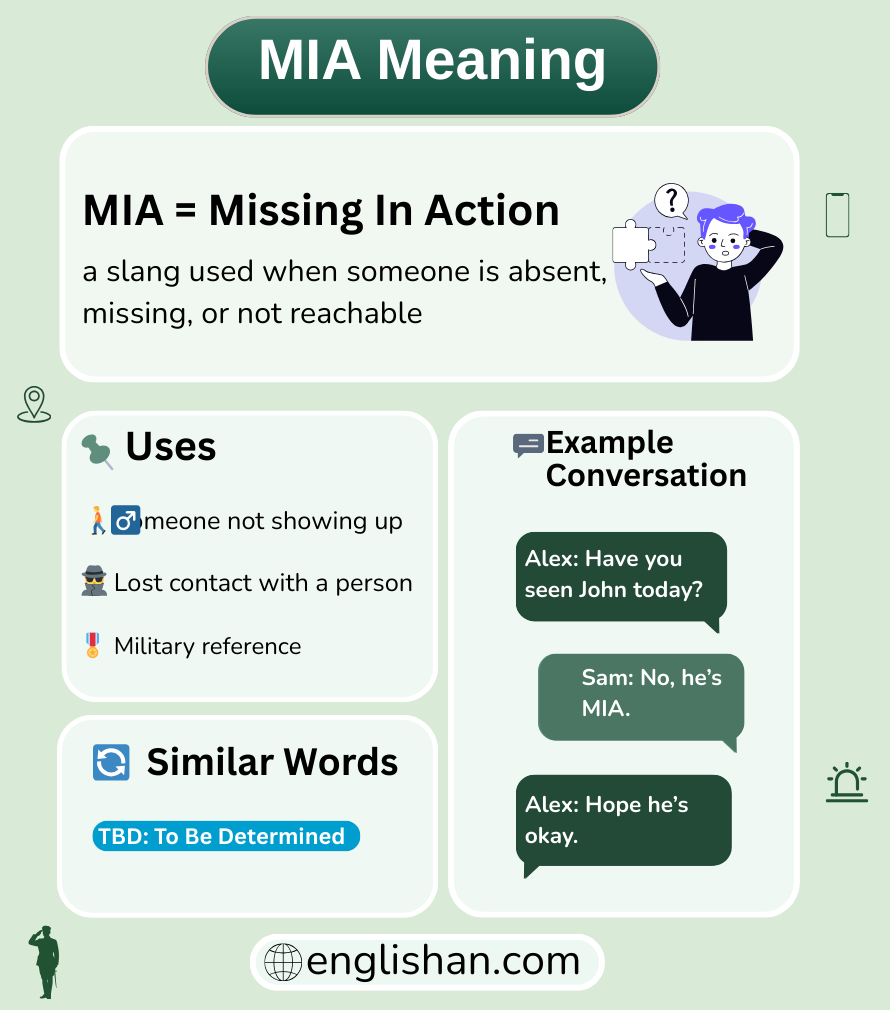
The acronym MIA functions as a description for someone or something that is currently unfindable. In casual conversation, it humorously exaggerates a person’s absence, implying they have vanished without a trace. Writers use it to express confusion or concern when a friend or object cannot be located.
What Does MIA Stand For?
This three-letter abbreviation stands directly for Missing In Action. It grammatically functions as an adjective phrase describing the status of the missing subject. While originally a serious military term, the letters now serve as common shorthand for anyone who is not where they are supposed to be.
How MIA Is Used
People use this term to describe unexplained absences in daily life. It appears when a friend skips a party without calling or when a coworker is away from their desk for hours. It frames the disappearance as a mystery, suggesting the person has dropped off the radar completely.
“Go MIA” Meaning
The phrase “go MIA” functions as a verb meaning to disappear on purpose. It describes the action of withdrawing from social contact or hiding from responsibilities. A student might “go MIA” during finals week to focus on studying without distractions.
MIA Example Conversations
These dialogues illustrate how friends and gamers use the term to track missing people.
Jason: Has anyone heard from Mike this weekend?
Sarah: No, he has been MIA since Friday night.
Jason: I hope he is okay, that isn’t like him.
Emily: Why did we lose that last match?
David: Our healer went MIA halfway through the fight.
Emily: That is so frustrating, I hate when players quit.
Jessica: I haven’t seen you post on Instagram in months.
Mike: Yeah, I decided to go MIA for a while to relax.
Jessica: It is probably good for your mental health.
In Texting
When used in a direct SMS, the sender is usually seeking an explanation. A text saying “You’ve been MIA” puts pressure on the recipient to explain where they have been. It is a gentle confrontation about the lack of contact.
In Group Chats
In group settings, the term is used to call out a member who is reading messages but not typing. Friends might tag the quiet person and say “MIA alert” to force them to participate. It serves as a playful way to re-engage silent members.
In Comments
On platforms like YouTube or TikTok, fans write “MIA” to express nostalgia or demand. If a favorite YouTuber takes a break, the comment section fills with “Why are you MIA?” queries. It shows the audience notices and misses the content.
Origin Of MIA
The term originated as an official military classification used to track soldiers whose status was unknown after a battle. It gained widespread civilian usage after the Vietnam War, eventually drifting into general slang. It transitioned from a solemn legal status to a casual figure of speech during the late 20th century.
Common Confusions With MIA
A frequent mix-up occurs with the similar military acronym AWOL (Absent Without Leave). While both describe absence, MIA implies the person is missing due to unknown reasons, whereas AWOL implies they left on purpose. Additionally, travelers often associate the letters with the Miami International Airport code.
MIA Vs AWOL
The distinction lies in intent and knowledge. AWOL means the person actively chose to leave without permission and is in trouble. MIA means the person is simply gone, and no one knows exactly where they are or why they vanished.
Other Meanings Of MIA
Outside of slang, the letters function as the IATA airport code for Miami, Florida. It also refers to the famous British recording artist known as M.I.A., known for the song “Paper Planes.” Context usually makes it clear if the topic is travel, music, or a missing friend.
Other Related Slang Words
These terms also describe disappearing or leaving.
- Ghost: To cut off communication.
- AFK: Away From Keyboard. Used in gaming.
- Bailing: Leaving plans early.
- Radio Silent: Not replying to messages.
Key Takeaway
We define this acronym as a versatile term standing for “Missing In Action,” originally a military classification for soldiers with unknown whereabouts. In modern slang, it describes anyone who has disappeared from social circles, stopped texting (“ghosting”), or gone silent on social media. It implies a sense of mystery regarding the person’s location, unlike “AWOL,” which implies they left on purpose. Remember that in gaming contexts, it is a strategic warning that an enemy is missing from the map.
FAQs
No, it usually expresses concern or curiosity.
It means an enemy is missing from lane.
Yes, like “my keys are MIA.”
Similar, but MIA can happen without bad intent.
Say the letters M-I-A.
You May Also Like