Sometimes people want a quick way to show excitement, surprise, or approval without typing a full sentence. In chats and gaming talk, pog fills that gap as a reaction word for moments that feel impressive or unexpected. It is used to show excitement or praise when something cool happens, especially during games, streams, or shared clips in group chats and messages.
In this article, we explain POG meaning first, then how people use it across gaming chats, social messages, and casual replies. We also look at how its use changes with tone, followed by short examples that help you know when it fits and when it feels forced.
What Does POG Mean
The slang term POG serves as an enthusiastic expression of excitement or admiration. It functions as an adjective or interjection to describe an impressive accomplishment, a lucky moment, or a sudden victory. Gamers primarily use it to celebrate high-skill plays or unexpected good fortune during a match.
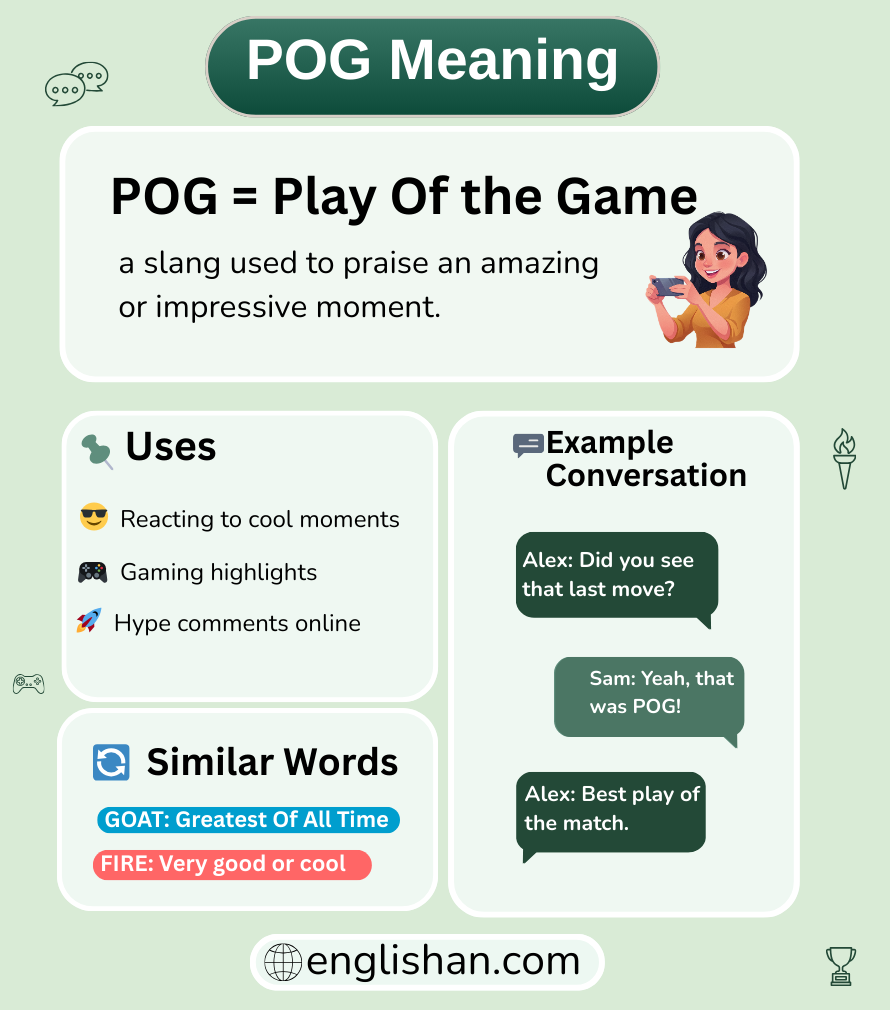
What Does POG Stand For
While often associated with the phrase Play Of the Game, the term originally stems from “PogChamp,” a specific emote name. The acronym “Play Of the Game” is a popular backronym adopted later to fit the context of gaming highlights. Therefore, it technically represents a specific surprised facial expression rather than a grammatical sentence.
How POG Is Used
People type this word in chat rooms and comment sections to generate hype and energy during live events. It acts as a digital cheer when a streamer or player executes a difficult move perfectly. Outside of gaming, younger generations use it in spoken conversation to describe anything cool, such as finding money or getting out of class early.
POG Examples And Conversations
These dialogues illustrate how friends use the word to react to victories and good news.
Jason: I finally defeated the final boss after three hours.
Mike: Pog! I knew you could do it.
Jason: That was the hardest level I have ever played.
Sarah: The teacher just canceled the pop quiz for today.
Emily: Wait, really? That is actually pog.
Sarah: Yes, we have a free period now.
David: Look at this legendary item I just found in a chest.
Jessica: Poggers! That is the rarest sword in the game.
David: I can’t believe my luck.
POG Origin
The term originated from a 2010 video featuring an internet personality playing the 1990s milk cap game known as Pogs. In the video, he made an exaggerated face of excitement, which became known as “PogChamp” or “Pog Champion.” This image was uploaded to streaming sites in 2012, eventually getting shortened to just “Pog” for general use.
Common POG Confusions
A frequent misunderstanding occurs between the slang term and the physical 1990s game pieces made of cardboard circles. While the slang is named after the game, they are completely different topics in conversation. Additionally, some people mistake “PAWG” for POG, which is a crude and unrelated acronym.
How Do You Pronounce POG
You pronounce the word as a single syllable that rhymes with dog or log. You do not spell out the letters P-O-G individually. It sounds exactly like the name of the old cardboard game.
Other Related Slang Words
These terms also express excitement or gaming success.
- Poggers: A variation of POG used to express enthusiasm.
- W: Win. Used to claim a victory.
- Hype: Used to build excitement for an event.
- Clutch: Used to describe a high-pressure success.
Key Takeaways
We define this popular slang term as an exclamation of excitement and celebration, commonly used in gaming communities. It serves as a shorthand to praise an impressive “Play Of the Game” or to react to good news with energy. Originating from a specific reaction image involving the 90s game Pogs, it has evolved into a general adjective for anything cool or awesome. Remember to use POG to hype up your friends when they achieve a victory.
FAQs
No, it is a positive expression of excitement. It is safe for all ages.
In military slang, yes. However, online it means excitement.
It is a specific expression with mouth open wide in surprise.
Yes, but it is mostly used by young gamers.
Yes, they are interchangeable slang terms.
You May Also Like