You watch a short clip where the camera moves as if you are the person there, walking through a door, reacting to news, choosing between two options. The moment feels personal, like you are inside the scene rather than watching from the outside.
Online, POV points to a shared point of view. Creators use it to frame a moment from one angle, often on video or photos, so the viewer steps into a role, joke, or situation without needing explanation.
This guide will teach you exactly how to read POV across clips, captions, and comments and reels. You will see real examples and short exchanges that show it in action. By the end, you will know when it fits and which similar phrases appear in the same moments, so you never miss the joke or the perspective again.
POV Meaning
POV is an acronym used in media to describe the angle or perspective from which a story is told. In digital content, it specifically invites the audience to see things through the eyes of a character. This technique makes the viewer feel like they are personally involved in the action.
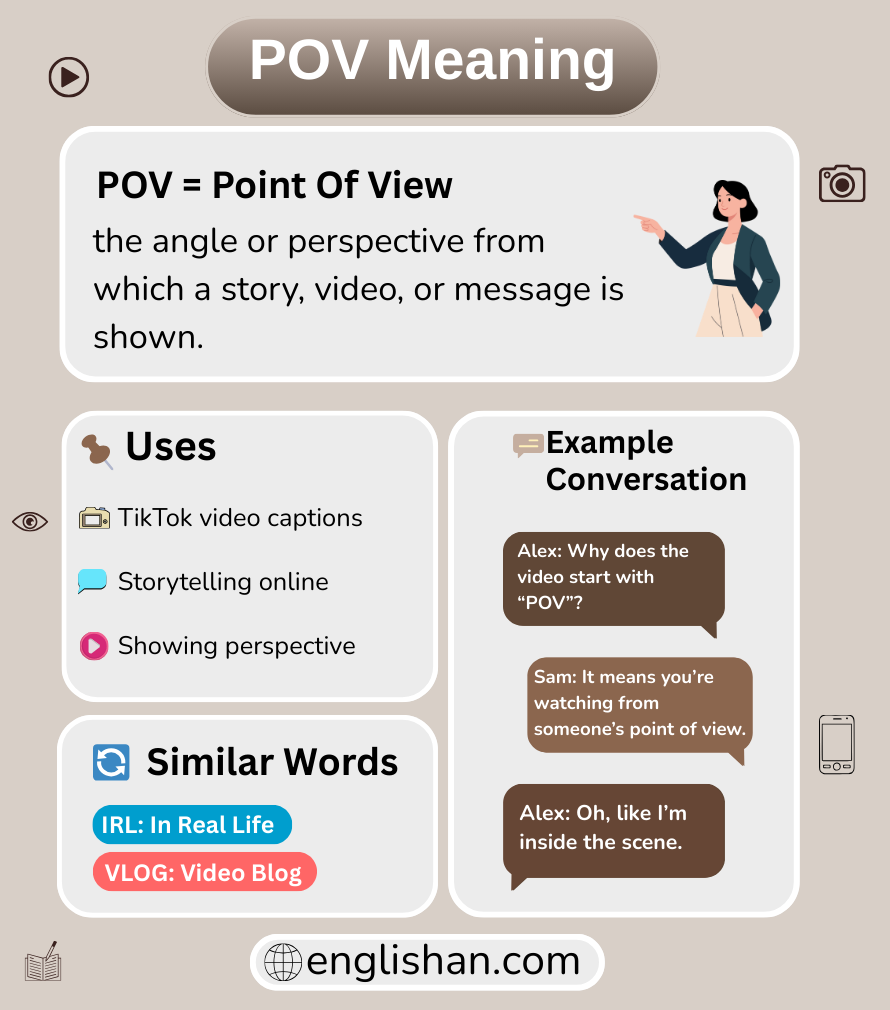
POV Stands For
This common acronym is short for Point of View. It comes from literature and film studies, where it defines who is telling the story. In modern internet slang, it acts as a label for immersive content or specific scenarios.
When To Use POV
People use this tag when they want the viewer to imagine themselves in a specific situation. It works best for relatable moments, funny skits, or roleplay videos where the camera acts as the viewer’s eyes. You place it at the start of a caption to set the scene immediately.
POV In Short Videos
Creators use this format to make the audience the main character of a clip. The camera is held or positioned to mimic human sight, often showing hands or looking down at objects. This style helps users connect deeply with the emotion or joke being presented.
POV In Text Messages
In private chats, friends use it to describe their current situation or physical view. Sending a photo of a messy desk with “POV: finals week” shares a personal glimpse of their reality. It turns a boring update into a shared experience.
POV Example Conversations
Here are a few ways friends use this term to set a scene or describe a moment.
Jordan: Did you see the video I sent you?
Casey: Yes, the POV of the roller coaster drop made me dizzy.
Sam: Send me a picture of the concert.
Taylor: POV you are stuck behind a tall guy and cannot see the stage.
Alex: I feel like I am in a sad music video right now.
Jamie: POV it is raining and you forgot your umbrella.
POV Origin
The term originated in literature and film long before the internet existed to describe narrative perspective. It gained massive popularity as a slang term on video apps around 2019. Now, it serves as a standard format for digital storytelling and memes.
Common POV Confusions
A frequent mistake involves using the tag on a video where the viewer can see the main character. True POV means the camera is the character, so you should not see yourself. Misusing it breaks the illusion of being in the scene.
POV First Person Vs Second Person
Internet POV usually relies on the second person perspective, addressing “you” as the participant. Traditional storytelling often uses the first person “I” to describe thoughts. The video trend blends these by making “you” experience the world directly.
POV Camera View Vs Caption POV
Sometimes the caption sets a scenario while the camera remains impartial. However, a “true” POV aligns the camera angle with the subject’s eye level. Mixing these up is common, but strict definitions require the visual to match the text.
Other Related Slang Words To POV
These terms also describe perspectives and reactions in digital media:
- TFW: Stands for “That Feeling When,” describing a specific relatable emotion.
- MFW: Stands for “My Face When,” showing a physical reaction to an event.
- OOTD: Stands for “Outfit Of The Day,” often filmed in a mirror POV.
- IRL: Stands for “In Real Life,” contrasting digital stories with reality.
POV Key Takeaways
We have explored how this term transforms passive viewing into an active experience. POV stands for Point of View and creates a scenario where the audience sees the world through a specific lens. Whether used correctly to show a first-person perspective or loosely to set a mood, it remains a dominant format in modern storytelling.
POV FAQs
Q1. What does POV mean on TikTok? On TikTok, POV puts the viewer in the scene as the main character.
Q2. Is POV always first-person? Yes, a true POV is strictly first-person, seeing through the character’s eyes.
Q3. Can POV be third person? No, if you can see the character, it is third person, not POV.
Q4. How do you film a POV video? Hold the camera at eye level to simulate human vision.
Q5. Why is POV so popular? It is popular because it makes content feel immersive and highly relatable.
You May Also Like