In marketing meetings or business chat, sm often stands for social media, as in sm strategy, sm manager, or sm campaign. In everyday texting, though, sm usually means so much, as in love you sm or thanks sm. The same two letters can point to very different ideas depending on who is speaking.
In this article, we explain SM meaning first, then how it is used in marketing talk, TikTok captions, Instagram comments, Snapchat messages, and group chat. We cover sm as social media before the casual texting use. Examples follow so the meaning fits naturally within each setting.
What Does SM Mean
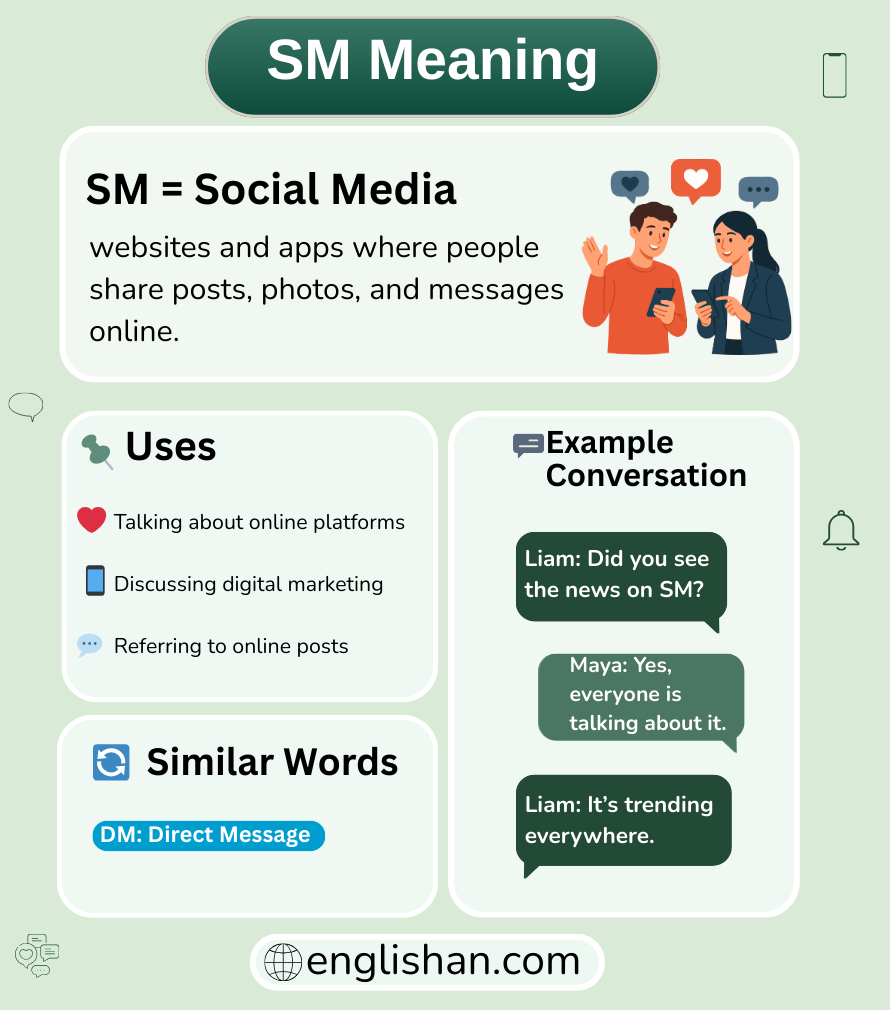
SM is a widely used acronym that refers to Social Media, the digital platforms and apps that allow people to create, share, and exchange content. This term acts as a broad label for the entire online ecosystem where users interact, including sites like Instagram, X (formerly Twitter), and TikTok. It allows speakers to reference their digital life collectively without naming specific applications.
What Does SM Stand For
In the context of technology and communication, these letters stand directly for Social Media. The abbreviation compresses the five-syllable phrase into a quick, two-letter tag that is efficient for typing and speaking. It is the standard shorthand used by influencers, marketers, and everyday users to describe their online presence.
How Is SM Used In Texting And Chat
People use this shorthand in messages to request contact details or discuss online behavior. It frequently appears when moving a conversation from a dating app to a more public platform, often in phrases like “do you have SM?” or “add me on SM.” It signals a desire to connect on a platform that offers more visual context than simple text messaging.
When To Use SM
You should use this acronym when writing short bios, designing business cards, or sending quick texts about internet trends. It is appropriate for casual conversations and digital marketing contexts where brevity is valued. However, avoid using it in formal academic writing or medical contexts where it might be confused with other technical terms.
How To Reply To SM
If someone asks for your SM, the best reply is to provide your username for the specific platform you are most comfortable sharing. If you prefer privacy, you can politely decline by stating you are not active on social apps. Always clarify which specific app they are looking for, as the term covers everything from LinkedIn to Snapchat.
Example Conversations With SM
Here are a few situations showing how people use this term to connect and share online details.
Jordan: I lost all my contacts, can you send me your SM info?
Alex: Sure, I will text you my handle so we can stay connected.
Taylor: I am trying to focus, so I am deleting my SM apps for the week.
Casey: That is a good idea, taking a break from the feed is healthy.
Jamie: Did you see the video he posted on SM yesterday?
Sam: No, I haven’t logged in since this morning.
Origin Of SM
The abbreviation emerged in the mid-2000s alongside the explosion of Facebook and Twitter, where users needed faster ways to type “Social Media.” As these platforms became central to daily communication, the industry and users alike adopted the two-letter code to save time. It transitioned from a marketing buzzword to common vernacular as smartphones made these apps accessible 24/7.
Other Related Slang Words
These terms often appear in conversations about online profiles and connectivity.
- DM (Direct Message): A private message sent between users on a social platform.
- Handle: The unique username (often starting with @) used to identify a person.
- Bio: The short section on a profile where a user describes themselves.
- Feed: The scrolling stream of content updates from friends and followed pages.
Common Confusions With SM
A frequent confusion arises with the lowercase texting slang “sm,” which stands for so much. If a friend texts “I love you sm,” they are using the adverb for intensity, not discussing apps. You must rely on the context of the sentence to determine if they mean “Social Media” (usually capitalized) or “so much” (usually lowercase).
Key Takeaway
This acronym primarily serves as a convenient shorthand for Social Media, encompassing the various apps and platforms we use to connect online. It helps users quickly reference their digital presence or ask for contact details without typing the full phrase. We must be careful to distinguish the capitalized “SM” (Social Media) from the lowercase “sm” (so much) by checking the surrounding context of the message. To communicate clearly, capitalize the letters when discussing your online profiles.
FAQs
In texting, SM typically means Social Media when capitalized, referring to apps like Instagram. If lowercase (sm), it usually means “so much.”
Yes, SM is the standard abbreviation for Social Media, which encompasses social networking sites, video apps, and blogs.
Yes, in medical fields, SM can refer to “symptoms” or “multiple sclerosis” (reversed). In business, it can mean “Service Mark.”
Yes, it is best to capitalize SM when referring to Social Media to avoid confusion with the lowercase slang “sm” (so much).
Yes, hashtags like #SM and #SocialMedia are frequently used by businesses and influencers to categorize marketing content.
You May Also Like