Someone drops a long message or post, and you want the main point without reading every line. Not to skip the conversation, just to get the takeaway quickly and move on.
Online, too long; didn’t read handles that situation. It signals a short summary of a longer explanation, or a reaction to something that feels lengthy. The tone can be practical, neutral, or slightly impatient, depending on how and where it is used.
This guide explains tldr meaning across comments, posts, and replies. By the end, you will know how to spot it instantly, understand what it signals, and use it correctly when shortening information matters.
What Does TLDR Mean?
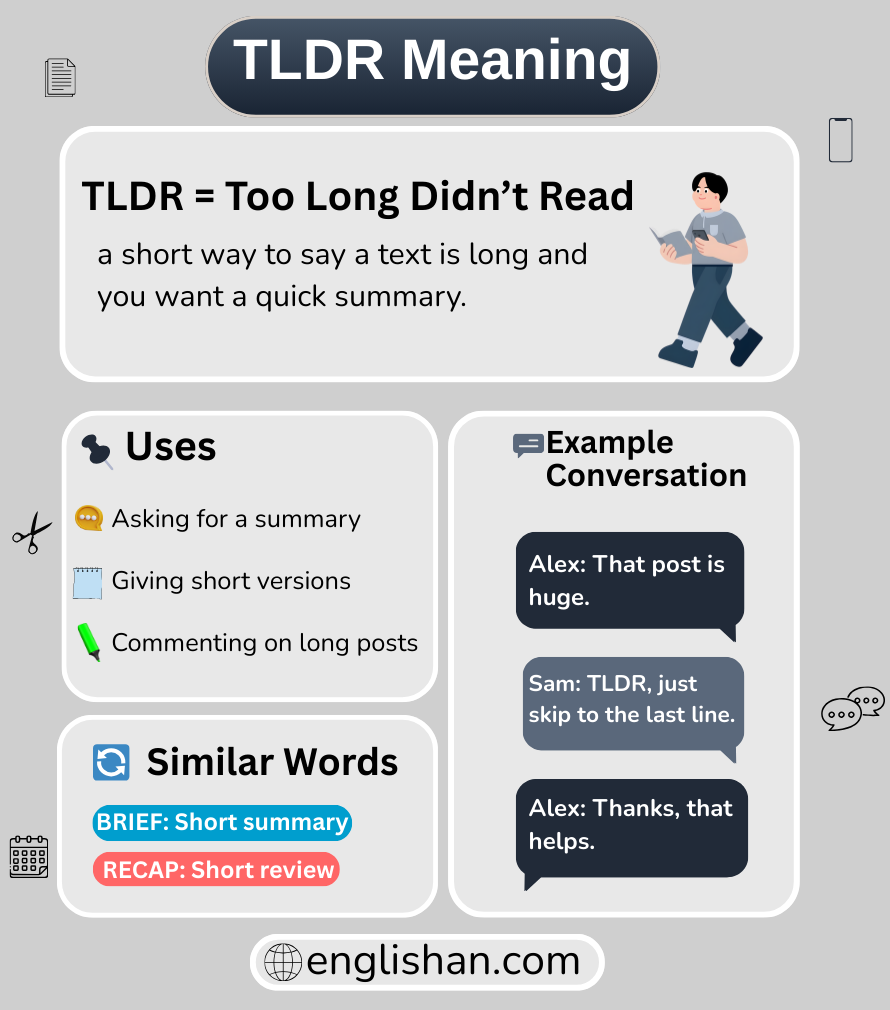
The acronym TLDR indicates that a specific piece of text is too long to read in its entirety. It acts as a label for a short summary provided either before or after a lengthy article. In some contexts, it serves as a dismissive comment to tell an author their post was excessively wordy.
What Does TLDR Stand For
This abbreviation strictly stands for Too Long; Didn’t Read. While the semicolon is often dropped in modern typing, the four letters always represent this specific phrase. It functions as both a noun referring to the synopsis and an adjective describing the length of the content.
How And Where TLDR Is Used
Writers place this term at the start of long emails or forum posts to offer a quick overview for busy readers. It helps the audience decide if they want to invest time in the full story. You will frequently see it in social media comments, corporate updates, and news articles to respect the reader’s time.
TLDR Examples And Conversations
- Email Subject: “Project Update (TLDR included inside)”
- Forum Reply: “Nice story, but I need a TLDR to understand the point.”
- Article Header: “TLDR: The movie is great visually but has a weak plot.”
These conversations show how people use the term to ask for summaries or shorten complex stories.
Kevin: I just forwarded you the documentation for the new software, it is about fifty pages.
Sarah: I see it. Can you send me a TLDR so I know the basics right now?
Kevin: Sure, basically it installs faster but uses more memory.
Jessica: Did you read that massive rant Mike posted on the group chat?
Amanda: No, I scrolled to the bottom looking for a TLDR and didn’t find one.
Jessica: He tends to ramble without getting to the point.
Tom: Here is the full breakdown of why my car broke down on the highway.
David: TLDR, please. We have to order dinner in two minutes.
Tom: Fine, the engine overheated and I need a ride.
TLDR Origin
This slang emerged from online discussion boards in the early 2000s. Users originally typed it to criticize other members for posting massive blocks of text without paragraph breaks. Over time, it evolved from a rude remark into a helpful tool for summarizing content efficiently.
TLDR Vs Too Long; Didn’t Read
The acronym and the full phrase mean exactly the same thing, but the abbreviated form is far more common in digital text. Writing out “Too Long; Didn’t Read” is rare and usually done only for emphasis or explanation. The semicolon in the full phrase is grammatically correct but often omitted in the slang version.
Common TLDR Confusions
A frequent mistake is confusing this summary term with BLUF (Bottom Line Up Front). While both serve to summarize, BLUF is a formal military and business term, whereas TLDR is casual internet slang. Users also sometimes mistake the tone, thinking it is always rude, when it is often just a practical time-saver.
Other Related Slang Words
These terms also relate to reading, writing, and text volume.
- BLUF: Bottom Line Up Front. A professional acronym for putting the conclusion first.
- Wall of Text: A large block of writing with no spaces that is difficult to read.
- ICYMI: In Case You Missed It. Used to highlight past content.
- TS;DR: Too Short; Didn’t Read. A rare joke response to very short posts.
Key Takeaways
TLDR started as a blunt forum remark, but today it plays a useful role in everyday communication. People use it to sum things up quickly and respect the reader’s time, especially when messages or content run long. It helps others catch the main point without digging through everything. When used well, TLDR adds value by clarifying your own message, not brushing off someone else’s effort.
FAQs
You should place it at the very top or the very bottom of your text. Putting it at the top is generally more helpful because it saves the reader time immediately.
Yes, in internal or slightly informal emails, it is acceptable. It shows you value your colleague’s time by offering a quick summary, though some prefer the formal acronym BLUF.
Ideally, it should be one to two sentences long. If the summary itself becomes a paragraph, it defeats the purpose of providing a quick snapshot of the content.
Not necessarily, as it often means you are prioritizing time. However, using it to dismiss a friend’s personal story can appear insensitive or lazy depending on the situation.
Yes, people say the letters out loud to ask for the short version. You might say “give me the TLDR” when someone is telling a rambling story.
The tone depends entirely on how you use it. When an author uses it to provide a summary, it is polite and helpful. If a commenter types it alone on someone’s hard work, it acts as a rude way to say the content was boring or poorly formatted.
You May Also Like