A conversation is ending for now, but not for good. Someone has to step away, get back to work, charge their phone, or finish something offline, so they use a short sign off instead of leaving the chat hanging. If you’ve ever wondered about TTY meaning in this context, in that setting, TTY usually means talk to you.
The phrase can confuse people because the same letters also appear in phone settings and accessibility talk. That is why TTY meaning in text depends heavily on context. In a chat, it points to a future conversation. In a technical setting, it points to something very different.
For most readers searching TTY meaning in text, the chat meaning is the one that matters first. Once you understand how it works in messages, how it compares with TTYL, and why it can also show up on a phone, the term becomes much easier to read and use naturally.
What Does TTY Mean in Text?
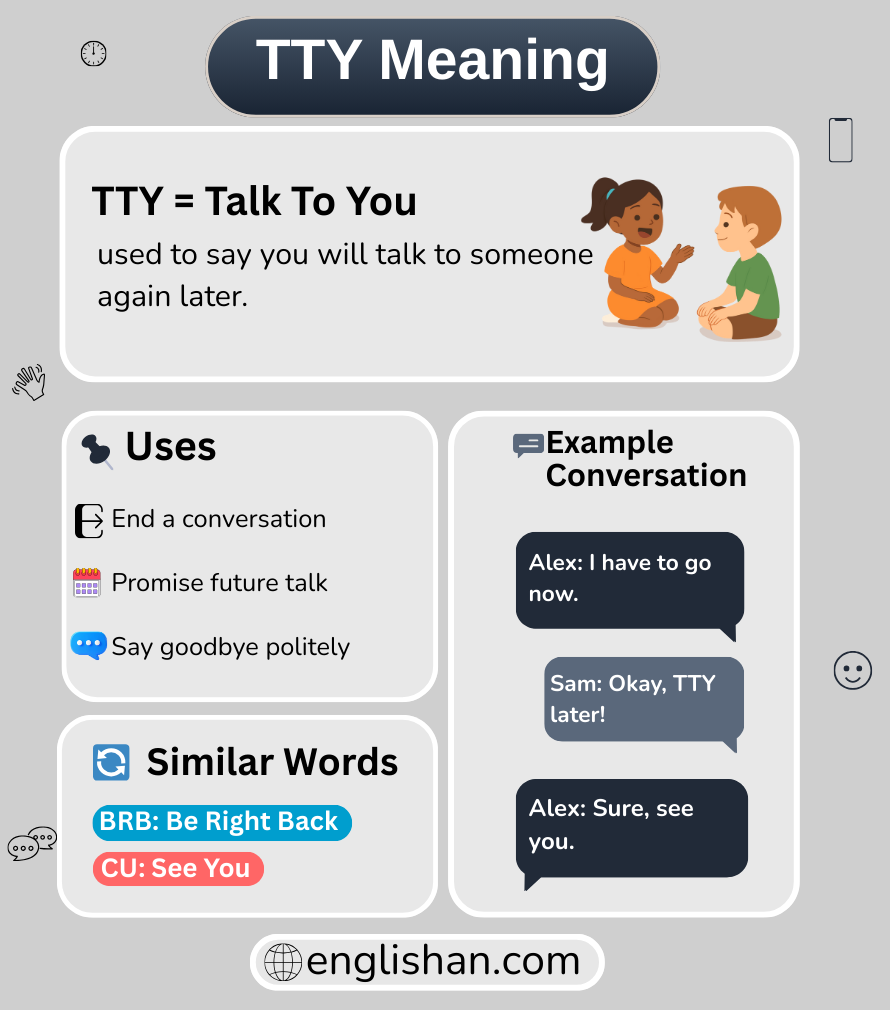
In text messages, TTY usually means talk to you. It is a short way to end a conversation while showing that you expect to speak again later.
People often use it when they:
- need to leave for a while
- want to end the chat politely
- plan to continue the conversation later
- do not want the silence to feel awkward
As a text sign off, TTY often carries the sense of:
- talk soon
- I will message you later
- we can talk again later
- I have to go for now
So when people ask what TTY means in text, the answer is usually about tone as much as wording. It is not a hard goodbye. It is more like a pause.
TTY Meaning at a Glance
In text messages: TTY means talk to you.
In texting: it works as a short, casual sign off.
On a phone: TTY usually means teletypewriter, not chat slang.
In modern messaging: people still understand it, but TTYL and fuller phrases like talk soon are often more common.
What Does TTY Stand For?
In texting, TTY stands for talk to you. That is the social meaning people usually mean when they use it in messages, DMs, and chat apps.
Outside texting, the same letters can also stand for teletypewriter. That use belongs to phone accessibility and technical communication, not casual conversation. This is why TTY in text messages and TTY on a phone are not the same thing, even though the letters match.
TTY in Text vs TTY on a Phone
This is the most important distinction to understand.
In text, TTY means talk to you.
It is shorthand used near the end of a conversation.
On a phone, TTY means teletypewriter.
That refers to an accessibility feature or communication system linked to text-based phone use.
So if someone writes:
- tty later
- busy rn, tty tonight
- heading out, tty tomorrow
they usually mean the chat version.
But if you see:
- TTY mode
- TTY settings
- turn TTY off
then the meaning is technical, not social.
For TTY meaning in text, context does most of the work. A message thread points one way. A settings menu points the other way.
How TTY Is Used in Messages
In messages, TTY is usually a conversation closer. It comes near the end of a chat when someone wants to leave without sounding cold.
You might see it in lines like:
- tty later
- tty soon
- tty after work
- tty tomorrow
- tty after class
As a chat sign off, it often lands better when there is a short reason before it.
Examples:
- I have to get back to work, tty later
- my battery is dying, tty tonight
- heading into class, tty after
- I need to finish this, tty tomorrow
This is why TTY in texting feels casual rather than dramatic. It signals that the conversation is stopping for now, not that the relationship or mood has shifted.
Where TTY Feels Natural in Chat
TTY in chat works best when:
- the conversation is casual
- both people already use shorthand
- the relationship is comfortable
- the pause is temporary
- the tone is relaxed
It feels most natural in:
- text messages
- private chats
- casual DMs
- group chats with friends
- light online conversations
For TTY meaning in messages, tone matters a lot. In a normal back-and-forth chat, the phrase feels quick and easy. In a serious conversation, it can feel too short unless there is more wording around it.
TTY vs TTYL
TTYL means talk to you later, and it is the more familiar version for many readers.
TTY is shorter and more clipped. TTYL feels fuller, more established, and a little easier to recognize right away.
Compare these:
- gotta go, tty
- gotta go, ttyl
Both make sense. But TTYL usually sounds more complete. That is one reason it often feels more current in everyday messaging.
If you are looking at TTY meaning in text from a traditional SEO or user-intent angle, this comparison matters because many readers already know TTYL and are trying to understand how close TTY is to it. The answer is that the meanings are closely related, but TTYL is the more common and more obvious sign off.
Is TTY Still Used?
Yes, but it does not feel as common as TTYL or full phrases like talk soon.
TTY still works in casual messaging, especially among people who already use a lot of shorthand. But in modern chat, many people lean more toward fuller sign offs because they sound smoother and more natural.
That does not make TTY in text wrong or outdated beyond use. It just means it can feel a bit older or more clipped than some nearby options. If someone writes it today, most readers will still understand it. They just may not use it as often themselves.
When TTY Sounds Natural and When It Feels Awkward
This kind of short sign off sounds natural when:
- the chat is light
- the tone is already friendly
- both people message casually
- the pause is brief
- the relationship is already warm
It can feel awkward when:
- the other person is upset
- the conversation is serious
- the relationship is new
- the message is too short for the moment
- the context is professional
For example, replying with only tty after a long emotional message can feel abrupt. In that kind of situation, a fuller line usually lands better.
Examples:
- I have to go right now, but we will talk later
- I will message you tonight
- talk soon
- let me get back to you later
So when readers think about TTY meaning in text, they should also think about fit. The letters may be correct, but the tone still has to suit the moment.
Better Modern Alternatives to TTY
If you want the same idea with a more natural modern tone, these alternatives often work better:
TTYL
This is the closest match. It is more familiar and feels a little fuller.
Talk soon
This sounds warmer and less shorthand-heavy.
Catch you later
This feels relaxed and casual.
Message you later
This is direct and useful when you want to sound slightly more natural than pure acronym slang.
I will text you later
This feels personal and less clipped.
As a message closer, TTY is still usable. But if the goal is smoother modern tone, one of these alternatives often lands better.
Related Sign Offs Like TTYT
You may also see related forms such as:
TTYL = talk to you later
TTYT = talk to you tomorrow
TTYN = talk to you never
Of these, TTYL is by far the most common and most useful. TTYT appears sometimes when someone wants to be more specific about timing. TTYN is usually playful or joking and is far less common.
This section matters because readers searching TTY in texting are often trying to understand the whole shorthand family around it, not only one term by itself.
TTY Examples in Conversation
Here are a few natural examples of how TTY in text messages actually appears:
A: I have to jump into a meeting.
B: okay, tty later.
A: my phone is at one percent
B: no worries, tty tonight
A: heading out now
B: alright, tty tomorrow
A: I need to finish this assignment
B: got it, tty after class
These examples work because the phrase fits the rhythm of the conversation. It sounds like stepping away for now, not pushing someone away.
Is TTY Rude?
No, TTY is not rude by itself.
It usually sounds neutral or friendly. The issue is not the letters. The issue is whether the message feels too brief for the situation.
In a casual conversation, tty later sounds normal. In a serious conversation, writing only tty can feel too short.
That is why TTY meaning in messages also depends on tone. If the chat is light, the phrase works. If the conversation is emotional, fuller wording often feels more considerate.
Can You Use TTY at Work?
It is usually better to avoid it in professional settings.
In a very casual team chat, people may understand it, but in email, client communication, or workplace messages with people you do not know well, fuller wording sounds more polished.
Better work-friendly options include:
- talk soon
- I will follow up later
- I will message you this afternoon
- speak soon
- I will get back to you later
So while TTY in text works well in casual chat, it is not the best fit for formal or professional communication.
TTY Mode and the Technical Meaning
If you are reading about a phone setting, accessibility option, or telecom feature, TTY is probably not slang at all.
In that setting, it refers to teletypewriter, which is part of accessibility communication. This meaning has nothing to do with ending a chat or using text shorthand.
This is where many readers get confused. One person sees TTY in a message and reads it as talk to you. Another sees TTY mode on a phone and needs the technical meaning instead. That is why TTY meaning in text and TTY mode meaning should never be treated as the same thing.
Key Takeaway
For TTY meaning in text, the main answer is talk to you. It is a short, casual sign off people use when they need to step away but expect to reconnect later.
The phrase can be confusing because TTY also means teletypewriter in phone and accessibility settings. In chat, though, the slang meaning is usually the one that matters. The easiest way to understand TTY in text messages is to check the setting first. If it appears in a conversation, it usually means talk to you. If it appears in a phone menu, it usually points to the technical meaning instead.
FAQs
In text, TTY usually means talk to you. It is a short sign off that suggests the conversation will continue later.
In texting, TTY stands for talk to you.
On a phone, TTY usually means teletypewriter, which is part of an accessibility feature, not casual texting slang.
Not exactly. TTYL means talk to you later and is more common. TTY is shorter and means talk to you.
Yes, but it is less common than TTYL and fuller phrases like talk soon.
You can, but it is usually better to use fuller phrases in email. Talk soon or I will follow up later often sounds better.
TTYT usually means talk to you tomorrow.
You May Also Like