Someone finishes a chat and needs to step away, but the conversation is not over. A short sign off keeps things friendly and lets the other person know there is no awkward ending, just a pause.
In everyday messages, TTYL is used to signal that the talk will continue later. It comes from talk to you later and feels relaxed, polite, and casual. People use it in texts, chats, and comments when leaving briefly without closing the door.
Here, we will explain ttyl meaning and how it is used in real conversations, including tone, timing, examples, and similar phrases. By the end, you will know exactly when to use it, how it sounds to others, and how to end chats smoothly while keeping connections warm.
What Does TTYL Mean?
The acronym TTYL functions as a standard sign-off to indicate that a conversation is ending for the moment. It serves as a polite goodbye that implies the dialogue will resume at a future time. Senders use it to close a digital exchange without ending the relationship or appearing abrupt.
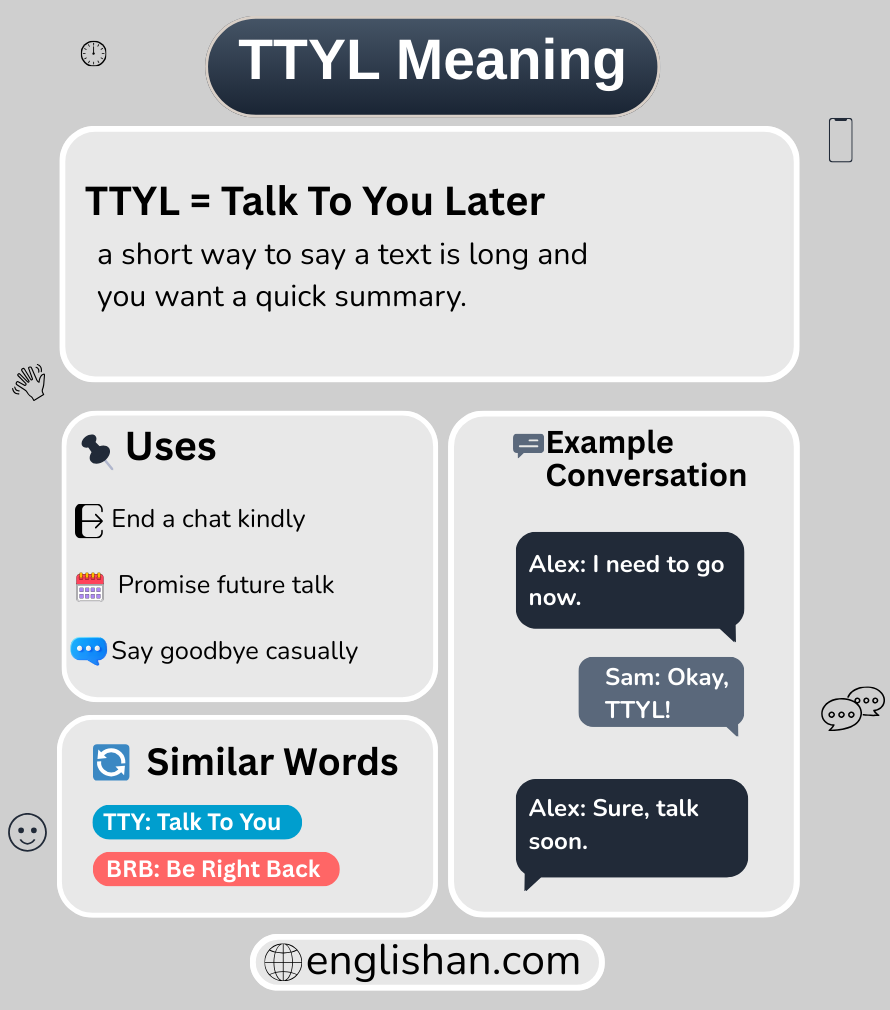
What Does TTYL Stand For
This four-letter abbreviation stands strictly for the phrase Talk To You Later. While punctuation is rarely used in instant messaging, the letters always represent these four specific words in that exact order. It grammatically functions as an interjection or a closing statement at the end of a message.
How And When TTYL Is Used
People type this term in text messages and direct messages when they need to leave a chat to do something else. It is appropriate for friends, family, and casual acquaintances who communicate frequently. You will often see it used when someone is stepping away from their computer or putting their phone down for the night.
TTYL Examples And Conversations
These dialogues illustrate how friends and colleagues use the term to pause conversations politely.
Jason: I really have to get going, my shift is starting in five minutes.
Mike: No worries, good luck with work today.
Jason: Thanks, TTYL.
Sarah: My battery is at 2% so my phone might die.
Emily: Okay, text me when you get home and charge it.
Sarah: Will do, TTYL.
David: Mom is calling me for dinner, I have to go.
Jessica: Go eat, we can finish this level later.
David: TTYL.
How To Reply To TTYL
You generally respond to this sign-off with a simple goodbye or agreement. Common replies include “bye,” “later,” or “see ya.” If the conversation was important, you might confirm a specific time to reconnect, such as “talk tomorrow.”
TTYL Origin
This abbreviation originated in the 1990s internet chatrooms and instant messaging services like AIM and ICQ. Users adopted it as a quick way to say goodbye without typing out the full phrase during fast-paced text discussions. It became a permanent fixture of digital vocabulary alongside terms like LOL and BRB.
TTYL Vs Talk To You Later
The full phrase “talk to you later” carries a sincere and formal tone suitable for spoken conversation or professional emails. The acronym is strictly for casual texting where speed is the priority. Both convey the exact same message, but the spelled-out version feels more personal.
Common TTYL Confusions
A simplified version, TTL, is sometimes confused with this slang, but in computing, TTL stands for “Time To Live.” Users might also confuse TTYL with TTY (Talk To You), which is less common and can also refer to accessibility devices. Always look at the context to see if it is a goodbye or a technical term.
Other Related Slang Words
These acronyms also serve as ways to say goodbye or pause a conversation.
- BRB: Be Right Back. Used when the break is very short.
- GTG: Got To Go. Used when leaving immediately due to obligation.
- CYA: See Ya. A casual phonetic spelling of goodbye.
- L8R: Later. A shorter way to say “see you later.”
Key Takeaways
We identify this acronym as the universal digital shorthand for “Talk To You Later,” used to end casual conversations politely. It signals that the user must leave the chat but intends to continue the connection in the future. While it originated in early internet culture, it remains a staple for courteous sign-offs in modern texting. Remember to use TTYL only with friends and family, as it lacks the formality required for professional correspondence.
FAQs
It is an older term from the 90s, but it remains widely understood and used today.
No, it is too informal. Use “Best regards” or “Speak soon” instead.
No, “talk” in this context usually means text or message again, not necessarily a phone call.
You can use TTYL or ttyl. Lowercase is seen as more casual and relaxed.
Most people say the letters T-T-Y-L. Some simply say the full phrase “talk to you later.”
The term is widely considered polite and standard in casual communication. It assures the other person that you intend to speak with them again, rather than just disappearing. However, using it to cut someone off in the middle of a serious emotional discussion can seem dismissive.
You May Also Like