Accident and incident are often confused because the two words overlap in meaning but are not used in the same way. An accident usually means an unplanned event that caused injury, damage, or loss. An incident is a broader word for an event or occurrence that may or may not involve harm.
The distinction matters in safety reports, news coverage, and everyday communication. A highway crash is usually called an accident because it caused damage or injury. A suspicious login attempt may be described as a security incident because it is an event that needs review.
This article explains the difference between accident and incident and how to use each word correctly.
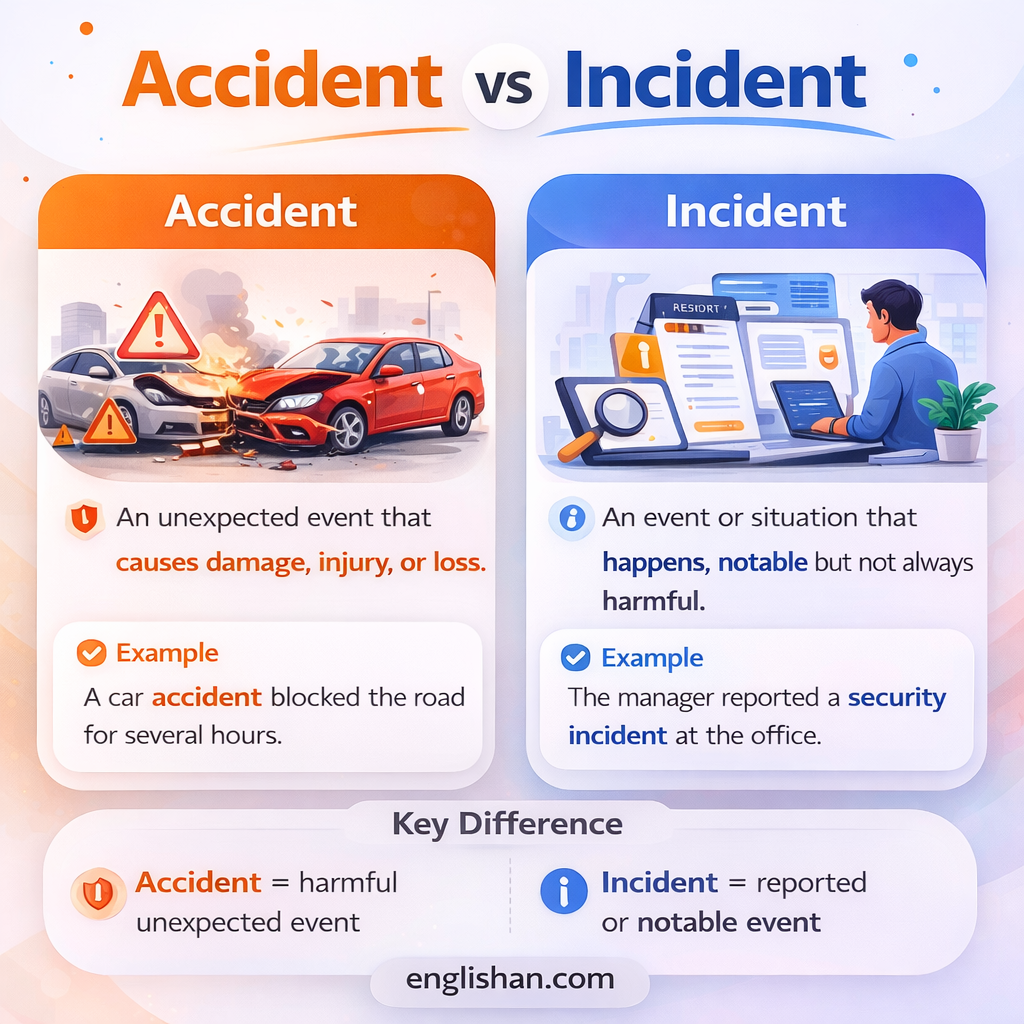
People sometimes use accident and incident as if they mean the same thing, but they usually describe events in different ways. An accident normally refers to an unplanned event that caused injury, damage, or loss. An incident is a broader word for an event or occurrence that is unusual, important, or worth reporting, whether harm happened or not.
The distinction becomes especially important in workplace reports, safety discussions, news coverage, and everyday speech. A crash on the highway is usually described as an accident because it caused damage or injury. A company might describe a suspicious login attempt as a security incident because it is an event that requires attention or review.
This article explains what each word means, how they differ, when each one fits best, and how to choose the right term in real situations.
Accident vs Incident: Quick Answer
Here is the quickest way to tell them apart:
| Word | Main Meaning | Harm Required? | Common Context | Example |
|---|---|---|---|---|
| Accident | unplanned harmful event | usually yes | traffic, injury, property damage | The crash was treated as a road accident. |
| Incident | notable or reportable event | no | safety, security, workplace, reports | The company reported a security incident. |
If the focus is on unintended harm or damage, accident is usually the better choice.
If the focus is on a notable event that needs attention or documentation, incident is usually the better choice.
What Does Accident Mean?
Accident is a noun that refers to an unexpected event that causes injury, damage, or loss. The word usually implies that the event was not intentional.
Common Contexts for Accident
The word often appears in situations involving harm or physical damage, such as:
- traffic crashes
- workplace injuries
- equipment failures
- household mishaps
- industrial disasters
Examples of Accident
- The highway was closed after a serious traffic accident.
- The warehouse accident damaged several storage units.
- A laboratory accident caused burns and equipment damage.
- The fall was recorded as a workplace accident because the worker needed medical care.
In everyday English, accident usually highlights that something went wrong and caused harm.
What Does Incident Mean?
Incident is also a noun, but it has a broader meaning. An incident is an event or occurrence that is unusual, disruptive, or important enough to be noticed or reported.
Unlike accident, the word incident does not require injury or damage.
Common Contexts for Incident
The word often appears in formal or organizational language, such as:
- security incident
- workplace incident
- IT incident
- customer service incident
- diplomatic incident
Examples of Incident
- The bank reported a cybersecurity incident after unusual login activity.
- The office recorded an IT incident affecting email access.
- There was a minor incident during the meeting, but no one was hurt.
- Police responded to an incident outside the stadium.
In many professional settings, incident functions as a neutral label for events that need investigation or documentation.
Key Difference Between Accident and Incident
The main difference is scope and emphasis.
- Accident highlights an unplanned event that caused harm or damage.
- Incident highlights an event that is notable, disruptive, or worth reporting, whether harm occurred or not.
Because incident is broader, an accident can often be described as an incident, but the reverse is not always true.
For example:
- A forklift collision that injures a worker is clearly an accident. In a safety log, it may also appear as a workplace incident.
- A suspicious badge access attempt may be recorded as a security incident, but it would not normally be called an accident.
So the two words can overlap, but they frame the event differently.
When to Use Accident
Use accident when the event was unplanned and the focus is on damage, injury, or harmful consequences.
Situations Where “Accident” Fits Best
- car crashes and road collisions
- injuries at work or home
- property damage
- unintended harmful mistakes
Examples
- A construction accident injured two workers.
- The chemical spill was treated as a lab accident because it caused burns.
- The airline narrowly avoided a serious accident during landing.
In these cases, the emphasis is on harm or damage.
When to Use Incident
Use incident when the event is notable, disruptive, or under review, especially in reports or formal descriptions.
Situations Where “Incident” Fits Best
- security or safety reports
- technical problems
- customer complaints
- workplace investigations
- public disturbances
Examples
- The airline is reviewing an incident during the flight.
- The company logged a security incident involving suspicious access.
- The warehouse incident disrupted deliveries for several hours.
In these cases, the emphasis is on documenting or reviewing the event.
Why Incident Often Sounds More Neutral
Organizations often choose the word incident because it sounds broader and less emotionally charged than accident.
For example, official reports may use phrases such as:
- security incident
- safety incident
- workplace incident
- technical incident
This wording allows investigators to describe an event without immediately assigning blame or defining the exact cause.
How to Remember the Difference
Use this simple rule:
Accident = harm or damage happened
Incident = something happened and it needs attention
If the main focus is injury, damage, or loss, the word accident usually fits best.
If the main focus is an event that must be reported or reviewed, incident is often the better choice.
Accident vs Incident in Sentences
Sentences With Accident
- He was taken to the hospital after a road accident.
- The factory accident led to new safety procedures.
- The broken equipment was the result of a maintenance accident.
Sentences With Incident
- The company reported a security incident affecting customer accounts.
- There was a minor incident in the parking area, but no injuries occurred.
- Management is investigating the incident that disrupted production.
Common Mistakes When Using Accident and Incident
Using Accident for Every Event
Not every unusual event is an accident. A disruption, complaint, or security problem may be better described as an incident.
Thinking Incident Means No Harm
An incident may involve harm. The word simply describes an event that requires attention or reporting.
Treating the Words as Exact Synonyms
The words can overlap, but they highlight different aspects of an event. Accident emphasizes unintended harm, while incident emphasizes the event itself.
Summary
Accident and incident are related but not identical. Accident usually describes an unexpected event that caused injury, damage, or loss. Incident is a broader word for an event that is unusual, disruptive, or worth reporting, whether harm happened or not. Once you connect accident with unintended harm and incident with notable or reportable events, choosing the correct word becomes much easier.
FAQs
An accident refers to an unplanned event that causes injury, damage, or loss, such as a car crash or a fall. An incident is a broader word for an event that is unusual, important, or worth reporting.
Yes. An accident can also be described as an incident, especially in formal or workplace reporting.
No. An incident may involve harm, but it does not have to. The word simply describes an event that requires attention or documentation.
Use accident when the event was unplanned and the main point is injury, damage, or harmful consequences.
You May Also Like