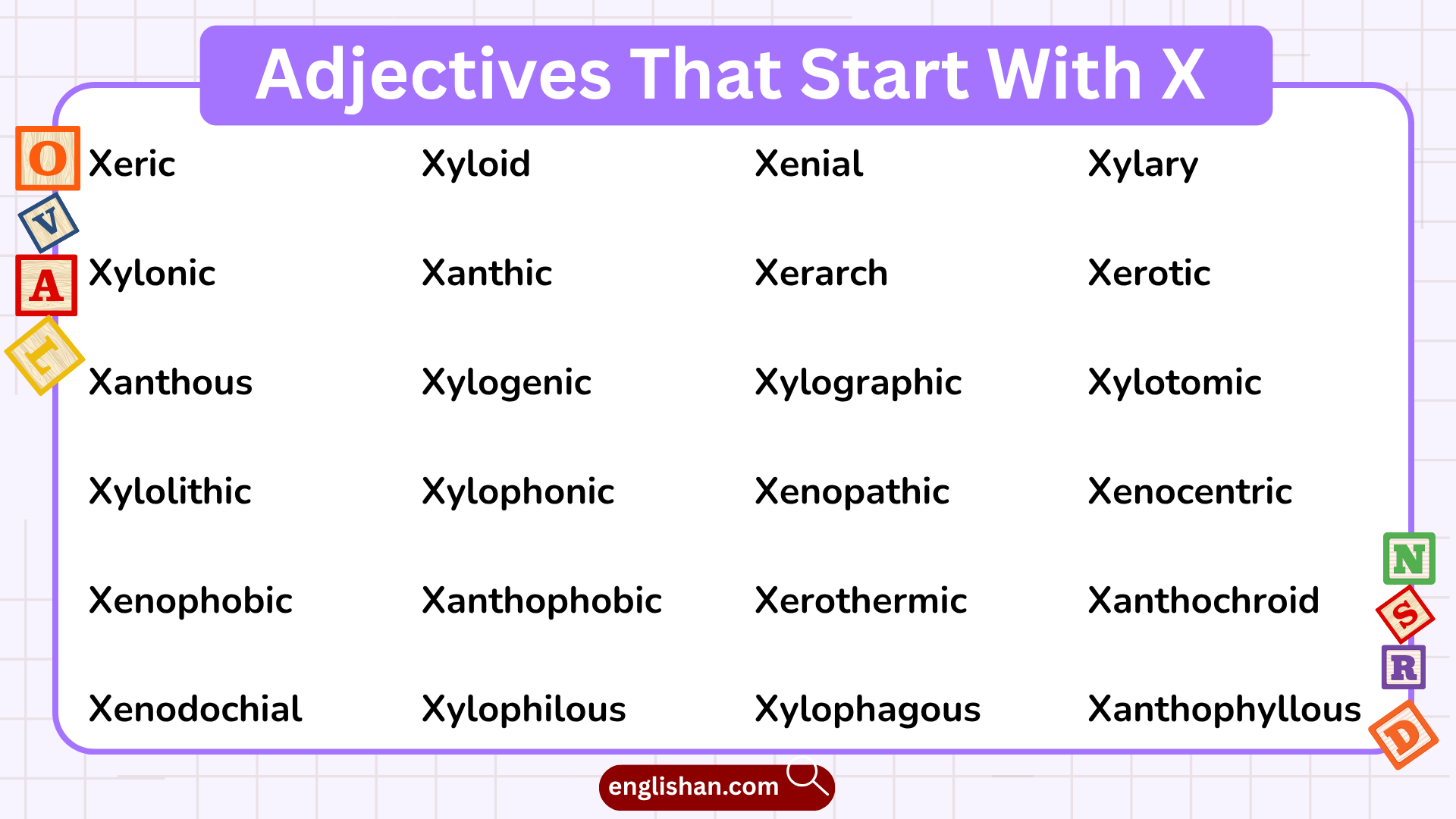
Many learners focus on familiar X adjectives like xenial or xeric, overlooking less common words that add precision and variety. Adjectives such as xylophilous, xanthous, xerothermic, and xenogenic describe people, objects, conditions, and emotions with detail. Using these words helps learners express subtle meaning and tone, making writing and speaking more accurate and engaging.
In this post, we present a curated list of adjectives that start with X, complete with meanings and example sentences. These are ideal for students and English learners aiming to expand their vocabulary and descriptive skills.
Adjectives That Start With X: Quick Chart
| Xenial | Xyloid | Xenophobic |
| Xenodochial | Xanthous | Xanthophobic |
| Xylonic | Xerothermic | Xenopathic |
| Xylary | Xylographic | Xenocentric |
| Xylophilous | Xylogenic | Xylophonic |
| Xylophagous | Xylolithic | |
| Xylotomic | Xerarch | |
| Xanthic | Xeric | |
| Xerotic | Xanthochroid | |
| Xanthophyllous |
Featured Image Metadata – only featured image
- Alt text: List of English adjectives That Start with X with meanings and examples
- Title: Adjectives That Start With X
- Caption: A comprehensive collection of adjectives That Start with X for learners
- Description: Illustrated image showing the adjectives That Start with X for vocabulary learning with meanings and examples
Adjectives That Start With X with Meanings and Examples
Xanthic: relating to a yellow tint; the color leans toward a warm tone.
- The xanthic glow spread across the field at sunrise.
- Painters used a xanthic wash to lighten the canvas.
- The mineral showed a faint xanthic shine under light.
Xanthochroid: having light hair and pale skin; the tone appears fair.
- Her xanthochroid look stood out in the old portrait.
- The novelist described a xanthochroid hero in calm detail.
- A xanthochroid child appeared in the vintage film.
Xanthophyllous: containing yellow plant pigment; the shade appears in leaves.
- The xanthophyllous layer brightened the autumn leaf.
- Scientists noted the xanthophyllous bands in the sample.
- A xanthophyllous tint marked the late-season plants.
Xanthophobic: showing fear of the color yellow; the reaction feels intense.
- The xanthophobic mood kept her away from yellow rooms.
- Some avoided xanthophobic triggers during therapy.
- A xanthophobic reflex appeared when the light changed.
Xanthous: yellow-colored; the tone looks warm and vivid.
- The xanthous sand reflected sunlight.
- A xanthous pattern covered the pottery.
- The bird had a soft xanthous streak on its wing.
Xenial: warm and hospitable toward guests; the welcome feels kind.
- The xenial host greeted everyone at the entrance.
- Visitors praised the xenial culture of the town.
- A xenial gesture made the meal pleasant.
Xenocentric: favoring foreign customs; the view leans outward.
- His xenocentric taste shaped his fashion choices.
- A xenocentric tilt influenced their design plan.
- The film’s style reflected a xenocentric trend.
Xenodochial: friendly to strangers; the tone feels open.
- The xenodochial group helped new arrivals.
- Her xenodochial nature eased tense meetings.
- A xenodochial smile set a calm mood.
Xenopathic: relating to effects triggered by foreign agents; the impact feels unusual.
- The xenopathic shift puzzled the medical team.
- A xenopathic pattern showed up in the report.
- The lab saw a xenopathic reaction during trials.
Xenophobic: fearing strangers or outsiders; the stance feels hostile.
- The xenophobic tone alarmed the community.
- Leaders spoke against xenophobic trends.
- A xenophobic act disturbed the gathering.
Xerarch: starting in a dry habitat; the growth begins on bare land.
- A xerarch stage formed on the rocky slope.
- Botanists tracked a xerarch line across the ridge.
- A xerarch path marked early plant spread.
Xeric: very dry; the setting lacks moisture.
- Xeric winds shaped the valley.
- A xeric patch formed during drought.
- Plants adapted to the xeric zone.
Xerothermic: hot and dry; the climate feels harsh.
- A xerothermic wave hit the region.
- The xerothermic season strained crops.
- Wildlife shifted during xerothermic peaks.
Xerotic: abnormally dry; the surface feels rough.
- Xerotic skin needed gentle care.
- A xerotic patch formed after cold weather.
- Doctors treated a xerotic flare in winter.
Xylary: relating to wood tissue; the structure feels firm.
- The xylary ring showed steady growth.
- A xylary band marked the tree’s age.
- The team measured xylary thickness.
Xylogenic: forming wood; the process builds solid tissue.
- Xylogenic change shaped the trunk.
- A xylogenic layer matured over time.
- Xylogenic action strengthened the stem.
Xylographic: made with wood engraving; the detail feels sharp.
- A xylographic print filled the gallery.
- The book used xylographic banners.
- Artists revived old xylographic skills.
Xylolithic: made of wood or set in wood; the form looks carved.
- A xylolithic stamp marked the crate.
- Collectors prized xylolithic pieces.
- The museum stored rare xylolithic tools.
Xylonic: relating to wood; the scent leans earthy.
- A xylonic aroma filled the workshop.
- Craftsmen shaped xylonic parts by hand.
- The xylonic feel suited rustic rooms.
Xylophagous: feeding on wood; the diet erodes timber.
- Xylophagous insects damaged the beams.
- A xylophagous cluster spread fast.
- Inspectors found xylophagous trails.
Xylophilous: attracted to wood; the habitat draws species in.
- A xylophilous beetle settled on bark.
- The xylophilous group gathered near logs.
- A xylophilous pattern showed in surveys.
Xylophonic: relating to wood-based sound; the tone rings bright.
- The xylophonic note echoed in the hall.
- Makers shaped xylophonic keys with care.
- A xylophonic timbre marked the melody.
Xylotomic: cutting wood; the action shapes grain.
- Xylotomic force split the plank.
- Workers used xylotomic tools outdoors.
- A xylotomic step prepared the timber.
FAQs
Adjectives beginning with X are relatively rare compared to other letters. Most are specialized, scientific, or descriptive in nature, such as xanthic (yellowish) or xeric (dry).
Many X adjectives derive from Greek or Latin roots, often used in biology, chemistry, or descriptive science (e.g., xylophilous, xanthophyllous).