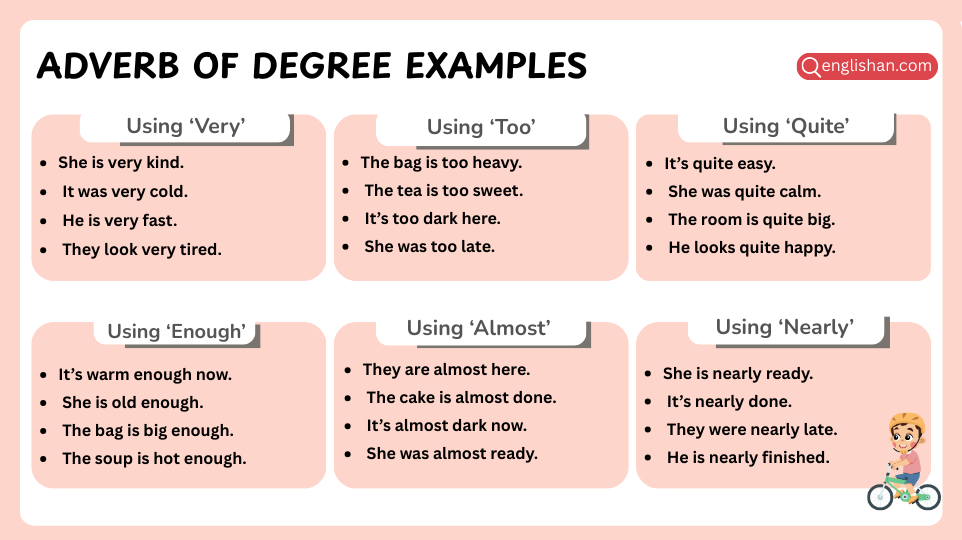
Some words, like “very” or “extremely,” tell us how much something happens. These are adverbs of degree that add meaning and detail to sentences.
Practicing adverb of degree examples improves English grammar and helps write clear, correct sentences that show how strong or weak an action is.

What is an Adverb of Degree?
An adverb of degree shows the intensity or level of an action, adjective, or another adverb. Words like very, too, and extremely help explain how much or to what extent something happens.
Adverb Of Degree Examples
Below is a list of adverb of degree examples.
- I am very happy today.
- She was quite tired after the walk.
- He is too busy to join us now.
- They are almost ready to leave.
- It is enough for today.
- The tea was too hot to drink.
- I am nearly finished with my homework.
- She is so excited for the trip.
- He was hardly awake in the morning.
- We are extremely grateful for your help.
- She was just on time for the meeting.
- He barely noticed the mistake.
- It is totally fine with me.
- I completely agree with your idea.
- She is fairly new in the class.
- He scarcely spoke during dinner.
Simple Sentences Using Adverbs Of Degree
These examples use adverbs of degree in simple sentences to help learners understand clear structure. Below is a list for practice.
- The movie was very interesting.
- She is too sleepy to study now.
- He was quite surprised to see me.
- The bag is almost empty.
- This food is enough for us.
- It was so cold last night.
- The water is too cold to swim.
- She is nearly there.
- I was barely awake during the lecture.
- The cat is very playful today.
- He was extremely tired after the match.
- She was just in time for class.
- The answer is totally correct.
- The weather is fairly warm now.
- They were completely ready to go.
- It is quite easy to follow.
Positive Sentences Using Adverbs Of Degree
Positive sentences show clear examples of adverbs of degree in affirmative statements. Below is a list for learners.
- She is very talented.
- The cake is quite delicious.
- He feels so happy today.
- The weather is extremely pleasant.
- I am completely satisfied with the result.
- The room is fairly clean now.
- They are totally prepared for the exam.
- She is enough skilled for this job.
- He was nearly finished with his work.
- The music is just perfect.
- The soup is too hot, but it tastes good.
- I was almost ready when you arrived.
- The dog is so friendly.
- The book is very interesting.
- It was quite easy to solve.
- The place is just beautiful.
Negative Sentences Using Adverbs Of Degree
These sentences use adverbs of degree in negative statements to help learners see sentence flow clearly. Below is a list.
- She is not very tall.
- It is not quite finished yet.
- The coffee is not too strong.
- They are not so sure about the plan.
- He was not completely ready.
- She does not feel extremely tired today.
- It is not fairly priced.
- They were not totally convinced.
- The movie is not just about action.
- The room is not enough big for us.
- I am not so excited about this.
- The news was not very clear.
- He did not feel too cold.
- It was not quite easy.
- They are not almost there yet.
Question Sentences Using Adverbs Of Degree
These questions help learners see how adverbs of degree fit naturally into English sentences. Below is a list.
- Are you very sure about this?
- Is it quite easy to learn?
- Are they too busy today?
- Is she almost ready to leave?
- Is the soup hot enough for you?
- Was the movie so interesting?
- Are you completely prepared for the test?
- Is it fairly easy to cook this dish?
- Was the meeting just about the project?
- Is he nearly finished with the book?
- Are they totally ready for the trip?
- Was she extremely happy yesterday?
- Are you so tired today?
- Is the room too small for your things?
- Is the book very long?
- Are you just in time for class?
Sentences Using ‘Very’
‘Very’ is an adverb of degree showing a high level or intensity. Below is a list of sentences using ‘very’.
- She is very happy today.
- The dog looks very cute.
- He is very good at math.
- The weather is very cold.
- They were very late.
- The exam was very difficult.
- I am very tired now.
- The cake tastes very sweet.
- She is very kind to everyone.
- The room looks very clean.
- The food smells very good.
- It is very important to study.
- The game was very exciting.
- The dress is very beautiful.
- The car moves very fast.
- The class is very interesting.
Sentences Using ‘Too’
‘Too’ shows excess or more than needed. Below is a list for practice.
- The soup is too hot.
- She is too tired to walk.
- The bag is too heavy for me.
- It is too late now.
- The room is too small.
- He is too young to drive.
- The weather is too cold today.
- The book is too long to finish today.
- They were too busy to call.
- It is too dark to see clearly.
- The chair is too high for him.
- She is too sleepy to study.
- The music is too loud.
- It was too hard for him.
- The movie was too boring.
- The road is too crowded.
Sentences Using ‘Quite’
‘Quite’ shows a considerable degree but not the highest level. Below is a list for learners.
- The tea is quite hot.
- She is quite friendly.
- The movie was quite interesting.
- He is quite tall.
- The book is quite easy to read.
- The food was quite good.
- The weather is quite warm today.
- She is quite smart.
- The exam was quite hard.
- The place is quite beautiful.
- The bag is quite heavy.
- The baby is quite active.
- It was quite late when they arrived.
- The class was quite noisy.
- The test was quite easy.
- He is quite strong for his age.
Sentences Using ‘Enough’
‘Enough’ shows a sufficient degree or amount. Below is a list for practice.
- She is old enough to travel alone.
- The room is big enough for us.
- He is strong enough to lift it.
- It is warm enough to swim.
- They have enough time to finish.
- The tea is sweet enough.
- She is skilled enough for the job.
- The bag is small enough to carry.
- He is fast enough to win.
- The soup is hot enough.
- The room is quiet enough for study.
- The cake is soft enough to eat.
- She is bold enough to ask.
- The light is bright enough.
- They have enough food for everyone.
- The weather is nice enough for a walk.
Sentences Using ‘Almost’
‘Almost’ shows something is nearly complete or nearly at a level. Below is a list for learners.
- She is almost ready to leave.
- The glass is almost full.
- He is almost done with his work.
- The bus is almost here.
- It is almost time for lunch.
- They were almost late.
- She was almost asleep.
- The cake is almost baked.
- The rain has almost stopped.
- The room is almost clean.
- The test is almost over.
- The water is almost boiling.
- The book is almost finished.
- He was almost crying.
- The sun is almost down.
- The meeting is almost starting.
Sentences Using ‘Nearly’
‘Nearly’ is close in meaning to ‘almost’ and shows something is close to happening or a condition. Below is a list for practice.
- She is nearly ready.
- The class is nearly over.
- The glass is nearly empty.
- He is nearly finished.
- They are nearly here.
- The job is nearly done.
- It is nearly dark outside.
- The rain has nearly stopped.
- She was nearly late.
- The test is nearly complete.
- He is nearly asleep.
- The bus is nearly full.
- The room is nearly clean.
- The food is nearly cooked.
- The water is nearly boiling.
- The sun is nearly setting.
Practice Sentences With Adverbs Of Degree
This section offers mixed practice sentences to help learners get comfortable with adverbs of degree. Below is a list for active learning.
- She is very kind.
- The tea is too hot.
- The book was quite good.
- It is warm enough outside.
- They were almost late.
- He is nearly finished with the test.
- The class was extremely noisy.
- The food is totally fine.
- She is so happy today.
- He was barely awake.
- The car is very fast.
- The room is fairly clean.
- It is too cold to go out.
- The cake is just perfect.
- The sun is nearly down.
- They are completely ready.
You May Also Like