Many people mix up censor and sensor because the words sound alike but refer to completely different ideas. Censor means blocking, removing, or suppressing speech, media, or published material. Sensor refers to a device that detects signals such as light, motion, heat, pressure, or sound.
The difference is easier to remember when censor is tied to media and sensor is tied to technology. Censor is used in discussions about media, speech, books, films, governments, and online platforms. Sensor is used in discussions about phones, cars, alarms, machines, and electronic systems.
In this article, you will learn the difference between censor and sensor, why people confuse them, how each word fits in context, and how to remember the right spelling and meaning.
Censor vs Sensor: Quick Answer
Here is the fastest way to separate the two words:
| Word | Main Meaning | Part of Speech | Common Context | Example |
|---|---|---|---|---|
| censor | remove, block, or suppress content | noun, verb | media, publishing, government, speech | The channel censored the scene. |
| sensor | detect or measure physical input | noun | technology, machines, devices | The motion sensor triggered the alarm. |
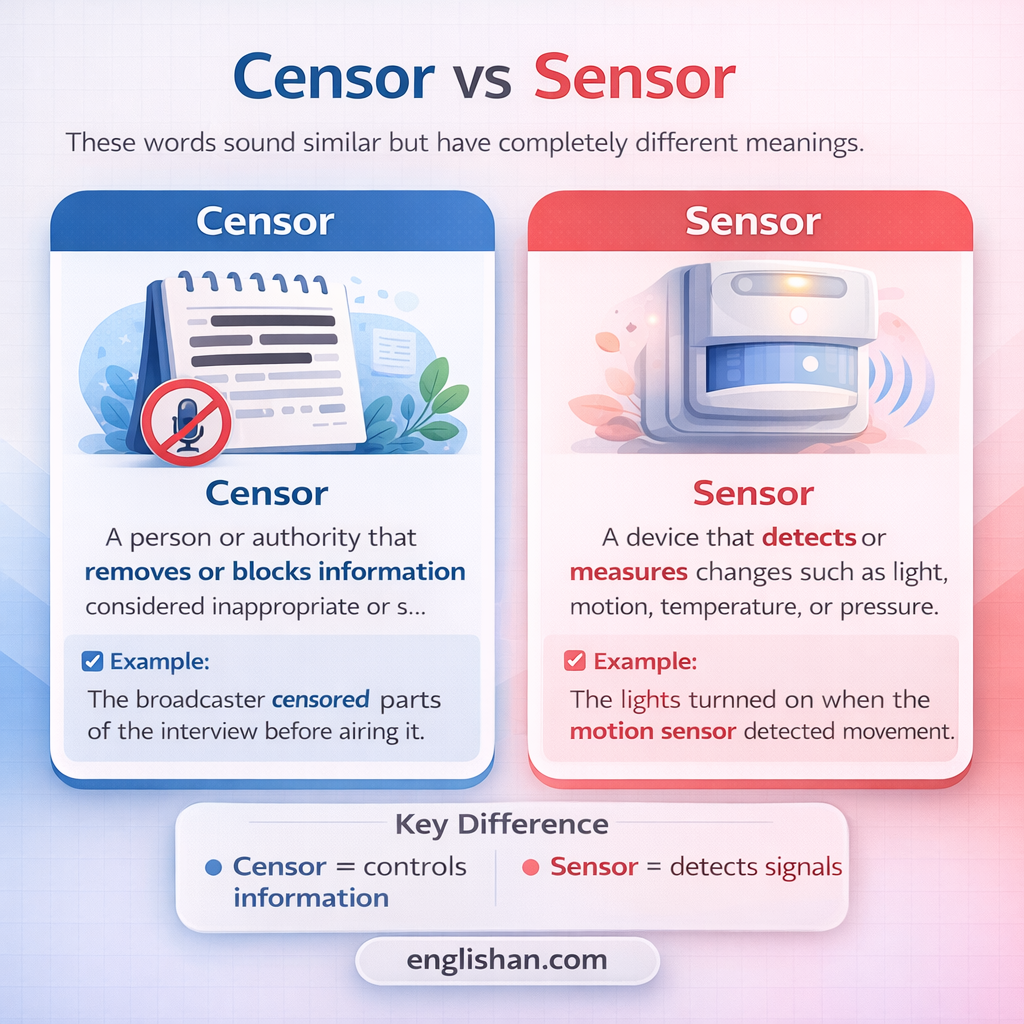
If the word is about controlling information or content, use censor. If it is about detecting something in the environment, use sensor.
What Does Censor Mean?
Censor can be a noun or a verb.
As a noun, a censor is a person, office, or authority that reviews material and removes or blocks parts considered unsuitable, offensive, or sensitive.
As a verb, to censor means to suppress, remove, block, or limit content.
Examples of Censor
- The censor reviewed the film before release.
- The network censored the violent scene.
- The platform was accused of censoring political content.
- Some governments censor websites and social media posts.
Both noun and verb forms are common, but many learners first meet censor as a verb in news, media, and public discussion.
What Does Sensor Mean?
Sensor is a noun. A sensor is a device that detects, measures, or responds to changes in the environment.
A sensor may react to:
- light
- heat
- movement
- pressure
- sound
- moisture
- speed
Examples of Sensor
- A motion sensor can detect movement in a room.
- A temperature sensor can measure heat levels.
- A light sensor can adjust screen brightness.
- A parking sensor can warn a driver about nearby objects.
In everyday English, sensor is usually used only as a noun.
Censor vs Sensor: Key Differences
The main difference is the type of job each word does.
Censor is about content, information, and expression. It belongs to areas such as publishing, broadcasting, government policy, speech, and online moderation.
Sensor is about detection, measurement, and response. It belongs to areas such as electronics, engineering, vehicles, phones, alarms, and automated systems.
Another important difference is grammar. Censor works as both a noun and a verb, while sensor is generally used as a noun.
Why People Confuse Censor and Sensor
These two words are easy to confuse because they are homophones in many accents, so they often sound the same in speech. They also differ by only one letter, which makes typing mistakes more likely.
Another reason for confusion is that both are valid English words. Because of that, spellcheck may not always catch the mistake. The best way to choose the correct word is not by sound, but by context.
If the sentence is about removing or restricting material, the correct word is censor. If it is about detecting or measuring something, the correct word is sensor.
How to Remember Censor vs Sensor
A quick memory tip can help:
- Censor connects with censorship
- Sensor connects with sense and sensing
If the sentence is about blocking, removing, or restricting information, think censorship, so the correct word is censor.
If the sentence is about detecting light, motion, heat, or another signal, think sense, so the correct word is sensor.
Censor vs Sensor in Sentences
Sentences With Censor
- The station chose to censor the scene before airing the program.
- Critics argued that the article had been censored unfairly.
- The censor ordered changes to the script.
Sentences With Sensor
- The motion sensor turned on the outside lights.
- Engineers tested the pressure sensor for accuracy.
- The phone’s sensor responded to the change in light.
Common Mistakes When Using Censor and Sensor
Using Sensor for Content Control
Incorrect:
The government used a sensor to remove parts of the article.
Better:
The government used a censor to remove parts of the article.
Using Censor for Technology
Incorrect:
The car’s rear censor warned the driver.
Better:
The car’s rear sensor warned the driver.
Forgetting to Check the Context
The quickest way to avoid mistakes is to ask:
Is this about content or information? Use censor.
Is this about detection or measurement? Use sensor.
Summary
Censor and sensor may sound alike, but they do very different jobs. Censor relates to removing, blocking, or suppressing content, and it can be a noun or a verb. Sensor refers to a device that detects or measures something in the environment, and it is usually a noun. If you connect censor with censorship and sensor with sense, the difference is much easier to remember.
FAQs
Censor means to remove, block, or suppress content, or it can refer to a person or authority that does this. Sensor means a device that detects or measures physical input such as light, heat, motion, or pressure.
Censor can be both. It can name a person or authority, and it can also describe the act of suppressing content.
In standard everyday English, sensor is usually used as a noun, not a verb.
The broadcaster censored the scene before the film aired.
The motion sensor activated the security light.
You May Also Like