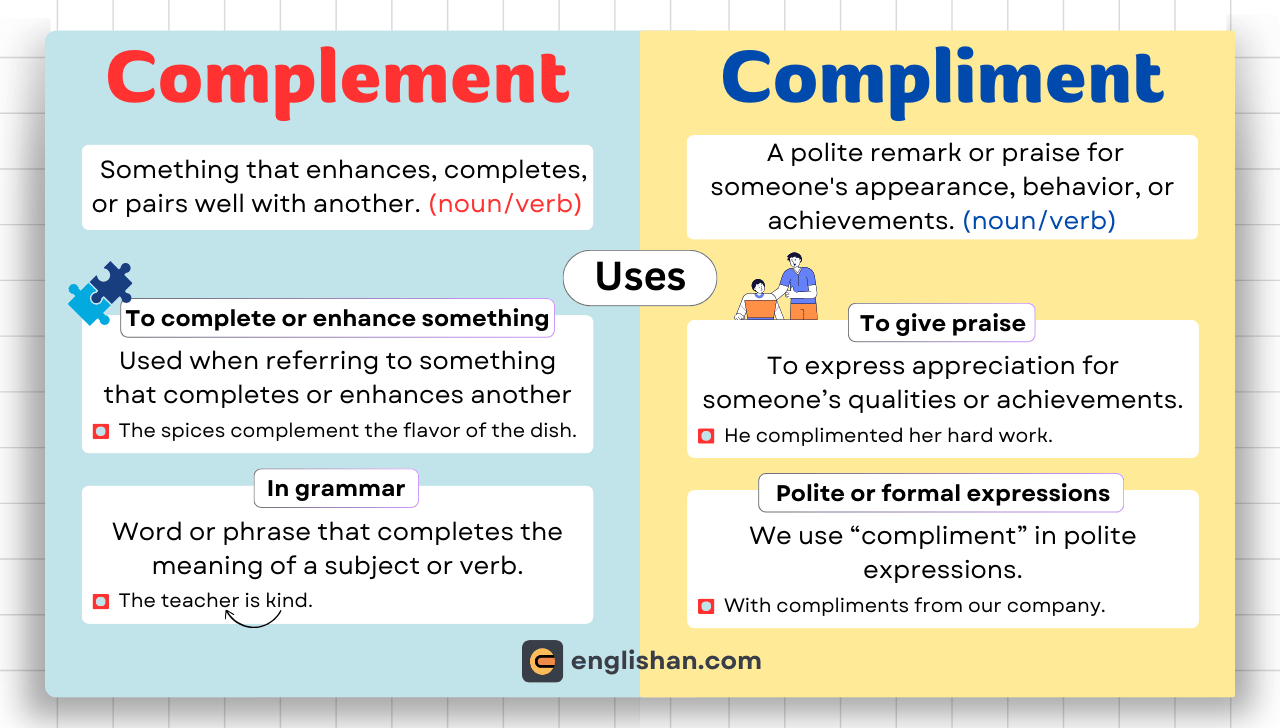
Complement and compliment sound the same, but they mean very different things. A complement is something that completes or improves something else. A compliment is a polite expression of praise or admiration. For example, “That scarf complements your outfit” vs “She gave me a kind compliment.” Many English learners confuse these words because they are homophones. Learn the difference between complement vs compliment with examples and clear usage rules below.
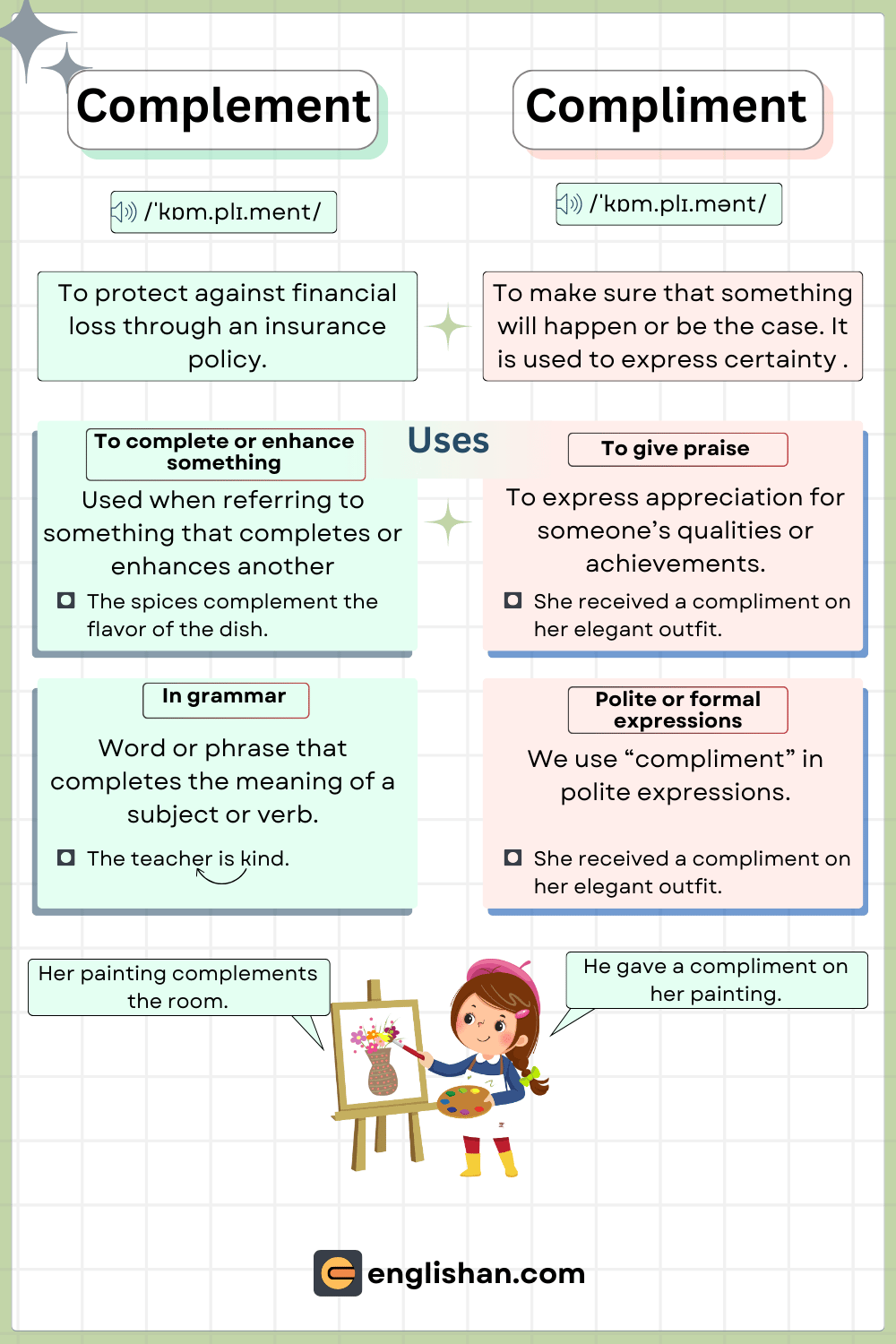
What Do “Complement” and “Compliment” Mean?
Definition of Complement
Complement (noun/verb) refers to something that completes, improves, or enhances another thing. It is commonly used when discussing balance, matching, or improvement.
Example:
- The blue hijab complements Aisha’s dress perfectly.
- His skills complement the team’s strengths.
Definition of Compliment
Compliment (noun/verb) means a polite expression of praise, appreciation, or admiration.
Example:
- Ahmed gave Fatima a compliment on her beautiful recitation of the Quran.
- She received many compliments on her elegant outfit.
Key Differences Between Complement and Compliment
| Aspect | Complement | Compliment |
|---|---|---|
| Meaning | Enhancing or completing something | A polite expression of praise |
| Usage | Used to describe something that improves another | Used to express admiration or appreciation |
| Part of Speech | Noun or Verb | Noun or Verb |
| Example | The teacher’s guidance complements the student’s efforts. | The teacher gave her student a compliment. |
| Memory Trick | Think of “complete” | Think of “praise” |
When to Use “Complement” (with Examples)
1. To Complete or Enhance Something
Use “complement” when one thing improves or completes another.
Examples:
- The spices complement the flavor of the dish.
- A scarf can complement your outfit.
2. In Grammar: Subject–Complement Relationship
In grammar, a complement completes the subject or verb.
Examples:
- The teacher is kind. (“Kind” is a complement.)
- His goal is to become a doctor. (“To become a doctor” is a complement.)
When to Use “Compliment” (with Examples)
1. To Give Praise
Use “compliment” when expressing admiration or appreciation.
Examples:
- Omar complimented his friend on his excellent speech.
- I received a compliment on my new shoes.
2. Polite or Formal Expressions
Use “compliment” in polite social or formal settings.
Examples:
- With compliments from our team.
- My compliments to the chef for this delicious meal.
Formal vs. Informal Use of Complement and Compliment
| Use | Complement Example | Compliment Example |
| Formal | The interior design complements the architecture. | The CEO complimented the team on their performance. |
| Informal | That belt really complements your outfit! | I complimented my friend on her new hijab. |
FAQs About Complement and Compliment
Q1: Are complement and compliment spelled differently?
Yes, “complement” has an “e” and relates to completing. “Compliment” has an “i” and relates to praise.
Q2: Can both be used as verbs and nouns?
Yes. Complement and compliment can both function as verbs and nouns depending on the sentence.
Q3: What is a simple way to remember the difference?
Use this trick: complement = complete, compliment = praise.
Q4: Are they homophones?
Yes. They sound the same but have different meanings and spellings.
Q5: Can I use “compliments” in formal letters or gifts?
Yes. It’s common to write “With compliments” in business or formal communication.
Aisha’s elegant dress complements her look, and she received many compliments on it.
You May Also Like