In English grammar, learning how object complements work can help improve both writing and speaking skills. An object complement is a word or group of words that follows a direct object and gives more information about it. This guide will help you understand and use object complements effectively.
What is an Object Complement?
An object complement is a word, phrase, or clause that provides extra information about the direct object of a sentence. It completes the meaning of the object by describing or renaming it. Object complements are often nouns, pronouns, or adjectives and usually follow verbs like make, name, elect, consider, find, appoint, and choose.
Example: The students elected Ali president.
Here, “Ali” is the direct object, and “president” gives more information about Ali’s role.
✅ Correct: The teacher called Ahmed brilliant.
The object “Ahmed” is described by “brilliant,” which functions as the object complement.
❌ Incorrect: The teacher called.
This sentence is incomplete because it lacks both an object and a complement, making the meaning unclear.
Other Types of Complements
Complements are not limited to object complements. They can include various types that help provide additional information about different parts of a sentence. Understanding these types will make your grammar more versatile and improve the clarity of your sentences. Here are some other common types:
Verb Complements
Verb complements are phrases that follow verbs to give them more meaning. These can be infinitive phrases or gerunds that help complete the verb’s action.
Example: He decided to leave early.
“To leave early” is the verb complement that explains what he decided.
Example: They enjoy swimming.
“Swimming” is a gerund complement that adds meaning to the verb “enjoy.”
Prepositional Complements
Prepositional complements are phrases that complete the meaning of a preposition. They are often noun phrases or clauses that come after a preposition to provide context.
Example: She is interested in reading books.
“In reading books” is the prepositional complement that adds more detail to what she is interested in.
Example: He was accused of stealing money.
“Of stealing money” is the prepositional complement that explains the accusation.
Subject Complements
Subject complements provide information about the subject, usually after linking verbs like is, seems, or becomes. They help to complete the meaning of the subject and add clarity to the sentence.
Example: Ayesha is happy.
“Happy” describes Ayesha and provides more information about the subject.
Example: Bilal seems tired.
“Tired” is the subject complement that describes Bilal’s condition.
Adjective Complements
Adjective complements add information to an adjective, often starting with to or that. They help to complete the meaning of an adjective and provide context to it.
Example: She is eager to learn.
“To learn” adds more meaning to the adjective “eager.”
Example: He is happy that he passed the exam.
“That he passed the exam” is an adjective complement that explains why he is happy.
Understanding these complements helps in using object complements more effectively, ensuring sentences are complete and meaningful.
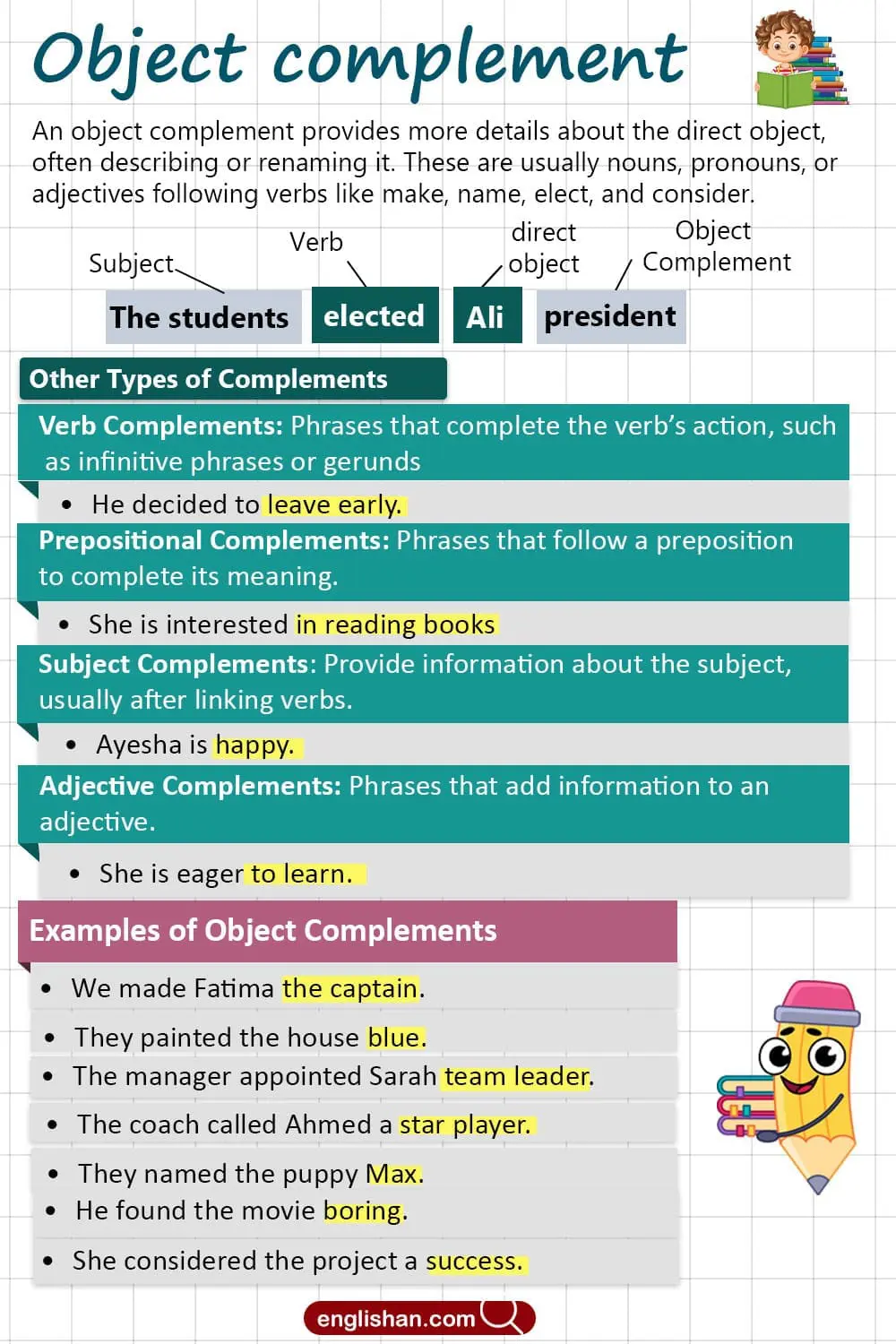
Examples of Object Complements
- We made Fatima the captain.
“Fatima” is the direct object, and “the captain” tells us her new role. - The committee named Saad the best performer.
“The best performer” is the object complement, explaining Saad’s role. - They painted the house blue.
“Blue” describes the direct object “house.” - ✅ Correct: He considers his brother a hero.
In this sentence, “his brother” is renamed by “a hero.” - ❌ Incorrect: He considers his brother.
Without an object complement, the meaning is incomplete.
Table of Examples
| Sentence | Direct Object | Object Complement |
|---|---|---|
| The group appointed Hassan leader. | Hassan | leader |
| The board found the plan successful. | the plan | successful |
| The judge declared her guilty. | her | guilty |
| They called the party a success. | the party | a success |
| The boss made Sara team leader. | Sara | team leader |
Summary
Object complements help provide more meaning to direct objects by renaming or describing them. They usually follow verbs like make, name, and consider. By practicing these concepts, you can make your sentences more descriptive and clear.
FAQs
An object complement gives more information about the object in a sentence.
Examples:
She painted the wall red. (“Red” describes the wall.)
They made him captain. (“Captain” tells what he became.)
We found the movie boring. (“Boring” describes the movie.)
Subjective complement: Describes the subject (after a linking verb).
Example: She is a teacher.
Objective complement: Describes or renames the object.
Example: They made him captain.
Key difference: Subjective complement = subject; Objective complement = object.
To find an objective complement:
Find the verb (action word).
Find the direct object (ask “What?” or “Whom?” after the verb).
Look for a word after the object that renames or describes it.
Examples:
We painted the house blue. (Blue describes house.)
They made him captain. (Captain renames him.)
Here are simple complements in sentences:
Subject Complement – Tells more about the subject.
Example: She is a teacher.
Object Complement – Tells more about the object.
Example: They made him captain.
Verb Complement – Completes the verb’s meaning.
Example: I like reading.
Adjective Complement – Explains an adjective.
Example: She is afraid of dogs.
Complements add extra meaning to sentences!
Read More