Addition and edition sound similar, but they are used in very different ways. Addition means something added, while edition refers to a specific version of a book, magazine, game, or software product.
People often confuse them in writing because both words look and sound close. This article explains what each one means, how they are used, and how to remember the difference.
Addition vs Edition: Quick Difference
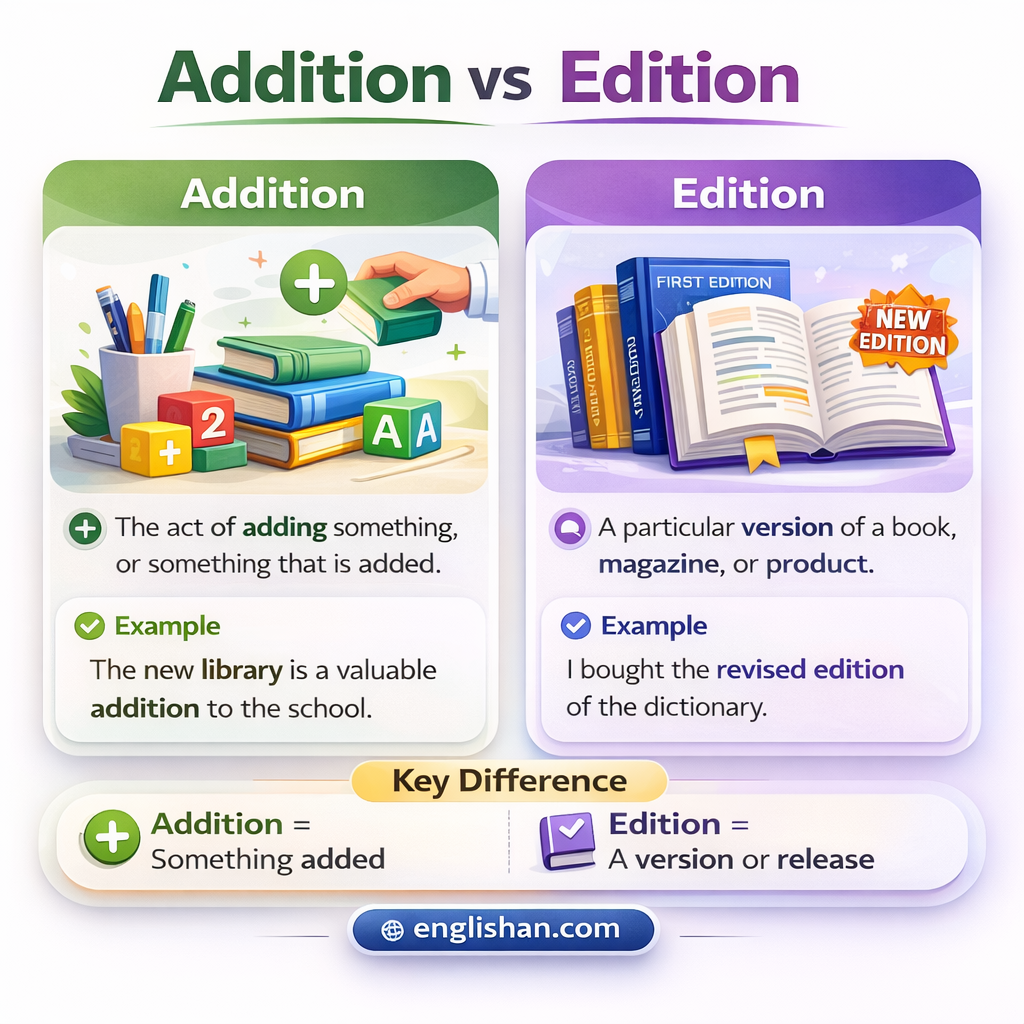
Here is the fastest way to separate them:
| Word | Meaning | Example |
|---|---|---|
| addition | something added | a new addition to the house |
| edition | a version of a published work | a revised edition of a book |
If you are talking about adding something, use addition.
If you are talking about a version of something published, use edition.
What Does Addition Mean?
Addition is a noun that means something has been added or included.
It is commonly used in:
- daily life (a new room, a new member)
- math (adding numbers)
- features or updates
Examples of Addition
- The garage is a new addition to the house.
- The team welcomed a new addition this season.
- In math, 10 + 5 is an addition problem.
In all cases, addition focuses on something being included or joined.
What Does Edition Mean?
Edition is a noun that refers to a specific version of a published work.
It is commonly used with:
- books
- magazines
- newspapers
- software
- games
Examples of Edition
- She owns a first edition of the novel.
- The latest edition of the textbook includes new chapters.
- They released a special edition of the game.
Here, edition focuses on versions, updates, or releases.
Addition vs Edition: Common Mistakes
These words are often mixed up in writing.
Incorrect:
- I bought the latest addition of this book.
Correct:
- I bought the latest edition of this book.
Incorrect:
- The kitchen is a beautiful edition to the house.
Correct:
- The kitchen is a beautiful addition to the house.
The mistake usually happens because both words sound alike.
Simple Way to Remember the Difference
A quick way to remember:
- Addition → Add
- Edition → Edit
If something is being added, choose addition.
If something is a revised or published version, choose edition.
Examples of Addition and Edition in Sentences
Addition
- The library received a valuable addition last year.
- The app update includes a small addition to its features.
Edition
- This is the second edition of the guide.
- The anniversary edition includes extra content.
Addition vs Edition in a Nutshell
Addition means something new is added or included. Edition refers to a version of a published work that may include updates or changes. Once you connect addition with adding and edition with editing or publishing, the difference becomes much easier to remember.
FAQs
Addition means something that is added to increase or improve something, such as a room or a number. Edition means a specific version of a published work, like a book or magazine.
No. Addition and edition have different meanings. One relates to adding something, while the other refers to a version of a published text.
The new room is an addition to the house.
This is the latest edition of the textbook.
Think of addition as “add,” which relates to increasing something. Think of edition as “edit,” which relates to publishing or updating a version of a text.
You May Also Like