A hangar is a building where aircraft are kept and repaired. A hanger is anything that hangs something else, and the shaped device that holds a shirt on a rail is only its best-known form. The two words sound identical in British and American English, so hangar vs hanger is decided by meaning alone, never by ear. One letter separates them, and that letter turns a coat rack into an airfield building.
What Is the Difference Between Hangar and Hanger
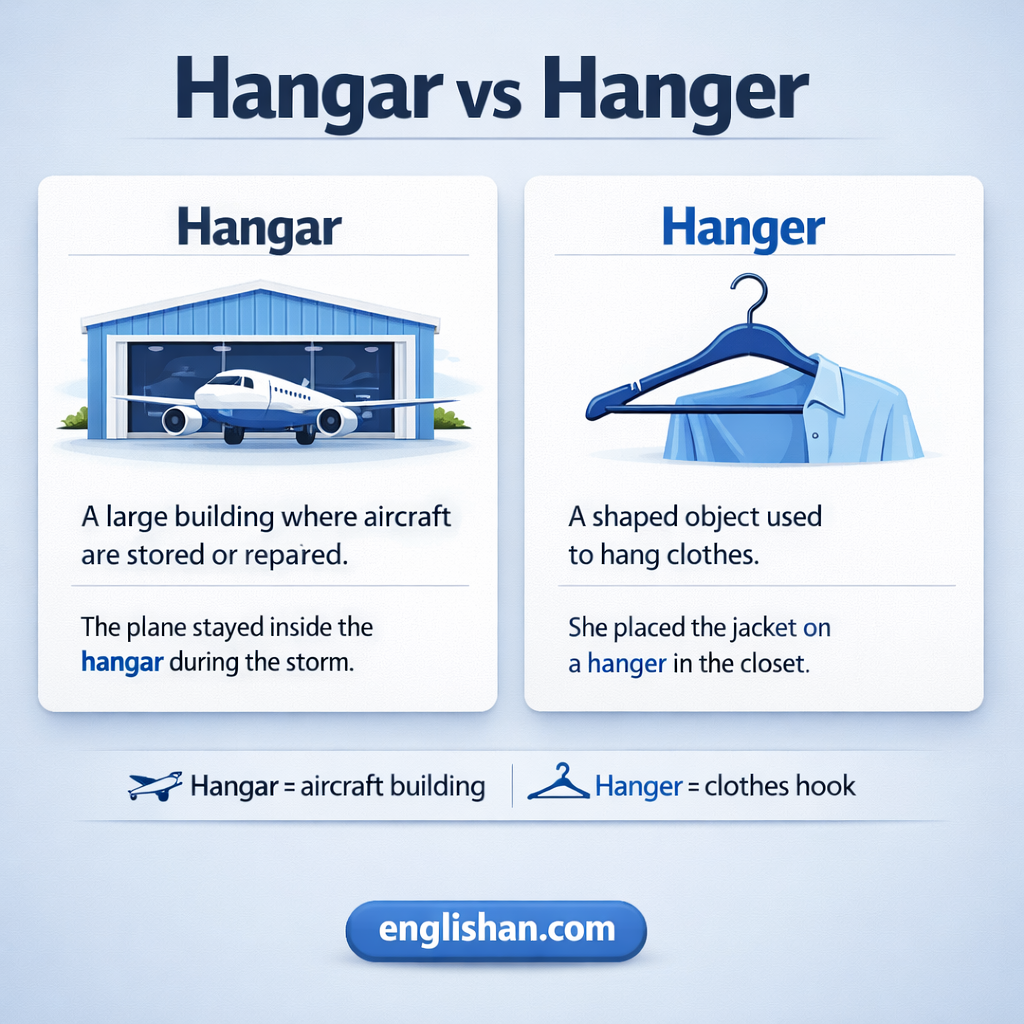
| Word | Meaning | Part Of Speech | Where You See It | Model Sentence |
|---|---|---|---|---|
| Hangar | A covered building for storing and repairing aircraft. | Noun, and a verb in aviation writing. | Airports, airbases, aircraft carriers. | The jet was towed into the hangar before the storm. |
| Hanger | Anything that hangs something else. | Noun. | Wardrobes, workshops, butcher counters. | She lifted the suit off its hanger. |
One rule settles nearly every case. Hangar has one meaning, the building for aircraft. Every other meaning of that sound is spelled hanger.
Hangar Meaning in Aviation and Aircraft Storage
Hangar started out as a word for a shelter and then narrowed. In current English it names the aircraft building and very little else.
- Aircraft building: the main sense. A hangar shelters aircraft from weather and gives mechanics the floor space to work on them.
- Shelter or shed: the older, wider dictionary sense, still recorded, still applied to large agricultural and industrial sheds.
- Hangar bay and hangar deck: the enclosed aircraft space aboard an aircraft carrier, and the same term now applied to spacecraft.
- A verb: aviation writing uses hangar as a verb. A pilot hangars an aircraft for the winter, and a hangared Cessna is parked under a roof instead of out on the ramp.
- Carriage shed: before flight, a few English speakers kept carriages in a hangar. That sense died with the horse.
Both spellings take a plain -s plural: one hangar, two hangars, one hanger, two hangers. The possessive works like any other noun, as in the hangar’s doors and the hangars’ roofs.
What Does Hanger Mean in English
Most writers know one meaning of hanger, and it is the narrowest one. The dictionary definition runs much wider: one that hangs, or anything by which something is suspended. The coat hanger is only the most familiar of them.
- Clothes hanger: the shaped wire, wood or plastic device with a hook at the top, also called a coat hanger.
- A person who hangs something: a paper hanger pastes wallpaper, and a picture hanger mounts frames on a gallery wall.
- Anything a load hangs from: a plant hanger for a basket, a joist hanger in a timber frame, a strap hanger for a standing passenger on a train.
- Hanger steak: a cut of beef taken from the diaphragm, known in French bistro cooking as onglet.
- Hanger-on and cliff-hanger: both come straight from the verb hang. Neither has anything to do with aircraft.
That range explains the direction of the error. Writers put hanger in front of aircraft far more than they put hangar in front of a coat, because hanger is the word they write every week.
Why Hangar and Hanger Sound Alike but Are Spelled Differently
The two spellings are not variants of one word. They come from different languages and arrived in English about four centuries apart.
Hang has been in English since before the 12th century. Hanger was built from it in the 15th century with the ordinary -er ending that turns a verb into the person or thing doing it: bake to baker, hang to hanger.
Hangar arrived in the 1850s from French, where it named a shed open at the side for storing carts, farm tools and crops. Further back it traces to an old Germanic compound meaning an enclosure around a building. The verb hang has nothing to do with it. When early aviation needed a word for the enormous sheds built to shelter aircraft, French supplied one and English took it whole. English speakers then pronounced hangar the way they already pronounced hanger, and the two have sounded identical ever since.
Words that sound the same and mean something different are homophones. In speech a homophone costs you nothing, because the conversation supplies the meaning. In writing the spelling is all the reader gets, which is why this pair only causes trouble on paper. Both words are pronounced /ˈhæŋər/ in standard British and American English, so listening for a difference is wasted effort.
Is It Plane Hangar or Plane Hanger
Plane hangar is correct. So are aircraft hangar and airplane hangar, each written as two words with no hyphen.
The mechanic worked in the airplane hanger. ❌
The mechanic worked in the airplane hangar. ✅
They are building a new hanger beside runway three. ❌
They are building a new hangar beside runway three. ✅
She hung the jacket on the hangar. ❌
She hung the jacket on the hanger. ✅
The mirror question has the same answer in reverse. Coat hanger is correct and coat hangar is not, because no coat has ever needed a building. If the phrase names aircraft, write hangar. If it names a garment, write hanger.
Hangar and Hanger Example Sentences
Hangar in a Sentence
- The airline hangared its regional fleet overnight after the ice warning.
- Ground crew towed the damaged jet into the hangar for inspection.
- Fighter aircraft returned to the hangar deck as the carrier turned into the wind.
- The old hangar at the edge of the airfield is now a woodworking workshop.
- Rain moved the whole airshow into a hangar big enough for four aircraft.
Hanger in a Sentence
- Every shirt came back from the dry cleaner on a wire hanger.
- The picture hanger levelled the last frame ten minutes before the gallery opened.
- A joist hanger takes the weight where two timbers meet.
- He ordered the hanger steak and a glass of red.
- The dress slipped off its hanger and landed on the wardrobe floor.
How to Choose the Right Spelling in a Sentence
One question decides it: does the word name a building that holds aircraft?
- Read the sentence for meaning: ask whether the word names a building for aircraft, or something that hangs.
- Try the swap: replace the word with aircraft shed. If the sentence still works, write hangar.
- Default to hanger: if the swap fails, write hanger, because every meaning except the aircraft building takes that spelling.
Common Mistakes With Hangar and Hanger
Hanger used for the aircraft building: the error that reaches print. Aviation trade copy and local news reports print hanger for aircraft buildings regularly enough that dictionary example corpora pick it up alongside the correct spelling.
The airport opened a 20,000-square-foot hanger last month. ❌
The airport opened a 20,000-square-foot hangar last month. ✅
Hangar used for clothes: the reverse error, rarer and more jarring, because it reads as a slip of the keyboard rather than a genuine mix-up.
Put your shirt on a hangar. ❌
Put your shirt on a hanger. ✅
Trusting your ear: the two words are identical in speech, so reading a draft aloud will never catch the swap. Check the meaning instead of the sound.
How to Remember Hangar vs Hanger
Two memory tricks work better than the rest.
- Hangar has an extra A, and so does aircraft: aircraft, airplane, hangar. Three A-words that belong together at the airfield.
- Hanger has hang inside it: the verb is right there in the first four letters. Hangar does not come from hang, which is why its spelling does not match.
From here, one check is enough. Before you publish anything with either spelling in it, ask whether an aircraft is involved. If one is, write hangar. If none is, write hanger, and move on.
FAQs
A hangar is a covered building where aircraft are stored, serviced and repaired. A hanger is anything that hangs something else, from the shaped device that holds a garment to the person who hangs wallpaper or pictures. Hangar has one meaning, and everything else takes hanger.
Plane hangar is correct. Aircraft hangar and airplane hangar are equally correct, and all three are written as two separate words with no hyphen. Plane hanger describes a clothes hanger belonging to a plane, which is not what the sentence means.
Coat hanger is correct. Coat hangar is a misspelling, because hangar names a building for aircraft and a coat needs a hook rather than a building. The same applies to clothes hanger, wire hanger and shirt hanger.
Yes. Both are pronounced /ˈhæŋər/ in standard British and American English, which makes them true homophones. No accent separates them, so the spelling has to be chosen from the meaning of the sentence.
Hanger is a word most people write regularly, and hangar is one they write rarely, so the familiar spelling arrives first. Spellcheckers make it worse, because both are valid English words and neither gets underlined. The error survives every automated check.
No. Hanger applies to anything that hangs or is hung from. It names the person who hangs something, as in paper hanger and picture hanger, the fitting that carries a load, as in joist hanger and plant hanger, and even a cut of beef, the hanger steak.
Hangar comes from French, where it named an open-sided shed for carts, tools and crops. Early aviation in France used those large sheds to shelter balloons and aircraft, and English borrowed the word along with the practice in the 1850s. The verb hang had nothing to do with it.
You May Also Like