

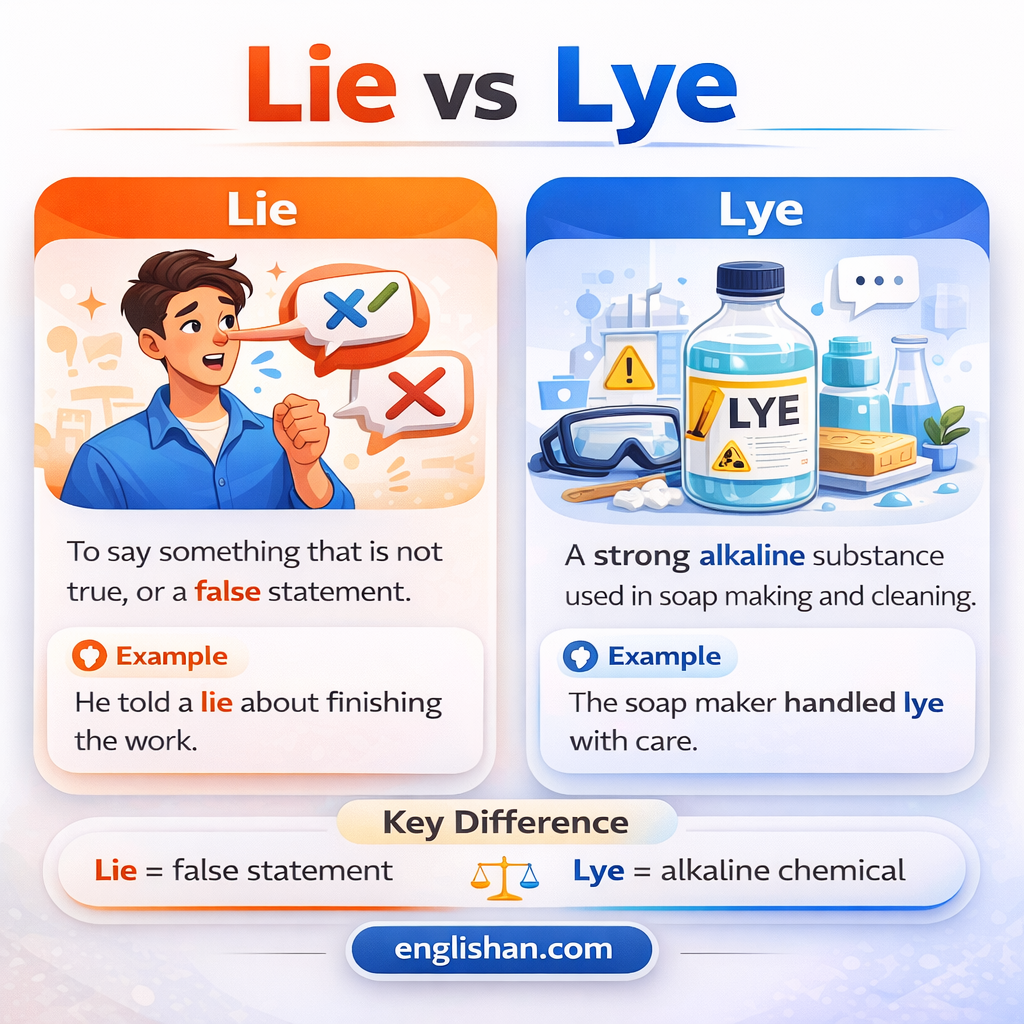
Lie and lye sound exactly alike, but they are far from interchangeable. Lie is the everyday verb you use for resting flat or saying something untrue, while lye is a harsh chemical used in soap making and cleaning. That difference is easy to miss in writing because only the spelling separates them. This article breaks down what each word means, where each one belongs, and how to avoid the mix-up.
Lie vs Lye: Quick Answer
Here is the quickest way to tell them apart:
| Word | Meaning | Part of Speech | Common Use | Example |
|---|---|---|---|---|
| lie | rest flat; say something untrue | verb | actions, speech | lie down; lie to someone |
| lye | strong alkaline chemical | noun | cleaning, soap making | lye solution |
If the sentence is about resting or saying something false, use lie.
If it is about a chemical substance, use lye.
What Does Lie Mean?
Lie is most commonly used as a verb, and it has two main meanings.
Lie Meaning 1: To Rest in a Flat Position
This use refers to being in or moving into a horizontal position.
Examples:
- I need to lie down for a while.
- After the long drive, he wanted to lie on the couch.
- The dog likes to lie near the window in the sun.
Lie Meaning 2: To Say Something Untrue
This meaning refers to giving false information on purpose.
Examples:
- It is wrong to lie to your friends.
- She admitted that she had lied about the missing papers.
- He chose to lie during the interview.
Lie can also be a noun, as in That was a lie, but the most common confusion in this word pair involves the verb forms.
What Does Lye Mean?
Lye is a noun. It refers to a strong alkaline chemical, usually sodium hydroxide or potassium hydroxide.
It is commonly used in:
- soap making
- drain cleaning
- heavy-duty cleaning products
- industrial processes
Because it is a chemical, lye often appears in product labels, safety instructions, and cleaning information.
Examples of Lye
- She used lye to make homemade soap.
- The label warned users not to touch lye with bare skin.
- This cleaner contains lye, so it must be handled carefully.
- The soap maker stirred the oils carefully before adding lye.
Common Mistakes With Lie and Lye
These words are easy to misspell because they are homophones, but their meanings are far apart.
Using Lye for Everyday Actions
Incorrect:
I need to lye down for a minute.
Correct:
I need to lie down for a minute.
Using Lie for Chemical Context
Incorrect:
The cleaner contains lie.
Correct:
The cleaner contains lye.
Forgetting That Lie Has Two Common Meanings
Some learners remember lie down, but forget that lie can also mean say something untrue.
Correct examples:
- Please do not lie to me.
- He went to lie down after lunch.
How to Remember Lie vs Lye
A quick memory trick makes this easier:
- lie = something people do
- lye = something you handle carefully
Another easy way to remember it is this:
- You can lie down
- You should never lie down in lye
That contrast makes the spelling difference much easier to remember.
Why These Words Get Confused
Lie and lye are homophones, so they sound the same when spoken. That means pronunciation does not help much. The correct spelling depends entirely on meaning and context.
The good news is that the meanings are far apart. One belongs to ordinary human action and speech. The other belongs to chemical and cleaning contexts. Once you connect each word to its usual setting, the correct spelling becomes much easier to choose.
Lie and Lye in Sentences
Here are side-by-side examples that make the difference clearer:
- I need to lie down after work.
- The soap was made using lye.
- It is not good to lie in a conversation.
- The drain cleaner contains strong lye.
- The cat likes to lie in the sun.
- Always wear gloves when handling lye.
Summary
Lie and lye sound the same, but they mean very different things. Lie is most often used as a verb for resting in a flat position or saying something untrue. Lye is a noun that refers to a strong chemical used in cleaning and soap making. If the sentence involves people, actions, or speech, use lie. If it involves chemicals or cleaning substances, use lye.
FAQs
Lie usually means to rest in a flat position or to say something false. Lye is a strong chemical substance used in soap making, cleaning products, and other industrial uses.
The correct phrase is lie down. Lye down is incorrect because lye is the chemical, not the verb.
Lye is used in making soap, cleaning drains, and some industrial processes. It is a powerful alkaline substance and must be handled carefully.
Yes. Lie can be a verb, as in “Please lie down,” and it can also be a noun meaning a false statement, as in “That was a lie.”
They are confusing because they sound the same when spoken, so the difference only becomes clear in writing and meaning.
You May Also Like