When writing about the peacock, it’s important to understand why this bird is admired for its beauty and cultural value. This essay on the peacock explains its features, habits, importance in India, and its role in nature. It’s written in 500 words to help students with schoolwork or exams. You can download this peacock essay as a free PDF or image to read, study, or print.
10 Lines Peacock Essay for Class 2 to Class 5
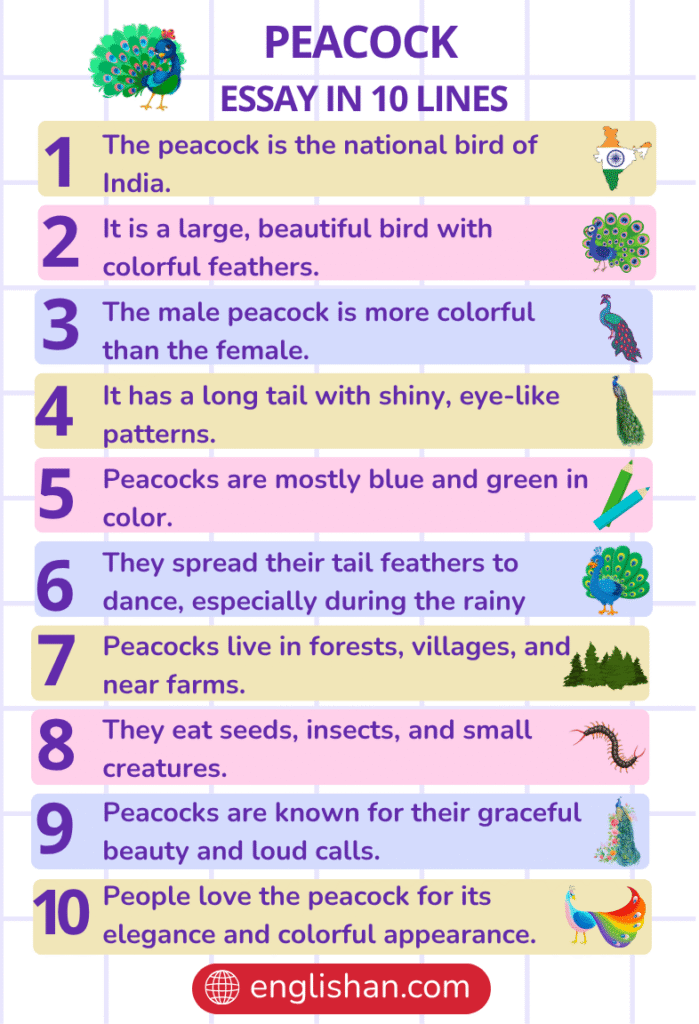
- The peacock is the national bird of India.
- It is a large, beautiful bird with colorful feathers.
- The male peacock is more colorful than the female.
- It has a long tail with shiny, eye-like patterns.
- Peacocks are mostly blue and green in color.
- They spread their tail feathers to dance, especially during the rainy season.
- Peacocks live in forests, villages, and near farms.
- They eat seeds, insects, and small creatures.
- Peacocks are known for their graceful beauty and loud calls.
- People love the peacock for its elegance and colorful appearance.
250 Words Essay on Peacock for Middle School
The peacock is one of the most beautiful birds in the world and is known as the national bird of India. It belongs to the pheasant family and is admired for its grace, color, and elegance. The male peacock has a long, vibrant tail with shiny blue, green, and golden feathers. These tail feathers are called a train and have eye-like patterns that look very attractive.
Peacocks are commonly found in forests, gardens, and near villages. They eat seeds, fruits, grains, insects, and small reptiles. Their loud and sharp call can often be heard before they are seen. During the rainy season, the peacock is seen dancing with its tail spread wide open. This dance is a sign of joy and is also used to attract female peahens.
Unlike the male, the peahen is dull in color and does not have long tail feathers. The male uses its beautiful feathers to impress the female during mating season. Peacocks are also considered sacred in some cultures and are often seen in paintings, stories, and temple art.
The beauty of a peacock is not only admired in nature but also used in decorations, fabrics, and traditional art. Because of its prideful walk and eye-catching feathers, the peacock is a symbol of grace, beauty, and dignity. Protecting this bird and its natural habitat is important for preserving its charm for future generations.
500 Words Peacock Essay for Upper Primary and Lower Secondary
Physical Features of a Peacock
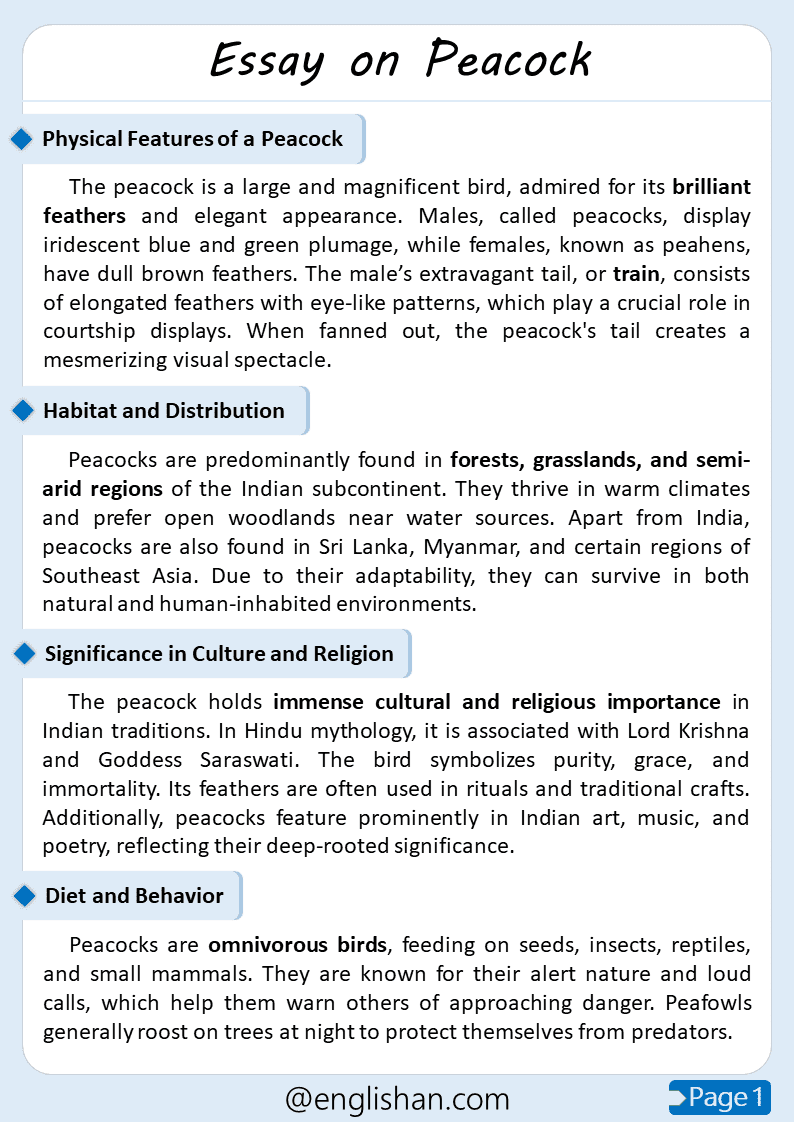
The peacock is a large and magnificent bird, admired for its brilliant feathers and elegant appearance. Males, called peacocks, display iridescent blue and green plumage, while females, known as peahens, have dull brown feathers. The male’s extravagant tail, or train, consists of elongated feathers with eye-like patterns, which play a crucial role in courtship displays. When fanned out, the peacock’s tail creates a mesmerizing visual spectacle.
Habitat and Distribution
Peacocks are predominantly found in forests, grasslands, and semi-arid regions of the Indian subcontinent. They thrive in warm climates and prefer open woodlands near water sources. Apart from India, peacocks are also found in Sri Lanka, Myanmar, and certain regions of Southeast Asia. Due to their adaptability, they can survive in both natural and human-inhabited environments.
Significance in Culture and Religion
The peacock holds immense cultural and religious importance in Indian traditions. In Hindu mythology, it is associated with Lord Krishna and Goddess Saraswati. The bird symbolizes purity, grace, and immortality. Its feathers are often used in rituals and traditional crafts. Additionally, peacocks feature prominently in Indian art, music, and poetry, reflecting their deep-rooted significance.
Diet and Behavior
Peacocks are omnivorous birds, feeding on seeds, insects, reptiles, and small mammals. They are known for their alert nature and loud calls, which help them warn others of approaching danger. Peafowls generally roost on trees at night to protect themselves from predators. Their courtship dance, where the male spreads its resplendent tail and vibrates its feathers, is one of the most fascinating aspects of their behavior.
Conservation Status
Despite being widely distributed, peacocks face threats from habitat destruction and poaching. Their feathers are in demand for decorative purposes, leading to illegal hunting. However, in India, they are protected under the Wildlife Protection Act, ensuring their safety from exploitation. Conservation efforts focus on habitat preservation and strict laws against hunting.
Peacock in Mythology and Symbolism
The peacock is a prominent figure in various mythologies and traditions. In Hinduism, it represents wisdom and divine protection, while in Greek mythology, it symbolizes immortality. Many cultures associate peacocks with pride, beauty, and prosperity.
Peacock Feathers and Their Uses
Peacock feathers are valued for their aesthetic appeal and spiritual significance. They are often used in home decor, religious ceremonies, and traditional attire. Many people believe that keeping peacock feathers at home brings good luck and wards off negative energy.
Different Species of Peacocks
There are three main species of peafowl: the Indian Peafowl, Green Peafowl, and Congo Peafowl. Indian Peafowl is the most well-known and widely distributed, while the Green Peafowl is found in Southeast Asia. The Congo Peafowl, native to Africa, is lesser-known but equally unique.
Lifespan and Reproduction
Peacocks have an average lifespan of 10 to 25 years in the wild, depending on environmental conditions. During mating season, males perform elaborate displays to attract peahens. After mating, the female lays eggs in a hidden nest, and the chicks hatch after about a month.
Role of Peacocks in Ecosystem
Peacocks contribute to the ecosystem by controlling insect populations and acting as prey for larger predators. Their presence in forests and farmlands helps maintain ecological balance, making them an essential part of their habitats.
Conclusion
The peacock is a symbol of beauty, elegance, and cultural heritage. Its striking features, fascinating behavior, and deep-rooted significance make it an extraordinary bird. Efforts to protect and preserve peacocks ensure that future generations continue to admire their majestic presence.
Difficult Words Used in 500 Peacock Essay
| Word | Meaning |
|---|---|
| Plumage | Feathers covering a bird’s body |
| Iridescent | Showing luminous colors that change with light |
| Courtship | Behavior related to attracting a mate |
| Omnivorous | Eating both plants and animals |
| Conservation | Protection of wildlife and nature |
Peacock Essay PDF
You May Also Like