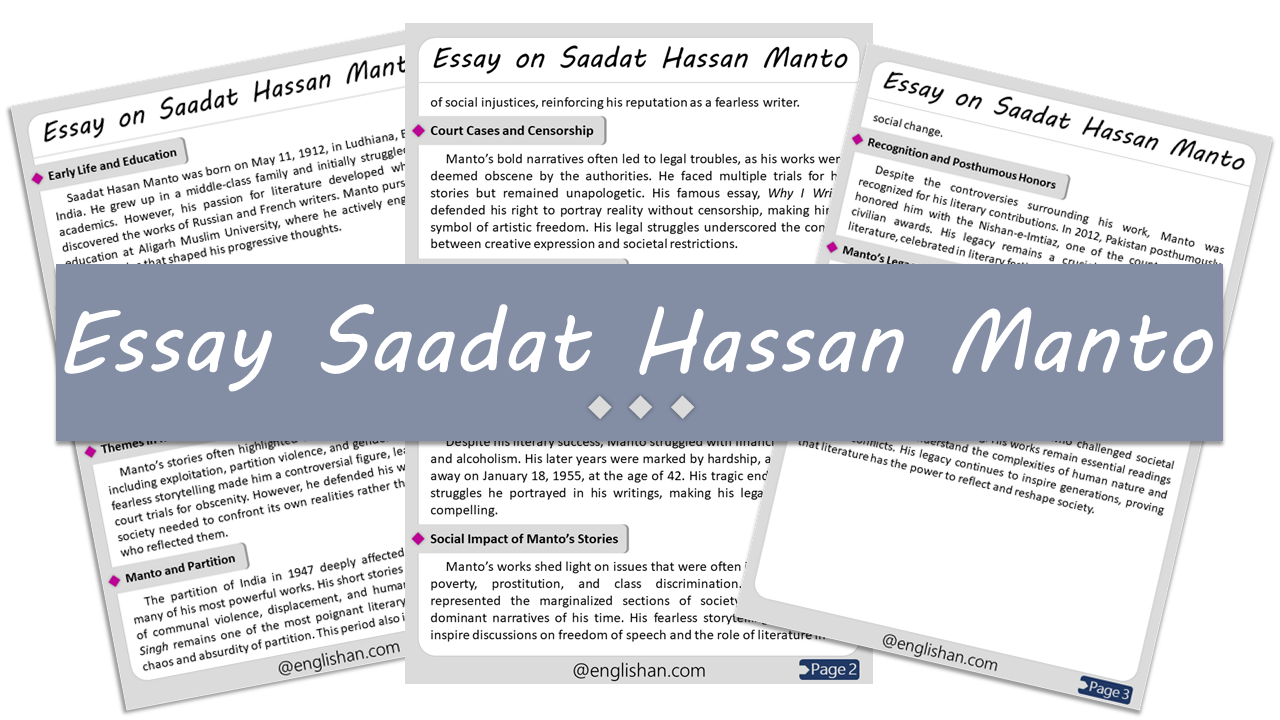
When writing about Saadat Hasan Manto, it’s important to understand his role as a bold Urdu writer who revealed real life and social issues through his short stories. This essay on Manto explains his early life, writing style, themes, and his impact on literature. It’s written in 250 words to help students with homework or exams. You can download this Saadat Hasan Manto essay as a free PDF or image to study or print.
10 Lines Saadat Hasan Manto Essay for Class 2 to Class 5
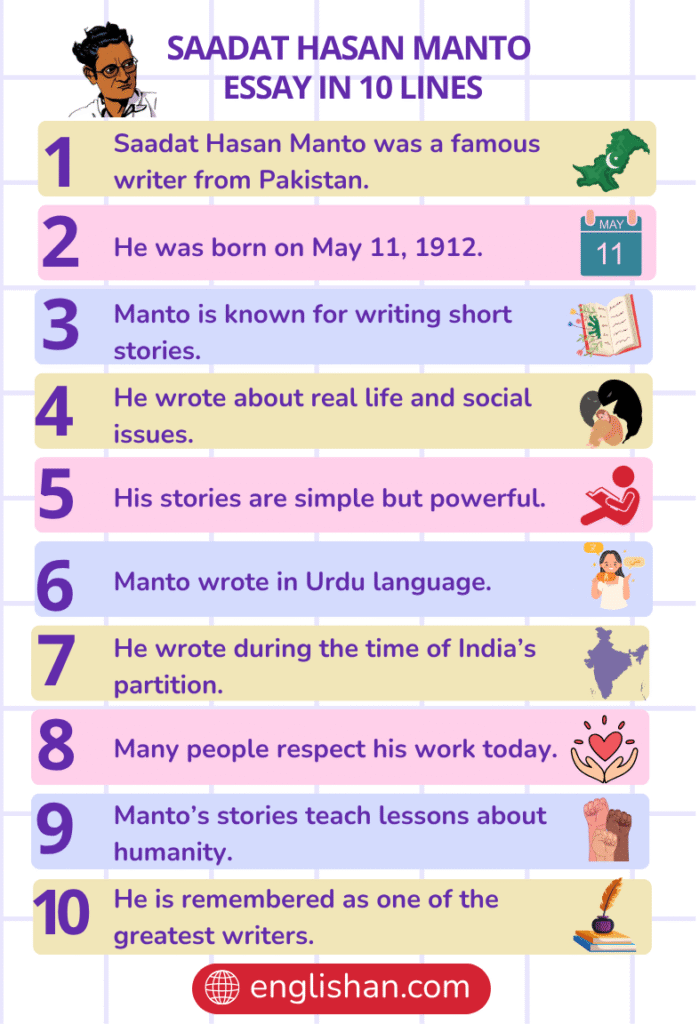
- Saadat Hasan Manto was a famous writer from Pakistan.
- He was born on May 11, 1912.
- Manto is known for writing short stories.
- He wrote about real life and social issues.
- His stories are simple but powerful.
- Manto wrote in Urdu language.
- He wrote during the time of India’s partition.
- Many people respect his work today.
- Manto’s stories teach lessons about humanity.
- He is remembered as one of the greatest writers.
250 Words Essay on Saadat Hasan Manto for Middle School
Saadat Hasan Manto was a famous writer known for his short stories and bold writing style. He was born on May 11, 1912, in British India. Manto wrote mainly in Urdu and is remembered for his honest and clear portrayal of human nature and society.
Manto lived during a difficult time in history, especially during the partition of India in 1947. His stories reflected the pain, fear, and struggles people faced during this time. Many of his works focus on social issues such as poverty, violence, and the impact of partition on common people.
Manto’s writing style was simple but powerful. He did not hide the harsh realities of life and wrote about subjects that others avoided. Because of this, some of his stories were controversial and faced criticism. However, his courage to tell the truth made him an important figure in literature.
Even today, Manto’s stories are studied and respected in Pakistan and around the world. His works teach important lessons about human nature, compassion, and the consequences of hatred. Manto’s contribution to Urdu literature has made him one of the greatest writers of the 20th century.
500 Words Saadat Hasan Manto Essay for Upper Primary and Lower Secondary
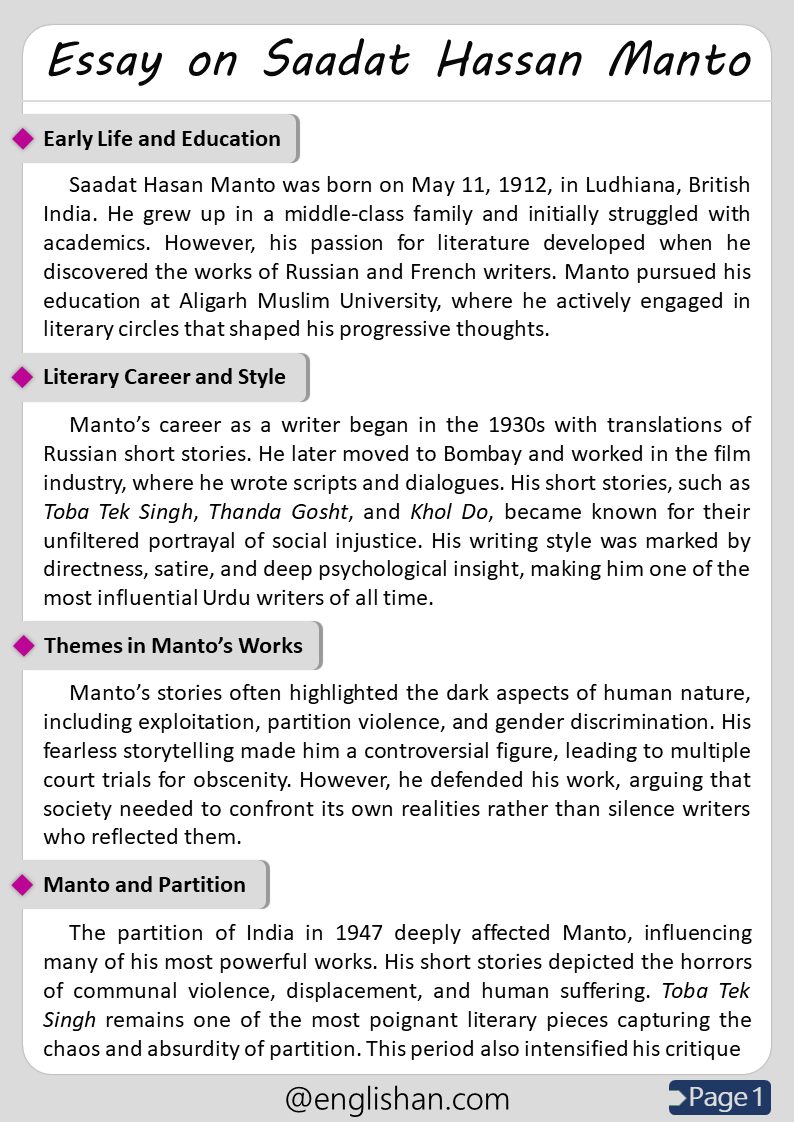
Early Life and Education
Saadat Hasan Manto was born on May 11, 1912, in Ludhiana, British India. He grew up in a middle-class family and initially struggled with academics. However, his passion for literature developed when he discovered the works of Russian and French writers. Manto pursued his education at Aligarh Muslim University, where he actively engaged in literary circles that shaped his progressive thoughts.
Literary Career and Style
Manto’s career as a writer began in the 1930s with translations of Russian short stories. He later moved to Bombay and worked in the film industry, where he wrote scripts and dialogues. His short stories, such as Toba Tek Singh, Thanda Gosht, and Khol Do, became known for their unfiltered portrayal of social injustice. His writing style was marked by directness, satire, and deep psychological insight, making him one of the most influential Urdu writers of all time.
Themes in Manto’s Works
Manto’s stories often highlighted the dark aspects of human nature, including exploitation, partition violence, and gender discrimination. His fearless storytelling made him a controversial figure, leading to multiple court trials for obscenity. However, he defended his work, arguing that society needed to confront its own realities rather than silence writers who reflected them.
Manto and Partition
The partition of India in 1947 deeply affected Manto, influencing many of his most powerful works. His short stories depicted the horrors of communal violence, displacement, and human suffering. Toba Tek Singh remains one of the most poignant literary pieces capturing the chaos and absurdity of partition. This period also intensified his critique of social injustices, reinforcing his reputation as a fearless writer.
Court Cases and Censorship
Manto’s bold narratives often led to legal troubles, as his works were deemed obscene by the authorities. He faced multiple trials for his stories but remained unapologetic. His famous essay, Why I Write, defended his right to portray reality without censorship, making him a symbol of artistic freedom. His legal struggles underscored the conflict between creative expression and societal restrictions.
Influence on Modern Literature
Manto’s impact on South Asian literature remains profound. Many contemporary writers and filmmakers draw inspiration from his unapologetic storytelling. His works are studied in academic institutions, and adaptations of his stories continue to appear in films, plays, and television dramas. For example, the 2018 biographical film Manto, directed by Nandita Das, highlighted his struggles and literary brilliance.
Personal Struggles and Death
Despite his literary success, Manto struggled with financial difficulties and alcoholism. His later years were marked by hardship, and he passed away on January 18, 1955, at the age of 42. His tragic end mirrored the struggles he portrayed in his writings, making his legacy even more compelling.
Social Impact of Manto’s Stories
Manto’s works shed light on issues that were often ignored, including poverty, prostitution, and class discrimination. His characters represented the marginalized sections of society, challenging the dominant narratives of his time. His fearless storytelling continues to inspire discussions on freedom of speech and the role of literature in social change.
Recognition and Posthumous Honors
Despite the controversies surrounding his work, Manto was recognized for his literary contributions. In 2012, Pakistan posthumously honored him with the Nishan-e-Imtiaz, one of the country’s highest civilian awards. His legacy remains a crucial part of South Asian literature, celebrated in literary festivals and academic discussions.
Manto’s Legacy in Cinema and Media
Manto’s influence extends beyond literature into cinema and media. Numerous films and documentaries have explored his life and stories, bringing his narratives to new audiences. His works continue to be adapted into plays and radio dramas, proving their timeless relevance in storytelling.
Conclusion
Saadat Hasan Manto was a fearless writer who challenged societal norms through his bold storytelling. His works remain essential readings for those seeking to understand the complexities of human nature and historical conflicts. His legacy continues to inspire generations, proving that literature has the power to reflect and reshape society.
Difficult Words Used in 500 Saadat Hasan Manto Essay
| Word | Meaning |
|---|---|
| Revolutionary | Bringing significant change |
| Unfiltered | Expressed without censorship |
| Psychological | Related to human behavior and mind |
| Exploitation | Treating someone unfairly for benefit |
| Marginalized | Pushed to the edge of society |
| Controversial | Causing public disagreement |
| Posthumously | After one’s death |
| Documentation | Recorded evidence or account |
Saadat Hasan Manto Essay PDF
You May Also Like