


When writing about supercomputers, it’s important to understand how powerful machines help solve big problems quickly. This essay on supercomputers explains what they are, where they are used, how they help in science, weather, and health, and why they are important for the future. It’s written in 500 words to help students with homework or exams. You can download this supercomputer essay as a free PDF or image to study or print.
10 Lines Supercomputer Essay for Class 2 to Class 5
- A supercomputer is a very fast and powerful computer.
- It can do many tasks in just a few seconds.
- Supercomputers are bigger than normal computers.
- They are used for solving very hard problems.
- Scientists use supercomputers to study weather and space.
- They help in medical research and big science projects.
- Supercomputers work day and night without stopping.
- They can do work that would take many people a long time.
- India also has some powerful supercomputers.
- Supercomputers are important for our future and learning.

250 Words Essay on Supercomputer for Middle School
A supercomputer is one of the fastest and most powerful computers in the world. It can process large amounts of data in seconds, which regular computers would take hours or even days to do. Supercomputers are much larger in size and are often kept in special rooms with cooling systems because they get very hot while working.
These powerful machines are used in many important areas. Scientists use supercomputers to study space, weather, and natural disasters like earthquakes. They help predict weather patterns, which is useful for farmers and for saving lives during storms or floods. In medicine, supercomputers are used to study diseases, find cures, and even design new medicines.
Supercomputers also play a big role in defense and national security. Governments use them to test defense systems and protect the country. They are also used in space research, helping scientists learn more about planets and stars.
India has developed its own supercomputers too, like PARAM and Pratyush. These machines have helped the country grow in science and technology.
In conclusion, supercomputers are very important for solving big problems and helping people. They save time, give fast results, and are used in many fields like science, health, weather, and space. As technology improves, supercomputers will become even more powerful and useful for the world.
500 Words Supercomputer Essay for Upper Primary and Lower Secondary
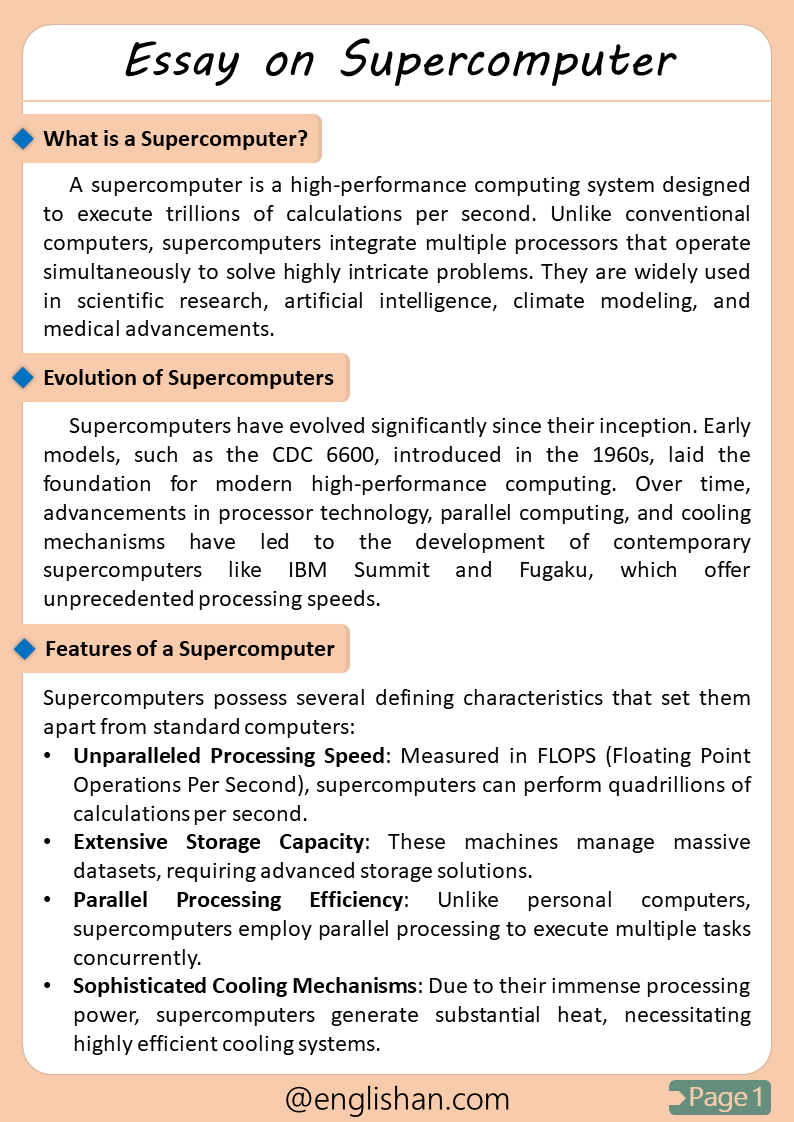
What is a Supercomputer?
A supercomputer is a high-performance computing system designed to execute trillions of calculations per second. Unlike conventional computers, supercomputers integrate multiple processors that operate simultaneously to solve highly intricate problems. They are widely used in scientific research, artificial intelligence, climate modeling, and medical advancements.
Evolution of Supercomputers
Supercomputers have evolved significantly since their inception. Early models, such as the CDC 6600, introduced in the 1960s, laid the foundation for modern high-performance computing. Over time, advancements in processor technology, parallel computing, and cooling mechanisms have led to the development of contemporary supercomputers like IBM Summit and Fugaku, which offer unprecedented processing speeds.
Features of a Supercomputer
Supercomputers possess several defining characteristics that set them apart from standard computers:
- Unparalleled Processing Speed: Measured in FLOPS (Floating Point Operations Per Second), supercomputers can perform quadrillions of calculations per second.
- Extensive Storage Capacity: These machines manage massive datasets, requiring advanced storage solutions.
- Parallel Processing Efficiency: Unlike personal computers, supercomputers employ parallel processing to execute multiple tasks concurrently.
- Sophisticated Cooling Mechanisms: Due to their immense processing power, supercomputers generate substantial heat, necessitating highly efficient cooling systems.
- High Energy Consumption: These machines require enormous amounts of energy to function efficiently.
Applications of Supercomputers
Supercomputers are essential in various domains that demand extreme computational power:
- Scientific Research: They facilitate complex calculations in physics, chemistry, and biology.
- Weather Forecasting: Meteorologists use supercomputers to predict climate patterns and natural disasters with high accuracy.
- Medical Advancements: These machines aid in genetic analysis, drug discovery, and disease simulations.
- Space Exploration: Supercomputers contribute to space mission simulations and astronomical data analysis.
- Cryptography and Cybersecurity: They play a critical role in securing communication through encryption and decryption processes.
- Artificial Intelligence & Machine Learning: Supercomputers accelerate deep learning models and AI-based simulations.
Ethical and Environmental Concerns of Supercomputers
The growing reliance on supercomputers has raised ethical and environmental concerns. One major issue is energy consumption; supercomputers require vast amounts of electricity, contributing to carbon emissions. To mitigate this, researchers are developing energy-efficient models. Additionally, ethical concerns arise regarding data privacy and security, as supercomputers process vast amounts of sensitive information. Striking a balance between innovation and sustainability is crucial for the responsible development of supercomputing technologies.
Challenges of Supercomputers
Despite their advantages, supercomputers come with several challenges:
- High Operational Costs: The cost of building and maintaining a supercomputer is extremely high.
- Excessive Power Consumption: These machines require extensive power sources, making them less energy-efficient.
- Complex Programming Requirements: Specialized knowledge is necessary to develop and manage software for supercomputers.
Future of Supercomputing
With rapid advancements in quantum computing, artificial intelligence, and cloud-based high-performance computing, supercomputers are expected to become more powerful and energy-efficient. Researchers are also exploring neuromorphic computing, inspired by the human brain, to further enhance processing capabilities.
Conclusion
Supercomputers represent a transformative technology that continues to shape the modern world. With their immense processing power, they solve intricate problems, accelerate scientific discoveries, and support various industries. As technological advancements continue, the capabilities of supercomputers will expand, reinforcing their indispensable role in future innovations.
Difficult Words Used in 500 Supercomputer Essay
| Word | Meaning |
|---|---|
| FLOPS | A unit measuring a computer’s processing speed in floating-point operations per second. |
| Parallel Processing | A computing method where multiple processors execute different tasks simultaneously. |
| Cryptography | The science of securing information through encryption techniques. |
| Quantum Computing | An advanced computing paradigm leveraging quantum mechanics for accelerated processing. |
| Artificial Intelligence | The simulation of human intelligence by machines for problem-solving and decision-making. |
| Neuromorphic Computing | A computing model inspired by the structure and functions of the human brain. |
| High-Performance Computing | The use of supercomputers and clusters to solve complex problems. |
Supercomputer Essay PDF
You May Also Like