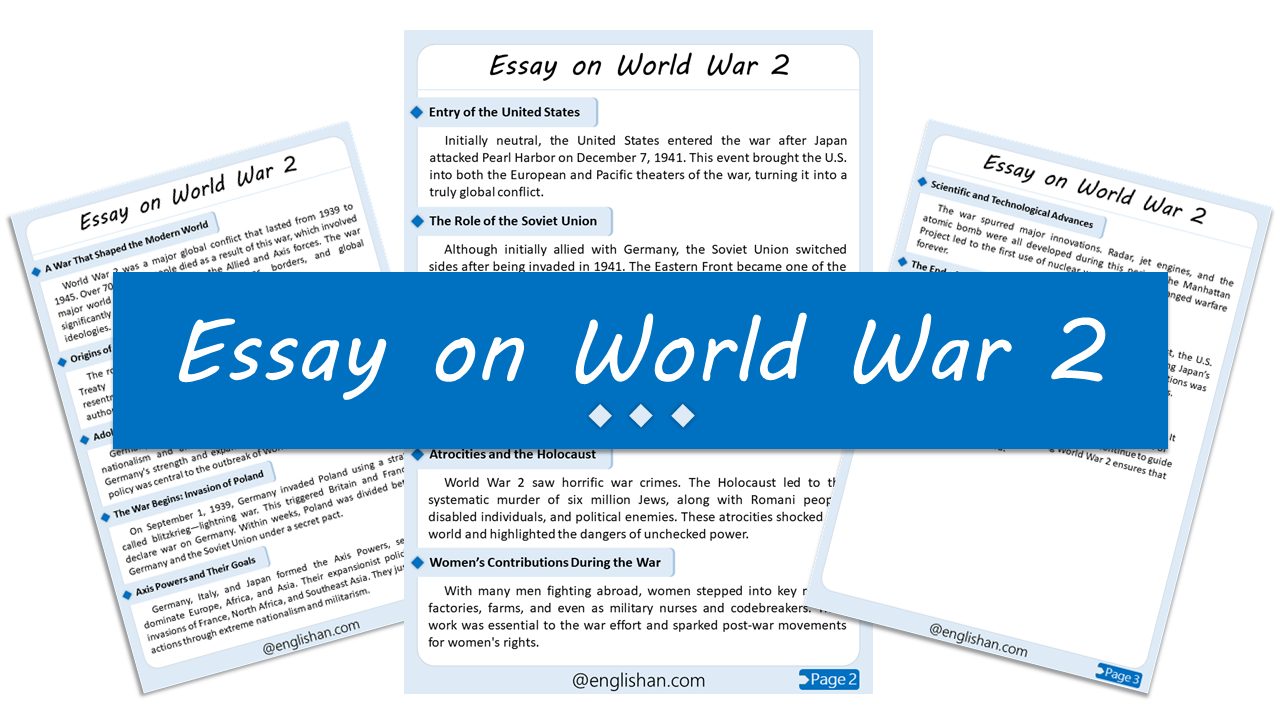
When writing about World War 2, it’s important to understand how this global conflict changed countries, lives, and the future of the world. This essay on World War 2 explains its causes, major events, countries involved, and the effects it had on people and history. It’s written in 500 words to help students prepare for homework, tests, or school projects. You can download this World War 2 essay as a free PDF or image to read, study, or print.
10 Lines World War 2 Essay for Class 2 to Class 5
- World War 2 was a big war that happened from 1939 to 1945.
- Many countries around the world were involved in the war.
- The two main groups were called the Allies and the Axis.
- The war started when Germany attacked Poland.
- Adolf Hitler was the leader of Germany during the war.
- Countries like the USA, UK, and Russia were part of the Allies.
- Japan attacked Pearl Harbor in 1941, bringing the USA into the war.
- Millions of people, including soldiers and civilians, died.
- The war ended in 1945 after Germany and Japan were defeated.
- World War 2 changed the world and taught us the value of peace.
250 Words Essay on World War 2 for Middle School
World War 2 was a major global conflict that lasted from 1939 to 1945. It involved many countries from around the world and is considered one of the most destructive wars in human history. The two sides in the war were known as the Allies and the Axis powers.
The war began when Germany, led by Adolf Hitler, invaded Poland on September 1, 1939. Britain and France declared war on Germany soon after. The Axis powers included Germany, Italy, and Japan. The Allies included countries like the United Kingdom, the Soviet Union, China, and later the United States.
One of the most tragic parts of the war was the Holocaust, in which millions of Jews and other innocent people were killed by the Nazis. In 1941, Japan attacked Pearl Harbor, leading the United States to join the war. Battles took place in Europe, Africa, and Asia.
World War 2 ended in 1945 when the Allies defeated Germany and Japan. Germany surrendered in May 1945, and Japan surrendered in August after atomic bombs were dropped on the cities of Hiroshima and Nagasaki.
The war caused the deaths of over 70 million people. It also led to the formation of the United Nations to promote peace. World War 2 had a huge impact on history and reminds us how important it is to avoid war and work together for peace.
500 Words World War 2 Essay for Upper Primary and Lower Secondary
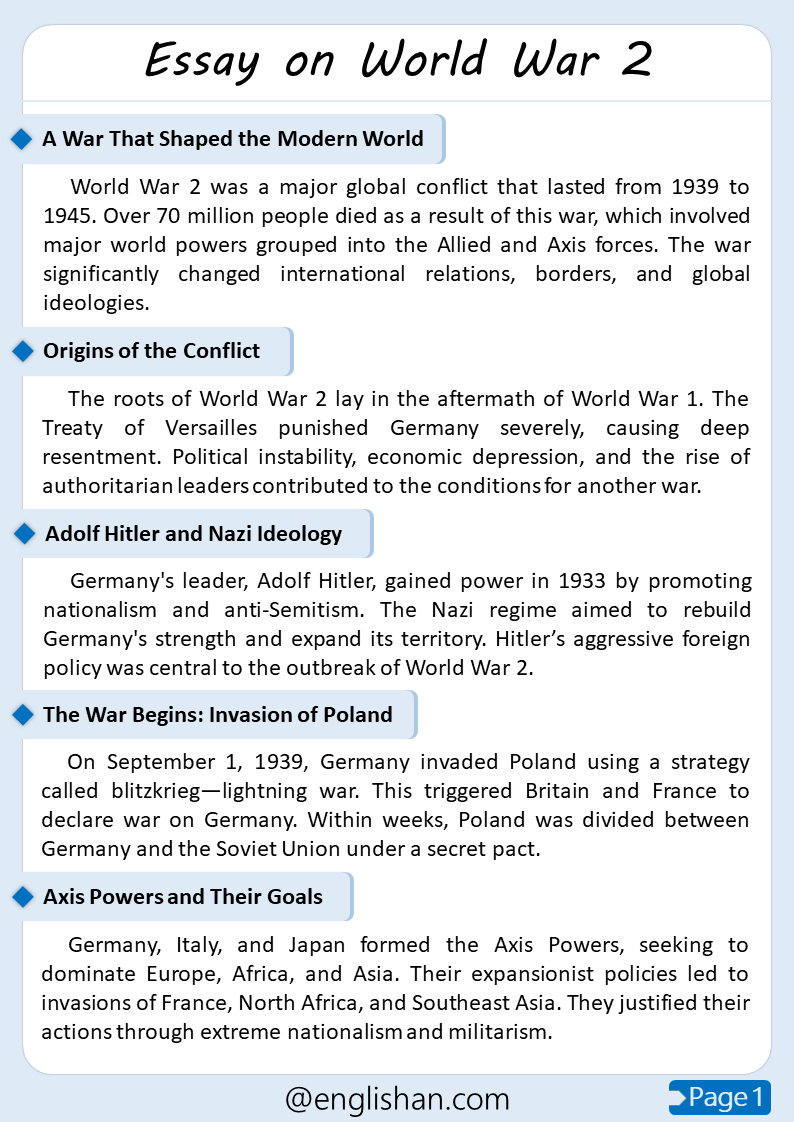
A War That Shaped the Modern World
World War 2 was a major global conflict that lasted from 1939 to 1945. Over 70 million people died as a result of this war, which involved major world powers grouped into the Allied and Axis forces. The war significantly changed international relations, borders, and global ideologies.
Origins of the Conflict
The roots of World War 2 lay in the aftermath of World War 1. The Treaty of Versailles punished Germany severely, causing deep resentment. Political instability, economic depression, and the rise of authoritarian leaders contributed to the conditions for another war.
Adolf Hitler and Nazi Ideology
Germany’s leader, Adolf Hitler, gained power in 1933 by promoting nationalism and anti-Semitism. The Nazi regime aimed to rebuild Germany’s strength and expand its territory. Hitler’s aggressive foreign policy was central to the outbreak of World War 2.
The War Begins: Invasion of Poland
On September 1, 1939, Germany invaded Poland using a strategy called blitzkrieg—lightning war. This triggered Britain and France to declare war on Germany. Within weeks, Poland was divided between Germany and the Soviet Union under a secret pact.
Axis Powers and Their Goals
Germany, Italy, and Japan formed the Axis Powers, seeking to dominate Europe, Africa, and Asia. Their expansionist policies led to invasions of France, North Africa, and Southeast Asia. They justified their actions through extreme nationalism and militarism.
Entry of the United States
Initially neutral, the United States entered the war after Japan attacked Pearl Harbor on December 7, 1941. This event brought the U.S. into both the European and Pacific theaters of the war, turning it into a truly global conflict.
The Role of the Soviet Union
Although initially allied with Germany, the Soviet Union switched sides after being invaded in 1941. The Eastern Front became one of the bloodiest battlefields. The USSR’s resistance and eventual counterattacks played a major role in defeating Nazi Germany.
Turning Points of the War
Several events changed the tide of war. These include:
- The Battle of Stalingrad (1942–43): A major Soviet victory.
- D-Day (June 6, 1944): Allied forces landed in Normandy, France.
- The Battle of Midway (1942): The U.S. halted Japan’s advance in the Pacific.
Atrocities and the Holocaust
World War 2 saw horrific war crimes. The Holocaust led to the systematic murder of six million Jews, along with Romani people, disabled individuals, and political enemies. These atrocities shocked the world and highlighted the dangers of unchecked power.
Women’s Contributions During the War
With many men fighting abroad, women stepped into key roles in factories, farms, and even as military nurses and codebreakers. Their work was essential to the war effort and sparked post-war movements for women’s rights.
Scientific and Technological Advances
The war spurred major innovations. Radar, jet engines, and the atomic bomb were all developed during this period. The Manhattan Project led to the first use of nuclear weapons, which changed warfare forever.
The End of the War and Aftermath
Germany surrendered on May 8, 1945 (V-E Day). In August, the U.S. dropped atomic bombs on Hiroshima and Nagasaki, prompting Japan’s surrender on August 15 (V-J Day). After the war, the United Nations was established to promote peace and prevent future global conflicts.
Conclusion of World War 2 Essay
World War 2 reshaped global politics, economies, and societies. It taught humanity the cost of hatred and dictatorship. The lessons of unity, resistance to tyranny, and global cooperation continue to guide international policies today. Remembering World War 2 ensures that such tragedy is never repeated.
Difficult Words Used in 500 World War 2 Essay
| Word | Meaning |
|---|---|
| Blitzkrieg | A fast, surprise military attack using speed and force |
| Expansionist | Favoring the enlargement of a country’s territory or influence |
| Authoritarian | Enforcing strict obedience at the cost of personal freedom |
| Counterattack | An attack made in response to an enemy’s offensive |
| Theater (war) | A large area where significant military events occur during a war |
| Atrocities | Extremely wicked or cruel acts, often involving physical violence |
| Ideologies | Sets of beliefs or ideas shared by a group or political system |
| Militarism | The belief that a country should maintain a strong military |
World War 2 Essay PDF
You May Also Like