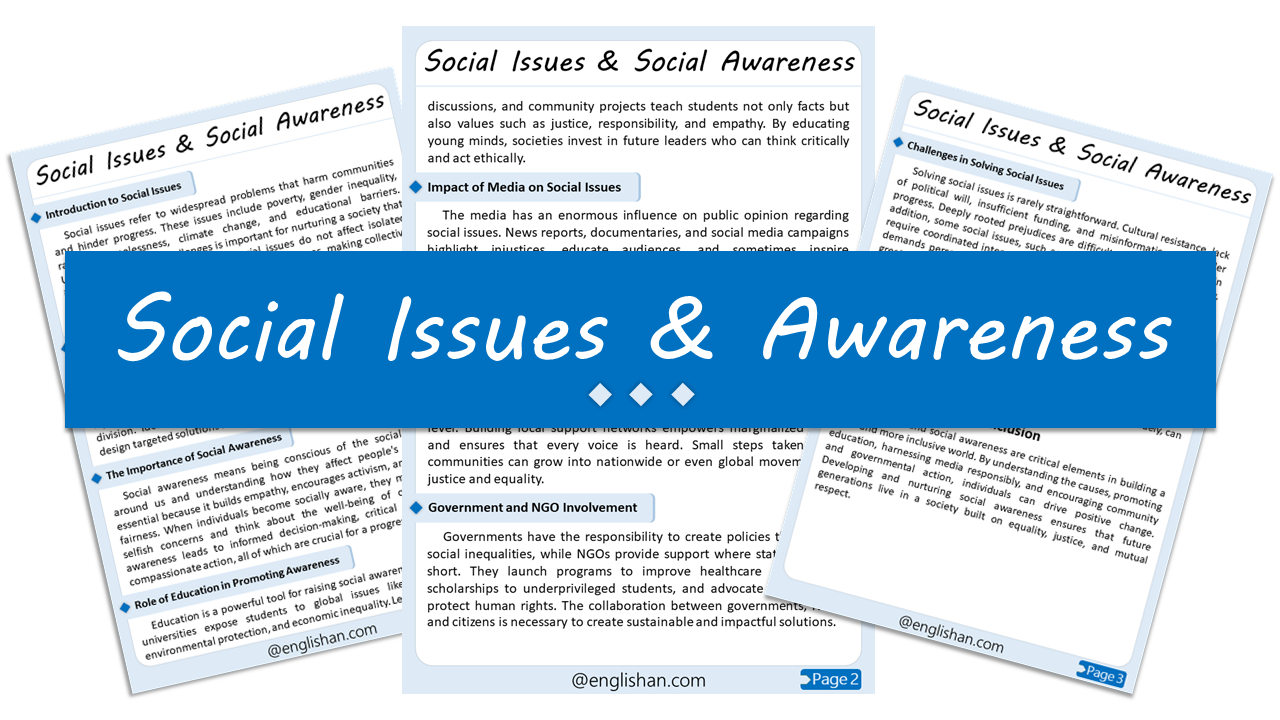
When writing about social issues and social awareness essay, it’s important to understand how problems like poverty, pollution, and inequality affect communities. This essay explains common social issues, the importance of being aware, and how education helps us make positive changes. It’s written in 500 words to assist middle school students with homework or exams. You can download this essay as a free PDF or image to study or print.
10 Lines Social Issues and Social Awareness Essay for Class 2 to Class 5
- Social issues affect many people in society.
- They include problems like poverty, pollution, and inequality.
- Social awareness means knowing about these problems.
- It helps people understand the difficulties others face.
- Being aware can lead to helping those in need.
- Education plays an important role in raising awareness.
- People can work together to solve social problems.
- Social awareness teaches kindness and respect.
- It encourages fair treatment for everyone.
- Together, we can make the world a better place.

250 Words Essay on Social Issues and Social Awareness for Middle School
Social issues are problems that affect many people in a community or country. These problems include poverty, unemployment, pollution, and discrimination. When people face social issues, it can make life difficult for them and for others around them. Social awareness means understanding these problems and knowing how they impact people’s lives.
Being socially aware helps us recognize the struggles faced by others. It teaches us to be kind, respectful, and caring toward everyone, no matter their background or situation. When we understand social issues, we can work together to find solutions. For example, people can help by volunteering, donating, or speaking up against unfair treatment.
Education is very important for social awareness. Schools and communities can teach students about social problems and how to help. Learning about these issues helps young people grow into responsible adults who care about their society.
Social awareness also promotes equality and justice. It encourages people to treat others fairly and stand against discrimination. When everyone is aware and acts kindly, social problems can reduce, and communities become stronger and happier.
In conclusion, social issues affect many people, but social awareness gives us the power to make positive changes. By learning and helping, we can build a better world where everyone is respected and supported.
500 Words Social Issues and Social Awareness Essay for Upper Primary and Lower Secondary
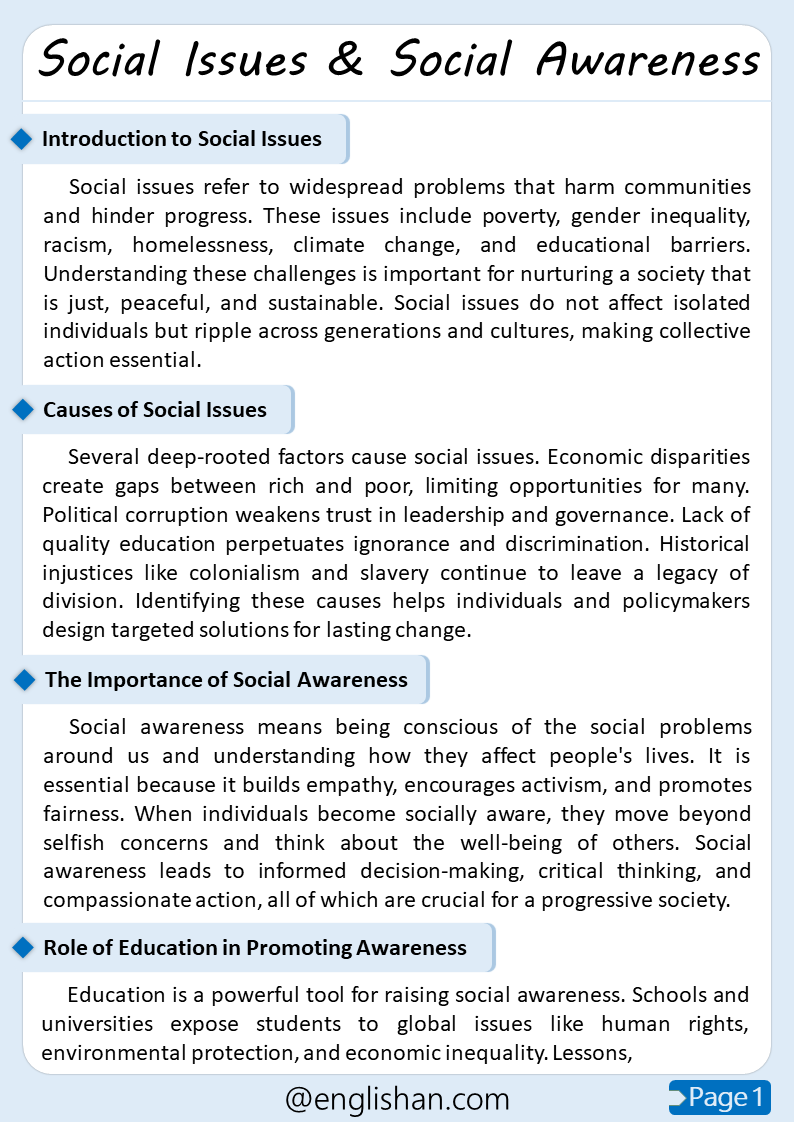
Introduction to Social Issues
Social issues refer to widespread problems that harm communities and hinder progress. These issues include poverty, gender inequality, racism, homelessness, climate change, and educational barriers. Understanding these challenges is important for nurturing a society that is just, peaceful, and sustainable. Social issues do not affect isolated individuals but ripple across generations and cultures, making collective action essential.
Causes of Social Issues
Several deep-rooted factors cause social issues. Economic disparities create gaps between rich and poor, limiting opportunities for many. Political corruption weakens trust in leadership and governance. Lack of quality education perpetuates ignorance and discrimination. Historical injustices like colonialism and slavery continue to leave a legacy of division. Identifying these causes helps individuals and policymakers design targeted solutions for lasting change.
The Importance of Social Awareness
Social awareness means being conscious of the social problems around us and understanding how they affect people’s lives. It is essential because it builds empathy, encourages activism, and promotes fairness. When individuals become socially aware, they move beyond selfish concerns and think about the well-being of others. Social awareness leads to informed decision-making, critical thinking, and compassionate action, all of which are crucial for a progressive society.
Role of Education in Promoting Awareness
Education is a powerful tool for raising social awareness. Schools and universities expose students to global issues like human rights, environmental protection, and economic inequality. Lessons, discussions, and community projects teach students not only facts but also values such as justice, responsibility, and empathy. By educating young minds, societies invest in future leaders who can think critically and act ethically.
Impact of Media on Social Issues
The media has an enormous influence on public opinion regarding social issues. News reports, documentaries, and social media campaigns highlight injustices, educate audiences, and sometimes inspire movements. However, misinformation and bias can distort realities and deepen divides. It is important to develop media literacy skills to evaluate sources critically, distinguish facts from opinions, and support credible journalism that promotes positive change.
How Communities Can Make a Difference
Communities are the backbone of social progress. Through collective efforts like fundraising events, environmental clean-up drives, and educational campaigns, communities address issues at the grassroots level. Building local support networks empowers marginalized groups and ensures that every voice is heard. Small steps taken within communities can grow into nationwide or even global movements for justice and equality.
Government and NGO Involvement
Governments have the responsibility to create policies that address social inequalities, while NGOs provide support where state efforts fall short. They launch programs to improve healthcare access, offer scholarships to underprivileged students, and advocate for laws that protect human rights. The collaboration between governments, NGOs, and citizens is necessary to create sustainable and impactful solutions.
Challenges in Solving Social Issues
Solving social issues is rarely straightforward. Cultural resistance, lack of political will, insufficient funding, and misinformation can hinder progress. Deeply rooted prejudices are difficult to eliminate quickly. In addition, some social issues, such as climate change or global poverty, require coordinated international efforts. Overcoming these challenges demands perseverance, innovation, and a shared commitment to the greater good.
Steps Individuals Can Take
Each person can play a role in tackling social issues. Staying informed, voting responsibly, supporting ethical businesses, volunteering for social causes, and educating others are all meaningful actions. Speaking up against injustice, even in small ways, contributes to a broader culture of fairness and respect. Personal responsibility, when embraced widely, can transform societies.
Conclusion
Social issues and social awareness are critical elements in building a fairer and more inclusive world. By understanding the causes, promoting education, harnessing media responsibly, and encouraging community and governmental action, individuals can drive positive change. Developing and nurturing social awareness ensures that future generations live in a society built on equality, justice, and mutual respect.
Difficult Words Used in 500 Social Issues and Social Awareness Essay
| Word | Meaning |
|---|---|
| Discrimination | Unfair treatment based on personal characteristics like race or gender |
| Inequality | Unequal distribution of resources or rights among people |
| Empathy | The ability to understand and share the feelings of others |
| Outreach | Activities aimed at bringing services or information to a wider group |
| Persistence | Continued effort to achieve something despite challenges |
| Citizenship | The status and duties of a person recognized as a member of a country |
| Conservation | Protection of the environment or natural resources |
| Misconception | A mistaken belief or idea |
| Innovation | The introduction of new ideas, methods, or products |
| Collaboration | Working together with others to achieve a common goal |
Social Issues and Social Awareness Essay PDF
You May Also Like