Hail and hale sound exactly the same, but they mean very different things. Hail can refer to ice falling during a storm, and it can also mean to greet, call out to, or praise someone. Hale, by contrast, describes a person who is healthy, strong, and full of energy.
That difference becomes easier once you connect each spelling to the kind of sentence where it usually appears. In hail vs hale, one word belongs in weather, greetings, and praise, while the other belongs in descriptions of health and strength. This article explains what each word means, how to use each one, and how to choose the right spelling in context.
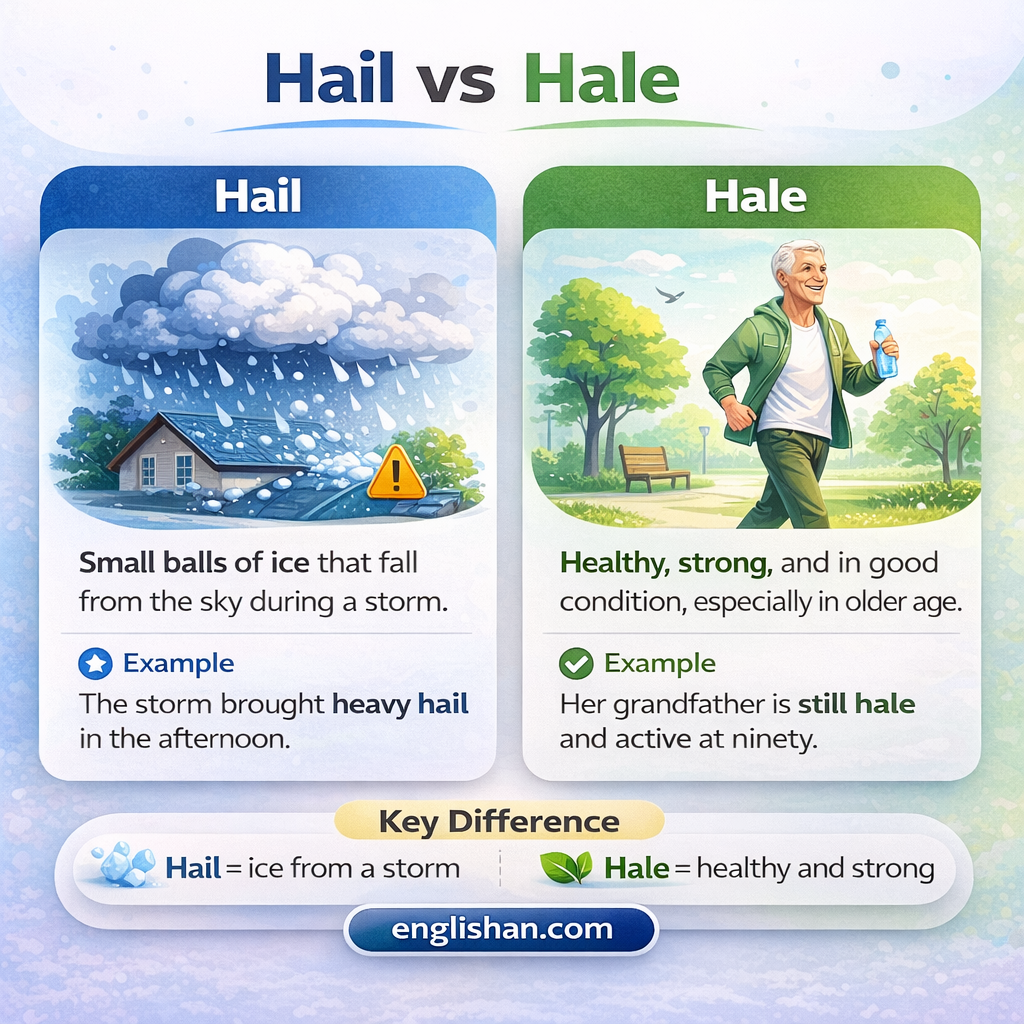
Hail vs Hale: Quick Answer
Here is the quickest way to tell them apart:
| Word | Main Meaning | Part of Speech | Common Context | Example |
|---|---|---|---|---|
| hail | frozen ice pellets, or to call out, greet, or praise | noun, verb | weather, calling, greeting, praise | Hail damaged the crops. |
| hale | healthy, strong, and active | adjective | health, aging, physical condition | She is still hale at eighty. |
If the sentence is about weather, calling out, greeting, or praise, use hail.
If it describes health, strength, or physical energy, use hale.
What Does Hail Mean?
Hail can be used as both a noun and a verb.
As a noun, hail means small, hard balls of ice that fall from the sky during certain storms. This kind of weather can damage crops, roofs, cars, and windows.
As a verb, hail means to call out to someone, signal for attention, greet, or praise.
Hail as a Noun
- The storm brought heavy hail that damaged the roof.
- Farmers feared the hail would ruin their crops.
- Large hailstones covered the ground within minutes.
Hail as a Verb
- She hailed a taxi on a busy street.
- He hailed his brother from the far side of the station.
- The crowd hailed the athlete as a hero.
What Does Hale Mean?
Hale is used as an adjective in modern English.
It describes someone who is healthy, strong, and energetic, often in a way that emphasizes how well they are doing despite age.
Examples of Hale
- He remained hale and active well into his nineties.
- Her grandmother is still hale and enjoys daily walks.
- After recovering from the illness, she looked hale again.
- Even in his late eighties, he remained hale and energetic.
The word often appears in the phrase hale and hearty, which emphasizes strength and good health.
Parts of Speech and Pronunciation
One of the easiest grammar rules in this pair is this:
- hail can be a noun or a verb
- hale works as an adjective
Examples:
- Noun: The hail damaged several cars.
- Verb: She hailed a taxi outside the station.
- Adjective: He is still hale and strong at an advanced age.
These two words are also pronounced the same in standard English: /heɪl/.
That makes them homophones, which means they sound alike but have different meanings and spellings. When you write them, context matters more than pronunciation.
How to Use Hail and Hale Correctly
Use hail when the sentence refers to storm ice, calling out to someone, attracting attention, greeting, or praising.
Use hale when the sentence describes a person who is healthy, strong, active, or in especially good condition despite age.
A quick test helps here. If the sentence could naturally include words like storm, ice, taxi, greet, or praise, the word is usually hail. If it could naturally include healthy, strong, active, or hearty, the word is usually hale.
How to Remember Hail vs Hale
A quick memory link can help:
- hail goes with storms and calling out
- hale goes with health
You can also remember that hale often appears near words like healthy, hearty, and strong, while hail appears in weather reports or in sentences about greeting or praising someone.
Once you connect hail with storms and hale with health, the spelling becomes much easier to choose.
Hail and Hale in Sentences
Seeing both words together makes the difference easier to recognize.
Sentences With Hail
- The hail damaged the crops overnight.
- He hailed a taxi during rush hour.
- The singer was hailed as a rising star.
Sentences With Hale
- She remains hale and energetic at eighty.
- The patient looked hale after the treatment.
- He stayed hale through years of hard work.
Common Mistakes With Hail and Hale
Using hale for weather
Incorrect:
The storm brought heavy hale.
Better:
The storm brought heavy hail.
Using hail for health
Incorrect:
He is still hail and strong.
Better:
He is still hale and strong.
Forgetting That Hail Has More Than One Meaning
Some readers connect hail only with storms, but the word also appears when someone calls out, greets, or praises.
Correct examples:
- She hailed a taxi outside the hotel.
- Critics hailed the film as a success.
Summary
Hail and hale sound the same, but they belong to different meanings. Hail refers to ice from storms or the act of calling out, greeting, or praising, and it works as both a noun and a verb. Hale describes someone who is healthy and strong, and it functions as an adjective. Once you connect hail with weather and calling, and hale with health, the difference becomes much easier to remember.
FAQs
Hail refers to ice pellets that fall during a storm or the act of calling out or praising. Hale means healthy, strong, and in good condition, usually used for people.
The correct phrase is hail storm, which refers to a storm that produces ice pellets.
Yes. Hail can mean to call out, greet, or praise someone, as in “They hailed the hero.”
Yes. Hale is mainly used to describe a person who is healthy and strong, especially in phrases like “hale and hearty.”
Yes. Hail and hale are pronounced the same, which often leads to confusion in spelling.
You May Also Like