In English, we have three main moods in grammar: the indicative (which deals with facts or reality), the subjunctive (used for hypothetical situations), and the imperative. The imperative mood is how we give commands or requests in grammar.
When you do an action without saying “you”. Examples
- Giving Directions: Turn left at the corner.
- Asking for Help: Please help me carry this.
- Making Requests: Pass the salt, please.
What is an Imperative mood?
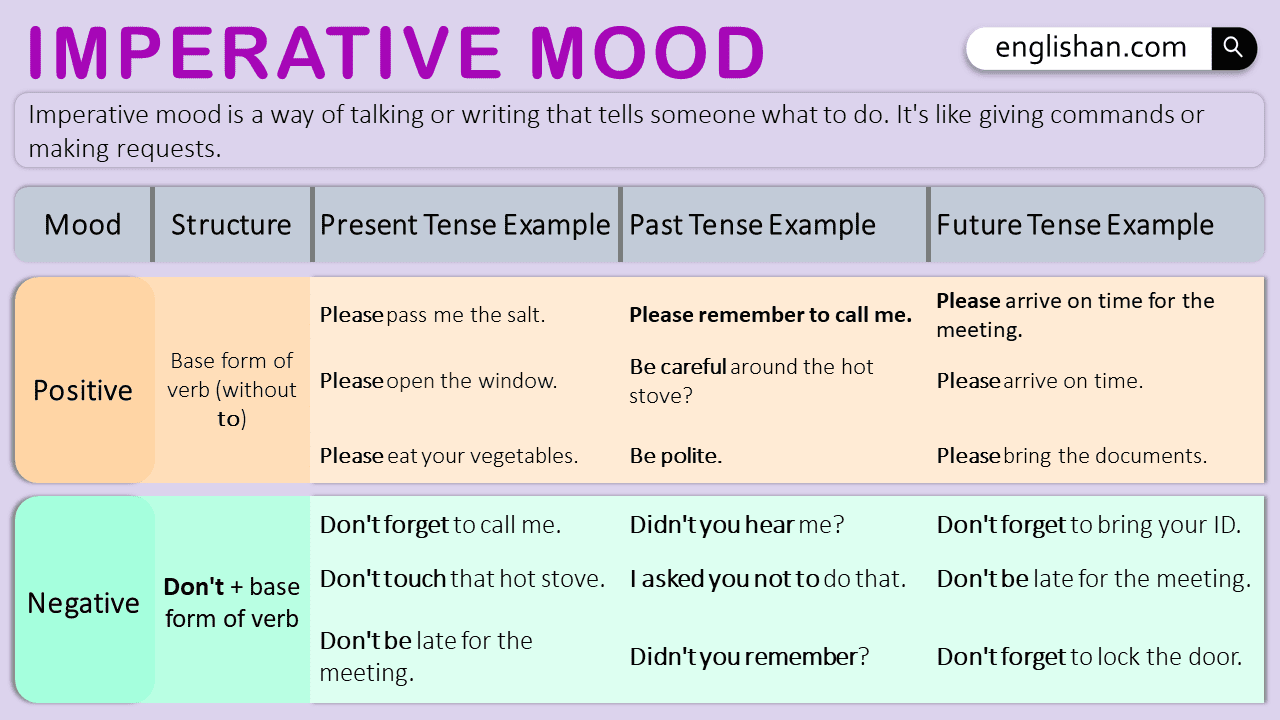
The imperative mood is a way of talking or writing that tells someone what to do. It’s like giving commands or making requests. When we use the imperative mood, we’re telling others to do something or not to do something.
For example
- Sit down!
- Please pass the salt.
In these sentences, we’re telling someone what action to take.
Formation of the Imperative mood
Formation of the Imperative mood are as follows:
Structure of Imperative Sentences
Basic Command
- Verb (base form) + object or rest of sentence
- Example: Open the door.
Negative Command
- Do not or Don’t + Verb (base form) + object or rest of sentence
- Example: Don’t touch that.
Polite Request
- Please + Verb (base form) + object or rest of sentence
- Or: Verb (base form) + object or rest of sentence + please
- Example: Please pass the salt. / Pass the salt, please.
Offer or Suggestion
- Verb (base form) + object or rest of sentence + shall we?
- Example: Let’s go for a walk, shall we?
Invitation
- Let’s + Verb (base form) + object or rest of sentence
- Example: Let’s watch a movie.
Note: Subject pronouns like “you” are often omitted.
Examples:
- Turn off the lights.
- Clean your room.
- Stand up.
These examples illustrate how imperative sentences are formed and how they are used to give commands or make requests in a straightforward manner.
Uses of the Imperative mood
The functions of the Imperative mood are as follows:
Giving Commands
- The imperative mood is primarily used to give direct commands or orders.
- It instructs someone to do something in a clear and concise manner.
Examples:
- Close the window.
- Sit down.
- Don’t touch that.
Making Requests
- Imperative sentences can also be used to make polite requests.
- They ask someone to do something without using question forms.
Examples:
- Please pass me the salt.
- Bring me a glass of water, please.
- Could you help me with this, please?
Offering Suggestions or Advice
- The imperative mood can be used to offer suggestions or give advice.
- It suggests a course of action without explicitly commanding it.
Examples:
- Try the new restaurant downtown.
- Take a break and relax.
- Consider studying abroad for a semester.
Giving Instructions
- Imperative sentences are often used to provide instructions or guidance.
- They tell someone how to do something in a step-by-step manner.
Examples:
- Mix the ingredients in a bowl.
- Follow the signs to reach the exit.
- Turn left at the next intersection.
These functions demonstrate the versatility of the imperative mood in communication, allowing speakers to convey commands, requests, suggestions, and instructions effectively.
Examples of the Imperative mood
Here are examples of the imperative mood in action:
Giving Commands
- Close the door.
- Stop talking.
- Go to bed.
- Stand up.
- Close the door.
- Finish your homework.
- Turn off your phone.
- Clean your shoes.
- Hand me the book.
- Drive carefully.
- Brush your teeth.
- Stop talking.
- Take out the trash.
- Eat your vegetables.
- Wait here.
- Put on your seatbelt.
- Walk, don’t run.
- Pay attention.
- Be quiet.
- Go to bed.
- Wake up early.
- Study for the exam.
- Don’t touch that.
Making Requests
- Please pass the salt.
- Bring me a glass of water, please.
- Could you help me with this, please?
- Pass the salt, please.
- Bring me some water, please.
- Help me, please.
- Open the window, if you can.
- Hand me that book, please.
- Close the door, please.
- Wait here for a moment, please.
- Turn down the music, please.
- Lend me your pen, please.
- Call me later, please.
- Hold the elevator, please.
- Get some milk, please.
- Let me know if you need help, please.
- Give me the sugar, please.
- Bring the chairs, please.
- Lock the door, please.
- Take out the trash, please.
- Don’t use your phone, please.
- Water the plants, please.
- Help me with these bags, please.
Offering Suggestions or Advice
- Try the new restaurant downtown.
- Take a break and relax.
- Consider studying abroad for a semester.
- You could try the new restaurant in town.
- How about taking a break and resting?
- Maybe consider studying abroad.
- Have you thought about trying a new hobby?
- Why not join a gym?
- You might enjoy a walk in the park.
- Perhaps talk to someone about it.
- It could help to make a to-do list.
- Have you tried keeping a journal?
- Yoga might help you relax.
- How about volunteering somewhere?
- Meditation can be calming.
- Have you tried cooking classes?
- Maybe set some boundaries.
- Getting more sleep could help.
- Try listening to music before bed.
- Mindfulness might be helpful.
- Consider asking a mentor for advice.
- Talk to someone you trust.
- Take a break from screens for a while.
Giving Instructions
- Mix the ingredients in a bowl.
- Follow the signs to reach the exit.
- Turn left at the next intersection.
- Mix the ingredients in a bowl.
- Follow the recipe step by step.
- Turn on the oven and preheat it to 350°F.
- Cut the vegetables into small pieces.
- Stir the sauce until it thickens.
- Pour the batter into the baking pan.
- Press the “start” button to begin the cycle.
- Fold the clothes and put them away.
- Take two tablets with water after meals.
- Connect the cable to the port labeled “Input.”
- Twist the cap clockwise to tighten it.
- Insert the key into the ignition and turn it.
- Slide the switch to the “on” position.
- Tighten the screws with a screwdriver.
- Place the document in the scanner and press “Scan.”
- Push the button to open the garage door.
- Plug the power cord into the outlet.
- Turn the knob to adjust the volume.
- Lift the handle to unlock the door.
- Press the “submit” button to complete the form.
Answers:
FAQs
The imperative mood is a grammatical mood used to give commands, make requests, or offer suggestions. It is one of the verb forms in grammar.
Imperative sentences are typically formed using the base form (infinitive) of the verb. Subject pronouns are often omitted, and the sentence structure is usually short and clear.
The imperative mood is used when you want to give someone an order, request, or suggestion directly. It’s commonly used in instructions, commands, advice, and invitations.
Yes, the imperative mood can be made polite by adding words like “please” or using softer language. This makes the request or command more polite and respectful.
Some examples of the imperative mood include:
1. Sit down.
2. Please pass the salt.
3. Stop talking.
4. Listen carefully.
5. Don’t forget your keys.
Yes, negative commands, which tell someone not to do something, are also considered to be in the imperative mood. For example, “Don’t run” or “Don’t forget your keys.”
You May Also Like