A lamp looks simple until you try to describe one small piece, label a diagram for school, or buy the exact item that fits. Knowing the parts of a lamp helps in everyday talk, whether you are shopping for a shade, checking the bulb size, or pointing out the socket, lampshade, switch, cord, plug, and base without guessing.
In this blog post, we keep the focus on the most common table lamp first, and you will also see how names can shift a bit for floor, desk, or touch lamps. We break things down from the bottom up, including the stem, harp, finial, and lampshade, and the labeled diagram right after this helps you match each word to its spot fast.
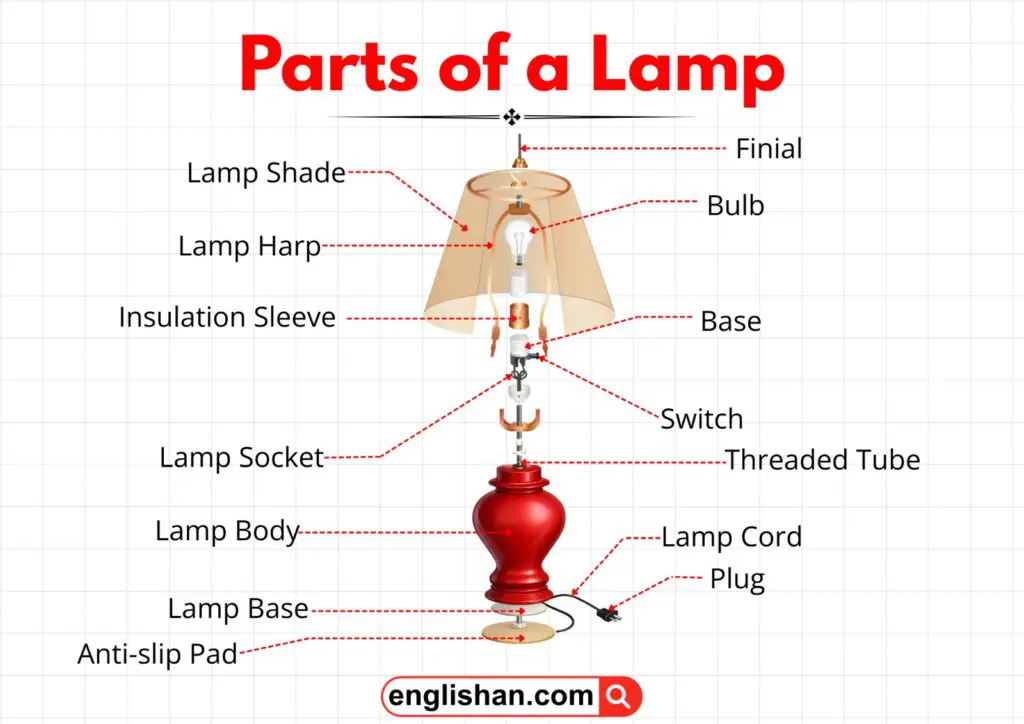
List of Parts of a Lamp
- Lamp Shade
- Lamp Harp
- Finial
- Bulb
- Lamp Socket
- Switch
- Lamp Cord
- Plug
- Lamp Base
- Lamp Body
- Threaded Tube
- Insulation Sleeve
- Anti-slip Pad
Lamp Parts and Their Features
Within the system, a lamp works as a small electrical fixture that carries power through connected parts until light is produced. Each named part plays a direct role in holding the circuit together, controlling current flow, or shaping how light leaves the bulb.
Lamp Shade
Within the lighting system, this part sits around the light source and manages how brightness spreads into the space. It reduces harsh glare and redirects light outward, while material and shape influence heat buildup and diffusion. Light diffusion and surface finish act together as current-driven light exits the bulb.
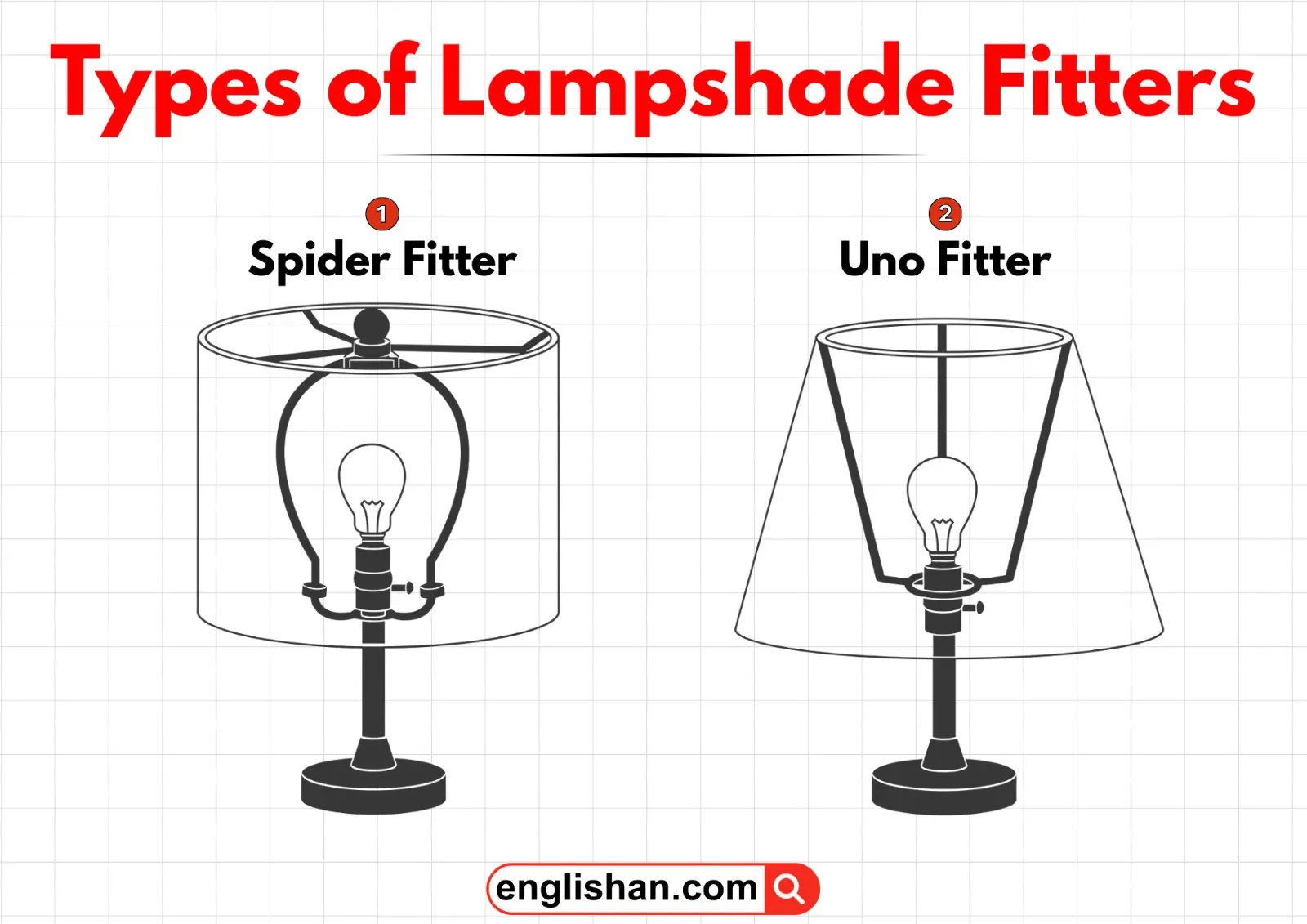
Lamp Shade Fitter Types
As the joining point between shade and lamp hardware, this group defines how the shade attaches and stays stable. Different fitter types affect spacing and balance, and the main traits are outlined below:
- Method used to secure the shade.
- Clearance maintained around the bulb.
- Stability during normal use.
Spider Fitter
Within the upper assembly, this fitter uses a wide ring that rests on the harp and tightens with a finial. The structure keeps the shade centered over the light source, and harp-supported mounting defines its pairing.
Uno Fitter
In contrast, this fitter connects directly to the socket shell without a harp. The shade sits closer to the energized bulb, and socket-based attachment shapes its compact setup.
Lamp Harp And Finial
Paired together within the system, these parts support and lock the shade in position. The harp forms a rigid frame above the socket, while the finial threads on top to secure it, creating vertical stability under load.
Bulb
Acting as the electrical load, this component converts incoming power into visible light. Behavior varies by design, and key electrical traits include:
- Power rating.
- Light color output.
- Heat generation.
Across types, light emission remains the shared result.
Lamp Socket
Serving as the electrical contact point, this unit holds the bulb base and transfers current from the wiring. Metal contacts maintain continuity and polarity, and electrical connection stability keeps operation consistent.
Lamp Socket Types
Within the lamp, socket formats differ to match bulb standards. Selection depends on:
- Base size and shape.
- Contact arrangement.
- Heat tolerance level.
Each type ensures proper current transfer to the bulb.
Bayonet Base Socket
This socket secures the bulb using side pins and a twist-lock action. The locking motion maintains contact pressure, and pin-lock engagement prevents loosening during operation.
Fluorescent Socket
Designed for tube lamps, this holder grips metal pins at the ends of the bulb. Current flows across the tube length, and dual-contact design supports steady discharge.
Halogen Socket
Built for high-temperature lamps, this socket supports small pin-based bulbs. Heat-resistant materials protect contacts over time, and thermal handling remains controlled.
Medium Base Socket
Common in household lamps, this threaded socket accepts standard screw-base bulbs. It balances current capacity and heat range, and standard threading defines compatibility.
Mogul Base Socket
Larger than standard types, this socket holds high-output bulbs. The wider base spreads electrical load, and high-current support distinguishes its role.
Switch
As the control point in the circuit, this part opens or closes current flow. Rotary, push, or pull actions interrupt or restore power, and circuit control determines lamp operation.
Lamp Cord
Functioning as the flexible conductor, this insulated cable carries power into the lamp. Inside, separate wires handle supply and return paths, and current transmission stays protected by the outer jacket.
Plug
At the system entry point, this component connects the lamp to mains power. Blade spacing and insulation maintain stable contact, where power input begins.
Lamp Base
Providing mass and balance, this part supports the entire assembly. It also encloses lower wiring paths, and structural support keeps the fixture steady.
Lamp Body
Rising from the base toward the socket, this section encloses internal wiring and hardware. Material choice affects heat flow and grounding behavior, while central housing links major components.
Threaded Tube
Running through the lamp body, this hollow rod holds parts together along a shared axis. It also guides internal wires upward, and mechanical alignment stays consistent.
Insulation Sleeve
Placed around wires where metal contact is possible, this layer prevents abrasion and short circuits. Over time, electrical insulation preserves separation within the system.
Anti-slip Pad
Attached beneath the base, this layer increases grip on the supporting surface. By reducing movement, surface traction limits strain on internal wiring.
Lamp Key Takeaways
A lamp functions as an electrical system made up of structural parts that support the fixture, conductive parts that carry power, control parts that switch current, load parts that generate light, and shielding parts that shape output. Electricity enters through the plug, moves along the cord, passes the switch, reaches the socket, powers the bulb, and exits as controlled light. Some variation exists in socket and fitter designs. We summarize the parts of a lamp as a linked chain where electrical flow produces light output through connected groups.
You May Also Like