A loom is a fascinating tool used to weave threads into fabric, and knowing its parts can make weaving much easier and more enjoyable. In this guide, we’ll walk you through all the important parts of a loom, explain what each one does, and show a clear labeled diagram. Whether you’re a beginner or just curious about weaving, this article will help you understand your loom better and get started with confidence.
List of Loom Parts With Names
- Warp Separators
- Rigid-Heddle Reed
- Shuttle
- Heddle Block
- Apron Rod / Stick
- Front Roller / Cloth Beam
- Weft
- Back Roller / Warp Beam
- Back Rail
- Pawl
- Sett
- Frame
- Turning Handle
- Ratchet
- Shed
- Warp
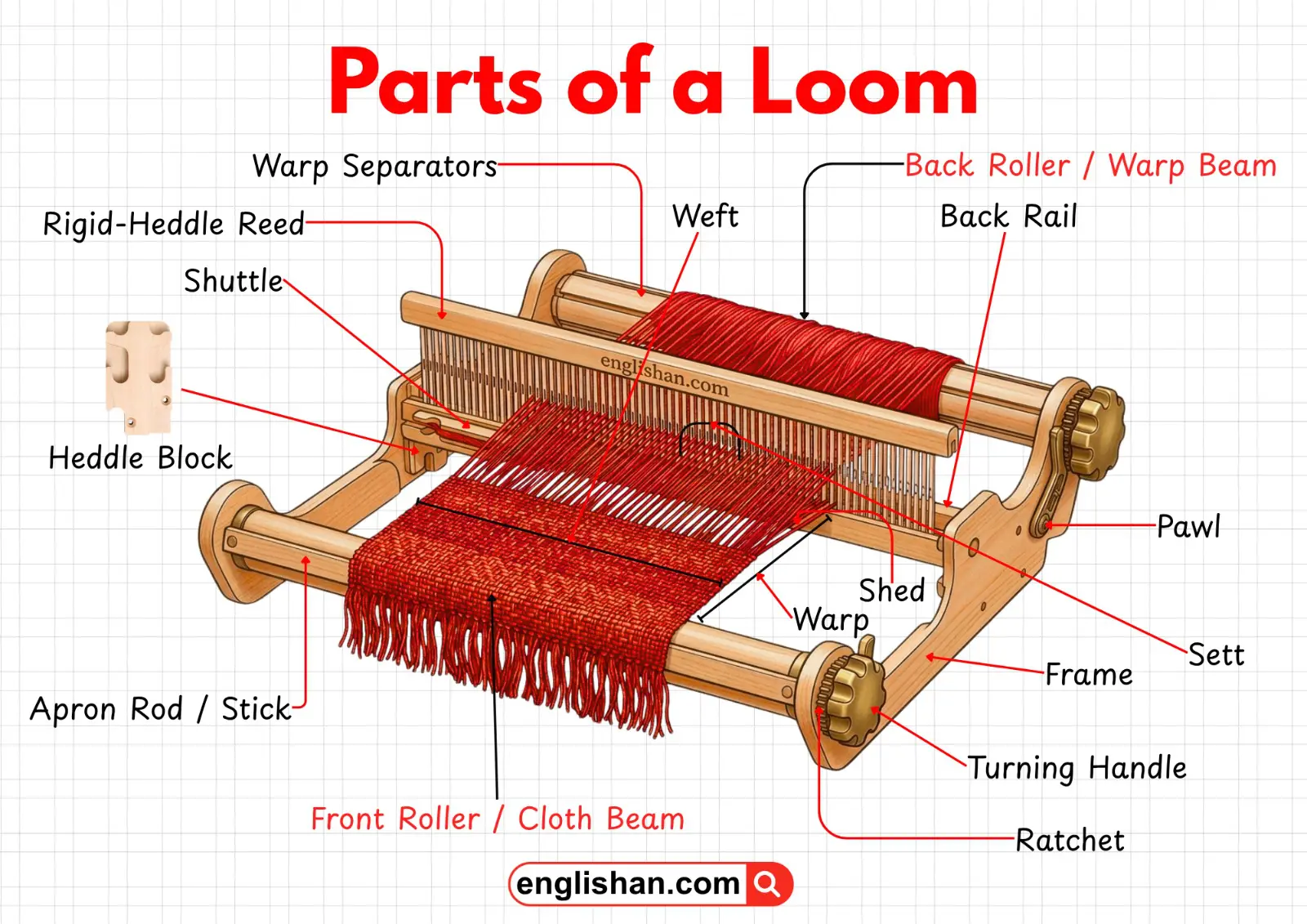
Parts of a Loom Diagram With Names
A loom is made up of several essential parts that work together to turn threads into fabric. The structural components, such as the frame, back rail, and heddle block, provide support and keep everything stable during the weaving process. The yarn-handling parts, including the warp beam, cloth beam, warp, and weft, manage the threads and help form the fabric. Tools like the shuttle and rigid-heddle reed guide and position the threads accurately, while the shed allows the weft to pass through smoothly. Control elements such as the turning handle, ratchet, and pawl help maintain proper tension and movement. Each part plays an important role in ensuring the loom functions efficiently and produces neat, well-woven cloth.
Warp & Weft Components
These parts are directly related to the threads themselves, which are the heart of weaving. Understanding them is essential because they determine the structure, texture, and pattern of the fabric.
Warp
The warp threads are the vertical threads stretched tightly along the length of the loom. They act as the foundation of the fabric, providing stability and structure. Each warp thread must be evenly tensioned, as uneven tension can cause irregularities in the weave, such as loose sections or uneven patterns. The warp can be made from different types of yarn depending on the fabric’s purpose, such as cotton for light fabrics or wool for thicker textiles.
Weft
The weft threads run horizontally and interlace with the warp threads to create the woven fabric. Unlike the warp, the weft is actively passed through the shed using the shuttle. The thickness, material, and color of the weft determine the texture, design, and overall appearance of the finished cloth. Weft threads can also be varied to create patterns, stripes, or decorative effects.
Warp Separators
Warp separators are devices such as rods, pegs, or comb-like structures that maintain equal spacing between warp threads. They prevent tangling, twisting, and overlapping, which is especially important when working with many warp threads. Proper separation ensures that the weave remains uniform and makes it easier to pass the weft thread through the shed smoothly.
Sett
Sett refers to the density or spacing of the warp threads, often measured in threads per inch. A tight sett produces a dense, firm fabric, while a loose sett creates a lighter, more open fabric. Proper sett selection is crucial because it affects the flexibility, durability, and drape of the finished textile.
Beams & Rollers
These parts hold and control both the warp threads and the woven fabric. They ensure proper tension and allow smooth progression as you weave.
Back Roller / Warp Beam
The back roller, or warp beam, holds all the warp threads before they are woven. It allows you to release more warp gradually as weaving progresses, keeping threads under constant tension. This is critical because uneven tension can distort patterns and make weaving difficult. The warp beam also makes it possible to weave long pieces of fabric without interruption.
Front Roller / Cloth Beam
The front roller, also known as the cloth beam, collects the woven fabric as you work. As the fabric is completed, it is rolled neatly onto this beam, preventing wrinkling or tangling. Proper alignment on the cloth beam ensures that the fabric is smooth and even, ready for finishing or cutting.
Heddle & Reed Components
These parts control the movement of warp threads and create the shed, allowing the weft to pass through and form the weave.
Rigid-Heddle Reed
The rigid-heddle reed has a series of slots and holes that guide the warp threads. It serves two functions: spacing the warp threads evenly and lifting alternating threads to create the shed. This makes weaving much faster and more precise. The reed also helps beat the weft threads into place, keeping the fabric compact and even.
Heddle Block
The heddle block holds the heddles, which are loops or wires through which each warp thread passes. By raising or lowering the heddle block, you control which warp threads are lifted, forming the shed. The heddle block ensures smooth operation and consistent weaving, especially when creating patterns.
Shed
The shed is the opening between lifted and lowered warp threads through which the weft passes. The size and consistency of the shed determine how easily the shuttle moves and how uniform the fabric appears. A well-formed shed is essential for fast, efficient weaving and precise pattern creation.
Loom Frame & Structure
These parts form the main structure, providing stability and support for all moving components. A strong frame is essential to maintain tension and ensure smooth weaving.
Frame
The frame is the backbone of the loom, supporting the warp and weft threads, rollers, heddle, and other mechanisms. A sturdy frame prevents wobbling, keeps threads taut, and allows precise control over the weaving process. Frames are typically made of wood or metal, depending on the loom type.
Back Rail
The back rail is a horizontal support at the rear of the loom. It helps maintain the alignment of the warp threads and supports the warp beam. A strong back rail ensures the loom can handle the tension of many threads without bending or shifting.
Apron Rod / Stick
The apron rod, or stick, secures the edge of the woven fabric to the front beam. It prevents the fabric from slipping or bunching as it rolls onto the cloth beam. This ensures a smooth, neat finished piece and helps maintain proper tension throughout the weaving process.
Tools & Mechanisms
These parts allow the loom to operate efficiently, helping to move threads and control tension accurately.
Shuttle
The shuttle carries the weft thread across the warp through the shed. Shuttles come in various shapes, but all are designed to pass the thread quickly and evenly, reducing manual effort. Using a shuttle properly ensures a consistent weave and smooth fabric surface.
Turning Handle
The turning handle allows the weaver to rotate the rollers, either advancing the warp threads or rolling up the finished fabric. This mechanism is essential for controlling fabric tension and keeping the weaving process continuous without manual adjustment of individual threads.
Ratchet
The ratchet is a locking mechanism attached to rollers. It prevents the rollers from moving backward, maintaining consistent tension on the warp threads. A proper ratchet ensures the warp does not loosen accidentally, which could ruin the fabric’s alignment.
Pawl
The pawl works together with the ratchet to hold the roller in place while allowing controlled forward rotation. It ensures that the roller advances smoothly and stops precisely where needed, giving the weaver complete control over the weaving process.
Key Takeaway
As we learned, a loom is made up of many parts, each with its own role. From the warp and weft threads that form the fabric, to the beams, heddles, and reed that guide and hold them, every component works together to make weaving smooth and precise. Understanding these parts helps you use your loom confidently and create even, beautiful fabric every time.
You May Also Like