Englishan-Logo-resized Englishan-Logo-resized
  • Home
  • Grammar
    • Parts of speech
    • Tenses
    • Worksheets
    • Example Sentences
  • Vocabulary
    • Picture Vocabulary
      • Animals
        • Insects
      • Foods
        • Fruits
      • Things
    • Words Lists
      • 5 Letter Words
      • Long Words
    • Vocabulary for Kids
    • Synonyms
    • Antonyms
    • Confused Words
    • Phrasal Verbs
  • English Composition
    • Applications
    • Essay Writing
    • Letters
  • Worksheets
    • Kindergarten Worksheets
  • Contact
Reading: 14 Parts of a Mushroom: Labeled Diagram and Anatomy Overview
Share
EnglishanEnglishan
Font ResizerAa
  • Home
  • Grammar
  • Vocabulary
  • English Composition
  • Worksheets
  • Contact
Search
Follow US
  • About
  • Contact
  • Privacy Policy
  • Terms of Service
Copyright © 2026 englishan.com All Rights Reserved.
Englishan > Vocabulary > Picture Vocabulary > Parts of Things > 14 Parts of a Mushroom: Labeled Diagram and Anatomy Overview
Parts of Things

14 Parts of a Mushroom: Labeled Diagram and Anatomy Overview

Narmeen Khan
By
Narmeen Khan
Last updated: February 4, 2026
4 Min Read
SHARE

Describing a mushroom is hard when you do not know the name for the cap or the stem. Learning the real parts of a mushroom helps you label a school drawing or explain exactly where the gills sit. You can use the right words instead of just pointing.

In This Page
  • Parts of a Mushroom
  • Mushroom Key Takeaways

In this article, we show the features of a common mushroom, from the mycelium in the dirt to the scales on top. Most types have a strong stalk and a thin ring. The diagram below points to the volva and spores so you can find them fast.

Parts of a Mushroom

The Fruiting Body (Sporocarp)
Think of this as the mushroom’s spore-making structure. It forms, matures, then releases spores and fades. Most of the living fungus keeps going as mycelium instead of staying in this form.

The Cap (Pileus)
This top section acts like a cover and keeps the spore surface protected while it develops. As it opens up, the mushroom reaches the stage where spore release can happen. Caps come in many shapes and textures, so they are one of the easiest parts to notice.

Gills (Lamellae) & Pores
These are the spore-release surfaces. Gills are thin sheets that create lots of area for spores, while pores release spores through many tiny openings. A mushroom usually has one type or the other, and that difference changes how the underside looks and works.

The Stem (Stipe)
The stem, also called stipe, holds the cap steady and keeps the spore surface supported as the mushroom develops. Some stems are solid, others are hollow, and some mushrooms barely form one at all. That variation is normal across species.

The Ring (Annulus)
A ring can be left behind when a protective covering breaks during growth. When it stays, it looks like a band of tissue and can be thick, thin, or fragile. Some mushrooms never form one, so it is not a guaranteed feature.

The Volva (Cup)
This cup-like part comes from an outer covering that protected the mushroom early on. If it remains, the volva can look like leftover tissue around the base of the stem. Many mushrooms do not keep it, and some never form it.

Mycelium & Hyphae
Hyphae are tiny threads, and their woven network is the mycelium. This is the main body of the fungus that takes in food from its surroundings. When conditions are right, it can produce new fruiting bodies again.

Spores
Spores are the fungus’s starting points for new growth. They are released from gills or pores, then spread and can begin new hyphae if they land in a suitable place. Spore color and amount can differ a lot across mushrooms.
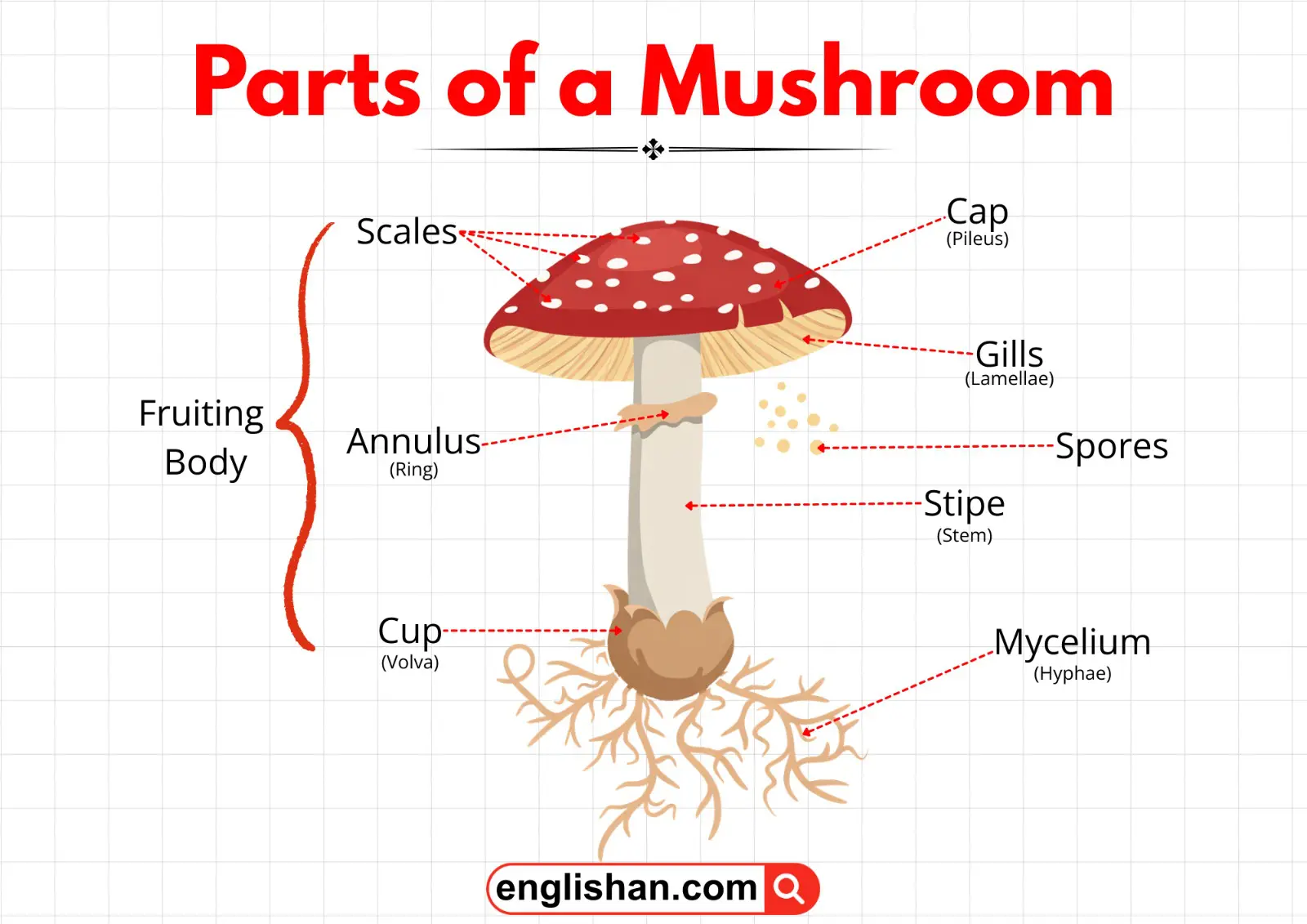
Parts of a mushroom labeled, including the cap, gills, stem, ring, and base.
Main parts of a mushroom explained in a simple diagram.
Advertisement

Mushroom Key Takeaways

Mushroom anatomy works as a linked growth and reproduction system. The fruiting body handles spore release, while caps and spore surfaces manage protection and dispersal. Stems provide structural support, and veil remnants reflect early growth stages. Mycelium and hyphae drive feeding and long term expansion beneath the surface. Spores begin the next growth cycle when conditions align. These groups connect in sequence, where growth leads to structure, structure leads to release, and release leads back to growth. We use the parts of mushroom as a stable reference for structure and function across species.

You May Also Like

  • Edible Mushrooms
  • Pizza Names in English
  • Parts of Fish Names in English
Advertisement
Share This Article
Facebook Pinterest Whatsapp Whatsapp LinkedIn Reddit Copy Link
Narmeen Khan
ByNarmeen Khan
Follow:
Narmeen Khan holds a BA (Honours) in English Literature from the Lahore University of Management Sciences (LUMS) and a BS in Media and Communication Studies from COMSATS University. She is also TEFL certified by Arizona State University and has completed training in computer fundamentals to support her tech-related content. With over seven years of experience in digital content creation, she writes educational articles focused on English learning, combining strong research with clear explanations and thoughtfully designed visuals to support learners at all levels.
Previous Article What Does BRB Mean? Origin, Use, Example Conversation
Next Article 122 Synonyms for Say with Meanings and Examples
270KLike
82KPin
- Advertisement -

You Might Also Like

Parts Of Wheelchair: Labeled Diagram For Easy Recall

5 Min Read

Parts of a Car Door ( Exterior and Interior Diagram )

7 Min Read

Identify Parts of a Piano with Labeled Diagram

13 Min Read

Parts of a Light Bulb Explained with Label Diagram

9 Min Read
Englishan-Logo-resized Englishan-Logo-resized

Englishan.com is a blog for better writing, speaking, and study results. We publish grammar and vocabulary posts, plus worksheets, word lists, and example sentences for practice.

Important Pages

  • About
  • Contact
  • Privacy Policy
  • Terms of Service

Get in Touch for Queries

Got any questions - Reach us out at
  • contact@englishan.com
  • +971561449880
  • About
  • Contact
  • Privacy Policy
  • Terms of Service
Welcome Back!

Sign in to your account

Username or Email Address
Password

Lost your password?