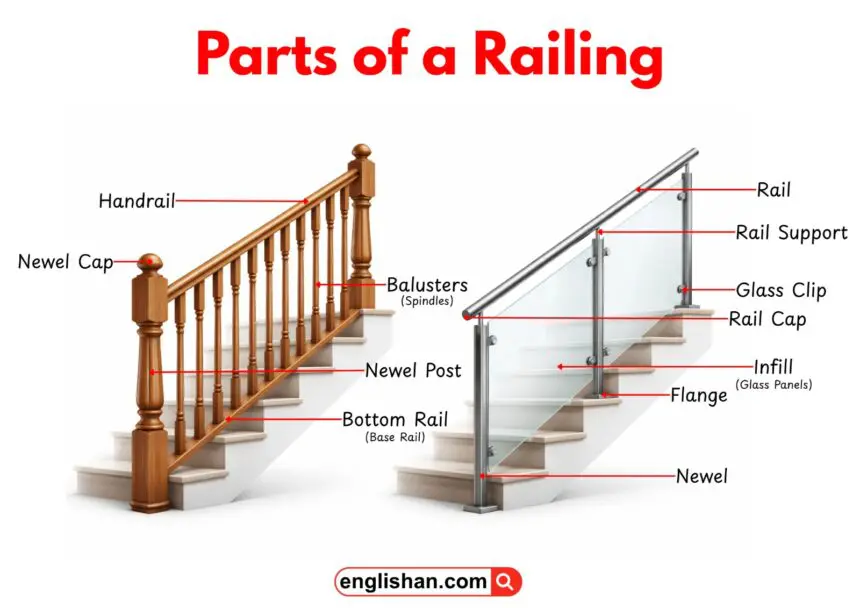
When you look at a railing, it might seem like a simple structure, but it’s actually made up of several important parts that work together for safety, support, and style. Whether it’s on a staircase, balcony, or deck, each component has its own role in keeping the railing strong and secure. In this article, we’ll walk through the different parts of a railing in a clear and easy way, along with a labeled diagram to help you understand how everything fits together.
List of Railing Parts With Names
- Handrail
- Newel Cap
- Balusters (Spindles)
- Newel Post
- Bottom Rail (Base Rail)
- Rail
- Rail Support
- Glass Clip
- Rail Cap
- Infill (Glass Panels)
- Flange
- Newel
Parts of a Railing Diagram With Names
A railing is a structural feature designed to provide safety, support, and style in spaces like staircases, balconies, and decks. The handrail offers a comfortable grip for stability, while the newel posts act as strong anchor points that hold the entire structure in place. Balusters (or spindles) fill the space between posts, adding both protection and decorative appeal. The bottom rail connects and supports the balusters from below, ensuring balance and strength. In modern designs, elements like glass panels (infill), rail supports, and clips create a sleek and open look. Additional parts such as the newel cap, rail cap, and flange enhance both the durability and appearance of the railing. Each component works together to create a secure, functional, and visually appealing railing system.
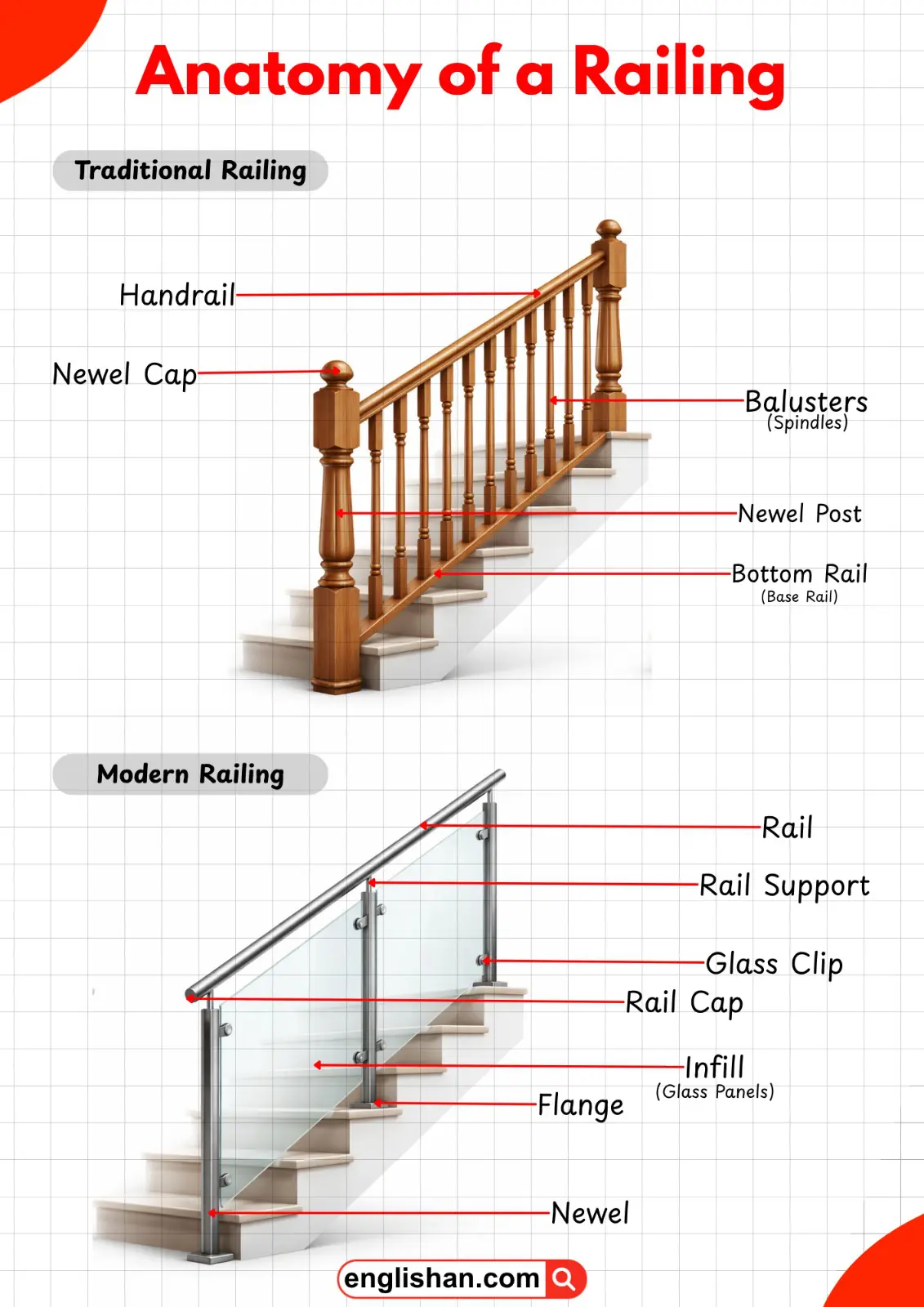
Traditional Railing Parts
Traditional railings have a classic design, usually made of wood, and focus on both strength and decorative detail. Each part plays an important role in keeping the structure safe and visually appealing.
Handrail
The handrail is the top horizontal part of it that you hold onto while going up or down the stairs. It is designed for comfort and grip, helping provide balance and safety. In traditional railings, it is often smooth, polished, and sometimes shaped for a more elegant look.
Newel Cap
The newel cap sits on top of the newel post as a decorative finishing piece. It adds style and character to it, often coming in rounded or carved designs. While it doesn’t provide structural support, it enhances the overall appearance.
Balusters (Spindles)
Balusters, also called spindles, are the vertical rods placed between the handrail and the bottom rail. They provide support and prevent people from falling through the it. In traditional designs, they are often turned or carved to add a decorative touch.
Newel Post
The newel post is a large, sturdy vertical post found at the beginning, end, or turns of the staircase. It acts as the main support for the entire railing system, holding the handrail firmly in place. Without it, that would not be stable.
Bottom Rail (Base Rail)
The bottom rail runs parallel to the handrail at the base and holds the balusters in position. It helps keep the structure aligned and evenly spaced, adding to both the strength and neat appearance.
Modern Railing Parts
Modern railings focus on a clean, minimal look, often using materials like metal and glass. These parts are designed for strength, simplicity, and a sleek appearance.
Rail
The rail in modern systems works like the handrail, providing support and a place to hold while using the stairs. It is usually made of metal and has a simple, straight design that matches modern aesthetics.
Rail Support
Rail supports are small brackets or connectors that hold the rail in place. They attach the rail to vertical posts or walls, ensuring it stays secure and stable during use.
Glass Clip
Glass clips are small metal fittings used to hold the glass panels firmly in place. They secure the glass without blocking the view, which helps maintain the open and modern look of the railing.
Rail Cap
The rail cap is a finishing piece placed on top of glass panels. It provides a smooth surface and protects the edges, while also adding a clean and polished appearance.
Infill (Glass Panels)
The infill refers to the material used between the posts—in this case, glass panels. These panels act as a barrier for safety while keeping the space looking open, bright, and modern.
Flange
The flange is the base plate that attaches the vertical posts to the floor or stairs. It ensures a strong and stable connection, helping keep the entire railing system firmly anchored.
Newel
In modern railings, the newel refers to the main vertical support post, similar to the traditional newel post. It provides structural strength and supports the rail, though its design is usually simpler and more streamlined.
Key Takeaway
As we learned, a railing may look simple, but it’s made up of several important parts that work together to provide safety, support, and style. In traditional railings, components like the handrail, balusters, and newel post focus on strength and decorative detail. In modern railings, parts like glass panels, clips, and metal rails create a clean, minimal look while still ensuring durability. Understanding these parts helps you better choose, maintain, or design a railing that fits both your safety needs and aesthetic preferences.
You May Also Like