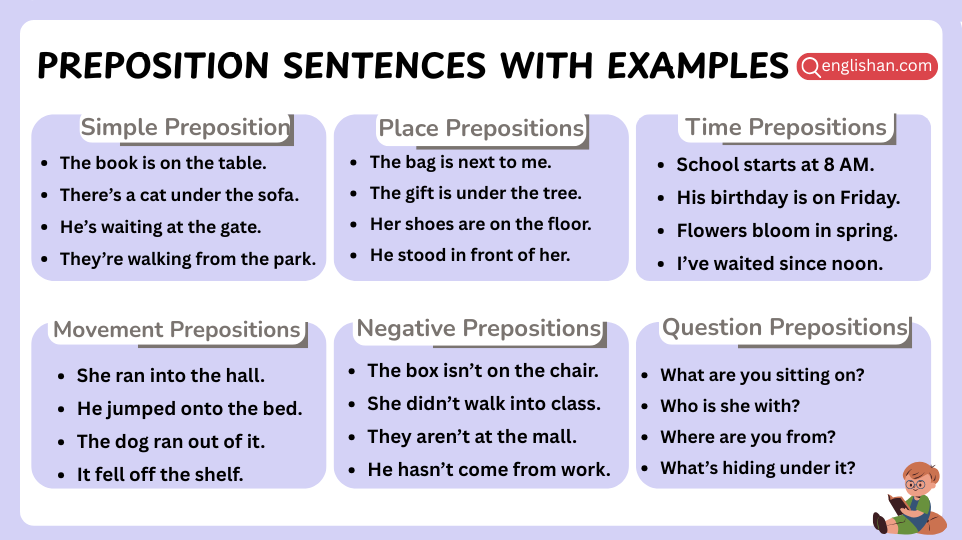
Preposition sentence examples help learners clearly understand how words like on, under, before, and between work inside real sentences. Seeing them used in different ways builds a stronger feel for grammar structure and sentence flow. This list offers natural, everyday sentence patterns that show where and how prepositions fit. With focused examples of place, time, movement, and more, you’ll recognize grammar forms faster and build sentence confidence.
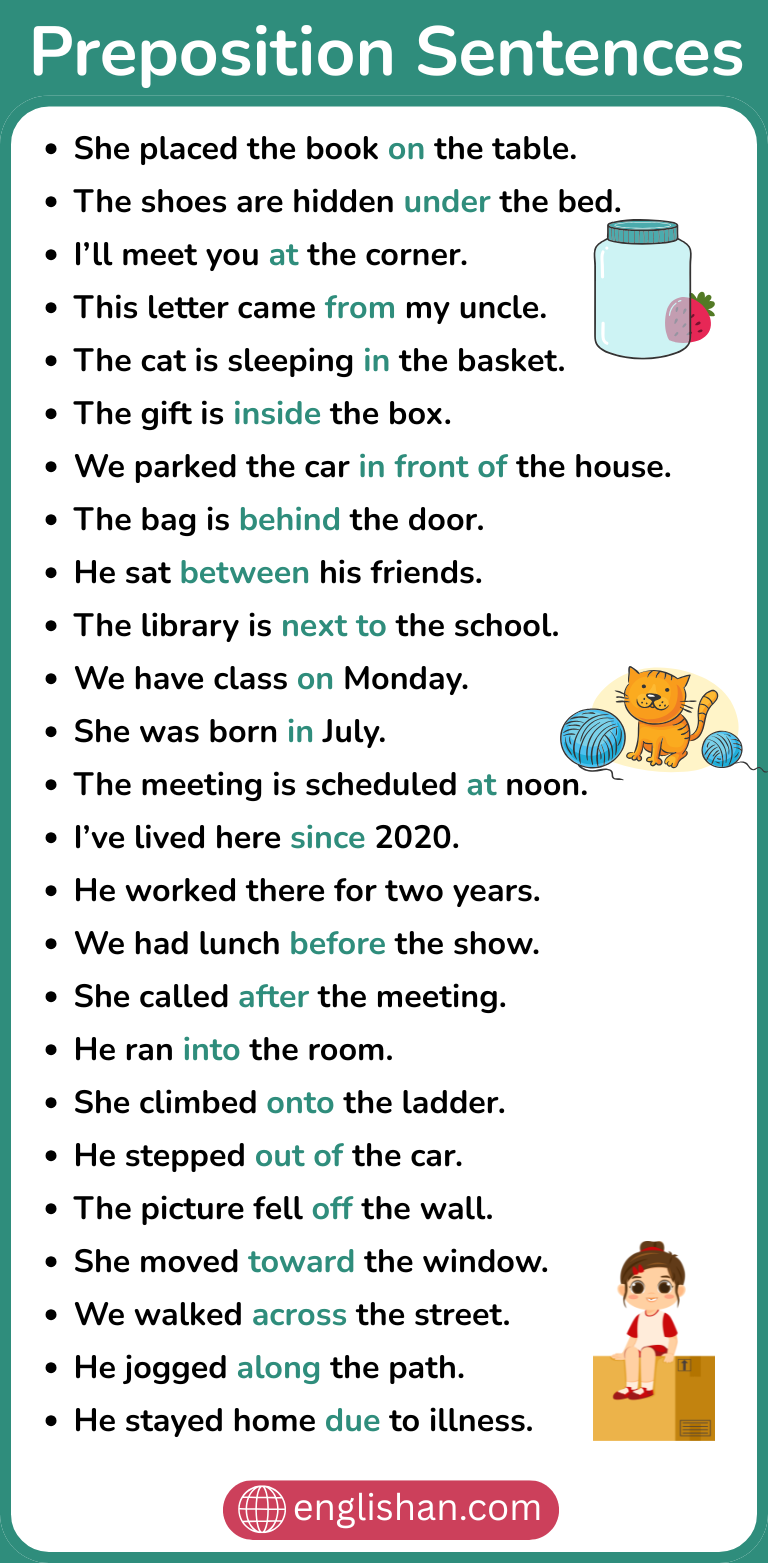
Simple Preposition Sentences
These short and clear sentences use basic prepositions like in, on, at, and under. The list below gives a foundation to help you recognize preposition placement and sentence rhythm.
- The book is on the table.
- He sat under the tree.
- We walked to the market.
- She jumped over the puddle.
- My keys are in the bag.
- They ran around the park.
- I left it behind the door.
- There’s a note on the fridge.
- I waited at the bus stop.
- The shoes are beside the bed.
- Sara hid under the blanket.
- The ball rolled into the street.
- He looked through the window.
- My pen fell between the seats.
- The phone is inside the drawer.
Sentences With Prepositions Of Place
Prepositions of place describe where something or someone is in relation to another object or location.
Inside, On, Under, In Front Of
Below is a list of sentences using prepositions to show specific positions and surface relationships.
- The shoes are under the bed.
- The letter is inside the envelope.
- She is sitting on the chair.
- He stood in front of the classroom.
- The keys are under the couch.
- The snacks are inside the bag.
- The cup is on the shelf.
- There’s a dog under the table.
- She parked in front of the shop.
- I found my notes inside my locker.
- The phone was on the counter.
- He placed the box under the stairs.
- The vase was on the fireplace mantel.
Behind, Between, Next To
These sentences focus on location described relative to objects near or beside each other.
- The dog is behind the curtain.
- She stood between her brothers.
- The bike is parked next to the fence.
- I left the file behind the printer.
- There’s a bench between the trees.
- The phone charger is next to the laptop.
- He hid behind the wall.
- They sat next to each other.
- I found the ball behind the sofa.
- The store is next to the bank.
- My car is parked between two trucks.
- She stood behind the door.
- I sat next to my friend in class.
- The lamp is between two books.
- He walked behind the crowd.
- There’s a small alley next to the cafe.
Sentences With Prepositions Of Time
These prepositions show when something happens in relation to other events or points in time.
At, On, In
Below is a list using common time prepositions for specific points, days, and months.
- I’ll meet you at 5 PM.
- My birthday is on Friday.
- She was born in July.
- We eat dinner at 8 o’clock.
- They left on Christmas Day.
- School starts in September.
- The show begins at noon.
- I arrived on the weekend.
- We’ll go in the evening.
- He came at night.
- She visited us on Monday.
- It happened in the morning.
- The flight leaves at dawn.
- He called me on Tuesday night.
- She got married in April.
- Let’s meet at lunchtime.
- My exam is on the 10th.
Since, For, Before, After
These examples help show duration, points of reference, and sequences in time.
- I’ve lived here since 2015.
- They waited for two hours.
- We met before lunch.
- I went to bed after the movie.
- He’s been sick since last week.
- I worked for three days straight.
- We talked before the meeting.
- She left after sunset.
- He’s studied since January.
- I rested for an hour.
- He slept after the trip.
- I’ve been working since this morning.
- The party lasted for five hours.
- I brushed my teeth before bed.
- He went home after class.
Sentences With Prepositions Of Movement
These sentences use prepositions that show motion toward or away from something.
Into, Onto, Out Of, Off
These examples use motion-based prepositions showing entry, exit, or movement away.
- He jumped into the pool.
- The cat climbed onto the roof.
- She got out of the car.
- He fell off the bike.
- They ran into the house.
- She placed the book onto the shelf.
- I got out of the taxi.
- He took his shoes off.
- They walked into the store.
- He slid onto the bench.
- I climbed out of the window.
- The ball rolled off the table.
- He dove into the water.
- She lifted the box onto the table.
- I jumped out of bed.
Toward, Across, Along
Used to show direction or motion relative to a point, path, or target.
- He walked toward the station.
- We ran across the field.
- She strolled along the beach.
- The car moved toward the light.
- He jumped across the gap.
- We biked along the river.
- She moved toward the door.
- They ran across the road.
- He walked along the fence.
- The dog ran toward me.
- They drove across the city.
- I walked along the path.
- The kids ran toward the park.
- He leaped across the puddle.
Question Sentences With Prepositions
This section shows how prepositions appear in questions, often placed at the end or middle to ask about place, time, or reason.
- Where are you from?
- What are you sitting on?
- Who are you waiting for?
- Which bag is it in?
- What are they looking at?
- Who did you walk with?
- Where is the book on the shelf?
- What did she throw it into?
- Who did you go with yesterday?
- Why is it on the floor?
- Where is she walking toward?
- What was that sound from?
Negative Sentences Using Prepositions
These examples show how prepositions function inside negative sentences, highlighting absence, negation, or incorrect placement.
- The book isn’t on the table.
- He didn’t go to the party.
- They weren’t at school today.
- She didn’t walk into the room.
- I’m not sitting next to him.
- The gift wasn’t under the tree.
- He hasn’t been in his office lately.
- We didn’t come from that area.
- She isn’t behind the door.
- They haven’t driven across the bridge.
- The pen isn’t in the drawer.
- He didn’t run along the beach.
- I wasn’t with them.
- He wasn’t on the bus.
- I haven’t gone since Monday.
- The cat isn’t hiding under the bed.
- It didn’t fall off the table.
Sentences Showing Cause And Purpose With Prepositions
These sentences demonstrate how prepositions like because of, due to, and for show reasons or purposes.
- She missed school because of the rain.
- He stayed home due to illness.
- I made this cake for your birthday.
- We’re here for a special event.
- He left early due to a family emergency.
- She baked cookies for the team.
- He apologized for the mistake.
- The train was delayed due to snow.
- We voted for a new leader.
- He didn’t come because of the strike.
- She’s raising money for the school.
- Flights were canceled due to fog.
- I made dinner for everyone.
- He stayed quiet for a reason.
- She cried because of stress.
- They gave a medal for bravery.
- The concert was postponed due to rain.
Prepositional Phrase Sentences
Each sentence below contains a full prepositional phrase, showing structure built around a preposition and its object.
- The book on the desk is mine.
- He waited at the corner.
- The cat is hiding under the couch.
- She sat beside her friend.
- We walked along the river.
- He arrived after the show.
- I stayed until the end.
- He ran toward the exit.
- The dog is sleeping in the sun.
- We moved to the city.
- She looked through the window.
- He left without a word.
- The gift in the box is yours.
- We rested under the tree.
- I wrote a message on the card.
- She hid behind the curtain.
- He spoke about the project.
Sentences With Multiple Prepositions Combined
These examples combine two or more prepositions naturally in one sentence, helping you learn how they work together.
- The ball rolled under the chair and into the hallway.
- She walked across the road and toward the shop.
- He jumped onto the bed and off the other side.
- They moved from the garage to the kitchen.
- I sat next to Sara and in front of the teacher.
- The dog ran out of the house and across the yard.
- She looked behind the curtain and under the couch.
- He traveled along the coast and through the hills.
- We went into the park and over the bridge.
- They talked about the idea and during the break.
- The keys are in the drawer and beside the notebook.
- I came from school and straight into the room.
- She ran toward the door and out of the room.
- He placed the vase on the table and against the wall.
- The cat jumped from the shelf onto the bed.
- He hid inside the box and under the blanket.
- She waved at the crowd and across the street.
Spoken English Sentences Using Prepositions
These casual sentences reflect how prepositions often appear in spoken English, using contractions and everyday tone.
- I’m on the way.
- She’s in the kitchen.
- We’re at the mall right now.
- He’s with his brother.
- They’re out of town.
- I’m heading to your place.
- It’s under the bed, I think.
- She’s waiting for you.
- He’s from Canada.
- We’re going into the shop.
- I’ve been at work all day.
- The bag’s on the chair.
- She’s already in the car.
- He’s staying with us tonight.
- I can’t find it under the couch.
- They’re flying from Dubai.
- She’s calling about the meeting.
- I’m walking toward the gate.
- He’s next to the speaker.
- They’re arriving at noon.
Sentences With Prepositions In Formal Contexts
These examples show how prepositions are used in more formal or professional English settings, such as meetings or official communication.
- The meeting is scheduled at 10:00 AM.
- He acted in response to the feedback.
- The decision was taken after careful review.
- Payment is due before the 15th.
- The letter was addressed to the director.
- The task must be completed within two days.
- She was appointed as the new supervisor.
- We agree with the proposed terms.
- He was promoted due to outstanding performance.
- The policy applies to all employees.
- The funds were allocated for training programs.
- They acted on legal advice.
- The file is stored in the shared drive.
- We discussed the issue during the session.
- The agreement was signed between the two parties.
- He resigned from his position.
- The data is accurate as of yesterday.
You May Also Like