Many people ask whether irregardless is a word, whether it means the same thing as regardless, and whether it belongs in careful writing. The answer is straightforward: regardless is the standard form, while irregardless is recognized by dictionaries but usually labeled nonstandard.
That difference matters because dictionary recognition is not the same as standard usage. A word may be recorded because people use it, but that does not make it the preferred form in school, work, or professional writing. This is why irregardless causes so much confusion.
In this article, you will learn what regardless and irregardless mean, why irregardless is treated as nonstandard, how they are used in sentences, and which form is the standard choice in polished English.
Regardless vs Irregardless: Quick Answer
If you want the answer first, here it is:
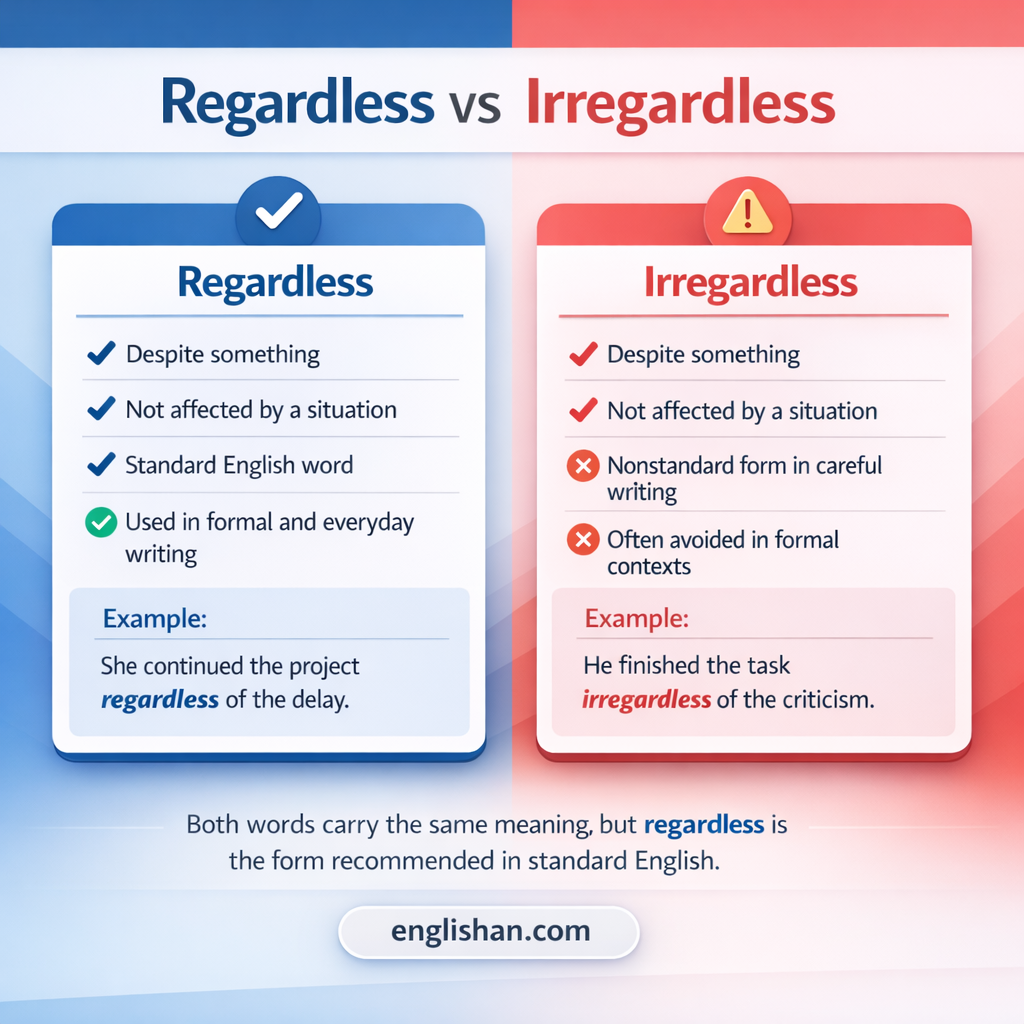
- Regardless is the standard word.
- Irregardless is listed in dictionaries, but it is usually labeled nonstandard.
- In formal, academic, and professional writing, use regardless.
For nearly every writing situation, regardless is the form to choose.
What Does Regardless Mean?
Regardless means despite that, without being affected by something, or in spite of the situation. It often appears in the phrase regardless of followed by a noun or noun phrase.
Examples:
- regardless of the weather
- regardless of the cost
- regardless of the result
Examples of Regardless in Sentences
- She continued with the trip regardless of the rain.
- He told the truth regardless of the consequences.
- The company accepts applicants regardless of location.
In standard English, regardless is the accepted form.
What Does Irregardless Mean?
Irregardless is generally used with the same meaning as regardless. In actual use, people usually say irregardless where standard English would use regardless.
Examples:
- irregardless of the cost
- irregardless of the risk
The main issue is not meaning. The issue is usage status. Although many readers understand irregardless, it is still widely treated as nonstandard English.
Is Irregardless a Real Word?
Yes. Irregardless appears in major dictionaries, which means it is a recorded word in English usage. However, that does not make it equal in status to regardless.
Most major dictionaries label irregardless as nonstandard. That label usually means:
- people do use the word
- dictionaries record it
- standard edited English still avoids it
So the better question is not only whether irregardless is real. The better question is whether it is the right choice for your writing.
Why Is Irregardless Nonstandard?
Irregardless is considered nonstandard because standard edited English has long preferred regardless. Even though the word is recognized, many teachers, editors, and careful readers still treat irregardless as a poor choice in formal writing.
Some people also object to the word because the added prefix makes it seem unnecessary when regardless already does the job. Whether readers think about word formation directly or not, many still react to irregardless as awkward, careless, or incorrect in polished writing.
That is why regardless remains the safer and more widely accepted form.
This is the practical difference most readers need to remember.
Should You Use Regardless or Irregardless?
You should use regardless in almost every kind of writing, especially when you want your English to sound standard and polished.
That includes:
- school assignments
- essays
- workplace emails
- blog posts
- reports
- academic writing
- professional communication
You may hear irregardless in conversation or informal speech, but it is not the safer choice when your writing may be judged for correctness.
If Irregardless Is in the Dictionary, Why Do People Still Avoid It?
A dictionary records words that people use. It does not always treat every listed word as equally standard.
That is the point many readers miss. Some people assume that once a word appears in a dictionary, objections to it should end. But usage labels still matter. A word can be real in the sense that people say it and still be marked nonstandard in edited English.
So dictionary inclusion explains why irregardless exists, but it does not make it the best choice for careful writing.
Are Regardless and Irregardless Interchangeable?
In meaning, they are usually very close. In standard usage, they are not equal.
If your goal is only to be understood, many readers will understand irregardless. If your goal is to use standard English that avoids distraction, correction, or criticism, choose regardless.
Example Sentences With Regardless and Irregardless
Standard Examples With Regardless
- She applied for the job regardless of the distance.
- They continued the match regardless of the cold weather.
- He stayed calm regardless of the pressure.
Nonstandard Examples With Irregardless
- She applied for the job irregardless of the distance.
- They continued the match irregardless of the cold weather.
- He stayed calm irregardless of the pressure.
These nonstandard examples are included for comparison only. In formal writing, regardless is the recommended form.
Common Mistakes to Avoid
Treating Both Words as Equally Acceptable
They may share meaning, but they do not share the same status. Regardless is standard, while irregardless is nonstandard.
Assuming Dictionary Listing Means Full Approval
Dictionary listing means a word is recognized in use. It does not mean the word is fully accepted in every context.
Using Irregardless in Formal Writing
This often leads to correction or a weaker impression on careful readers, editors, and teachers.
Simple Rule to Remember
Use regardless. Avoid irregardless in formal writing.
That rule will solve the issue for almost every reader.
Summary
Regardless and irregardless are usually understood to mean the same thing, but they differ in status. Regardless is the standard and widely accepted word in English. Irregardless is recorded in dictionaries, but it is usually labeled nonstandard and is still avoided in formal and edited writing. If you want the safest and most accepted choice, use regardless.
FAQs
Yes. Irregardless appears in major dictionaries, but it is usually labeled nonstandard.
Regardless is the standard correct choice for formal and edited writing.
Yes. They are usually used with the same meaning, such as despite that or in spite of something.
Many people object to it because it is considered nonstandard and often sounds careless in standard written English.
It is better to avoid it. In polished writing, regardless is the safer choice.
It is best avoided in academic writing because most teachers, editors, and careful readers prefer regardless.
You May Also Like