“In conclusion” is a clear, correct way to end an essay, speech, or report. But relying on it every time can make your writing feel repetitive, and readers may start to tune out right when you want them to pay attention.
Fortunately, you don’t have to abandon the phrase. You can simply reach for a synonym for “in conclusion” that fits the moment. Use to sum up when you need a quick recap, or ultimately when you want to leave a strong final impression.
Below, you will find these alternatives and more with simple explanations so you can choose the right one with confidence. Whether you need a formal phrase for an essay or a smooth sign-off for a speech, these options will help you finish strong.
What Does In Conclusion Mean?
In conclusion is a phrase we use at the end of writing or speaking to show that we are wrapping things up. It’s a way to sum up your main ideas or give a final thought.
Examples:
- In conclusion, staying active and eating healthy can improve your overall well-being.
- In conclusion, teamwork is the key to completing any project successfully.
- In conclusion, reading every day helps you learn new words and ideas faster.
List of Synonyms for In Conclusion
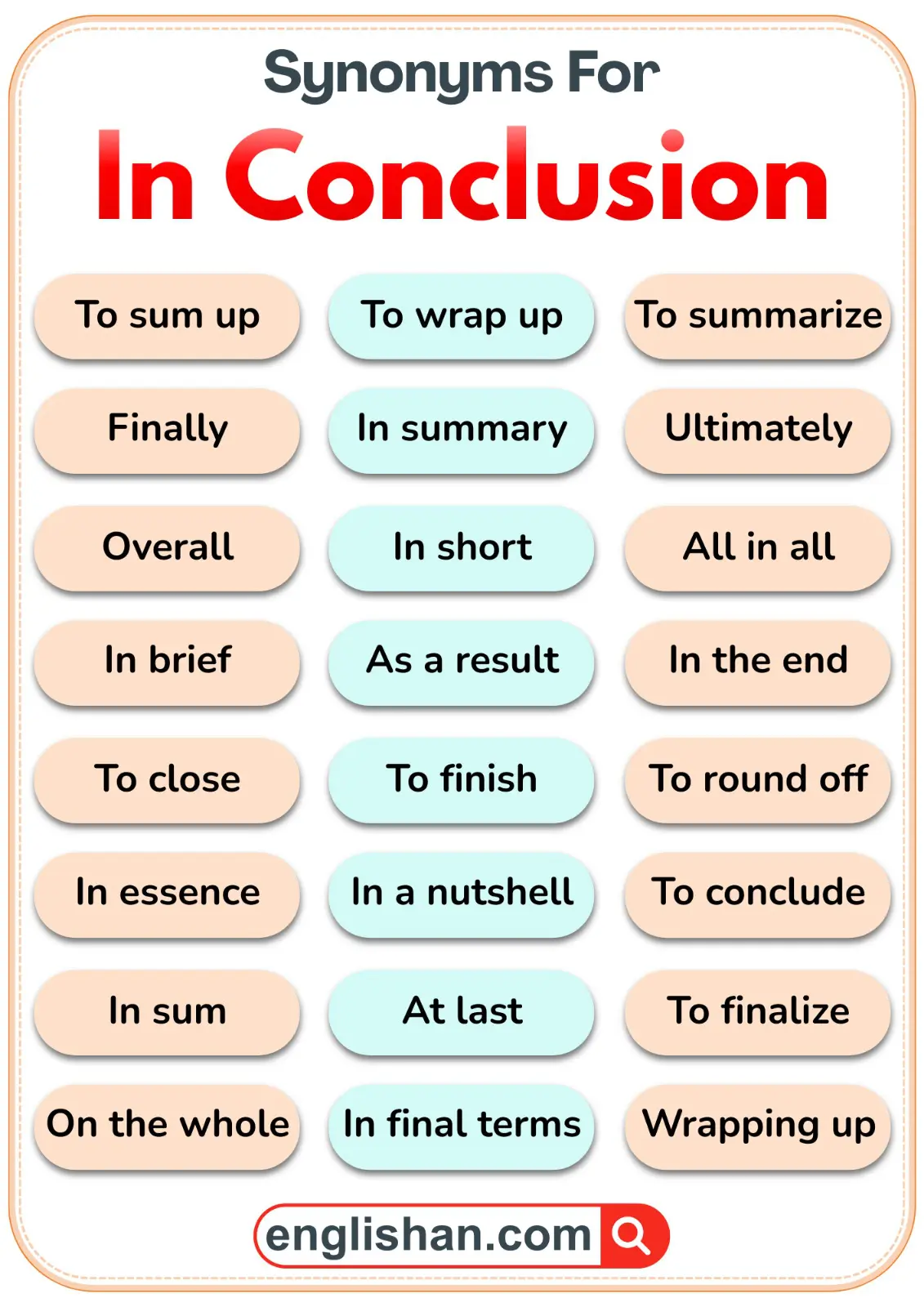
| To sum up | To wrap up |
| To summarize | Finally |
| In summary | Ultimately |
| Overall | In short |
| All in all | In brief |
| As a result | At the end of the day |
| In the end | As we have seen |
| To close | In conclusion |
| To recapitulate | To finish |
| To round off | In final analysis |
| To bring to a close | In essence |
| In a nutshell | In the long run |
| To put it briefly | As a final point |
| To make a summary | Ultimately speaking |
| To conclude | To finalize |
| To draw a conclusion | At last |
| In sum | On the whole |
| As a summary | In final terms |
| Wrapping up | In closing |
Common Synonyms for In Conclusion
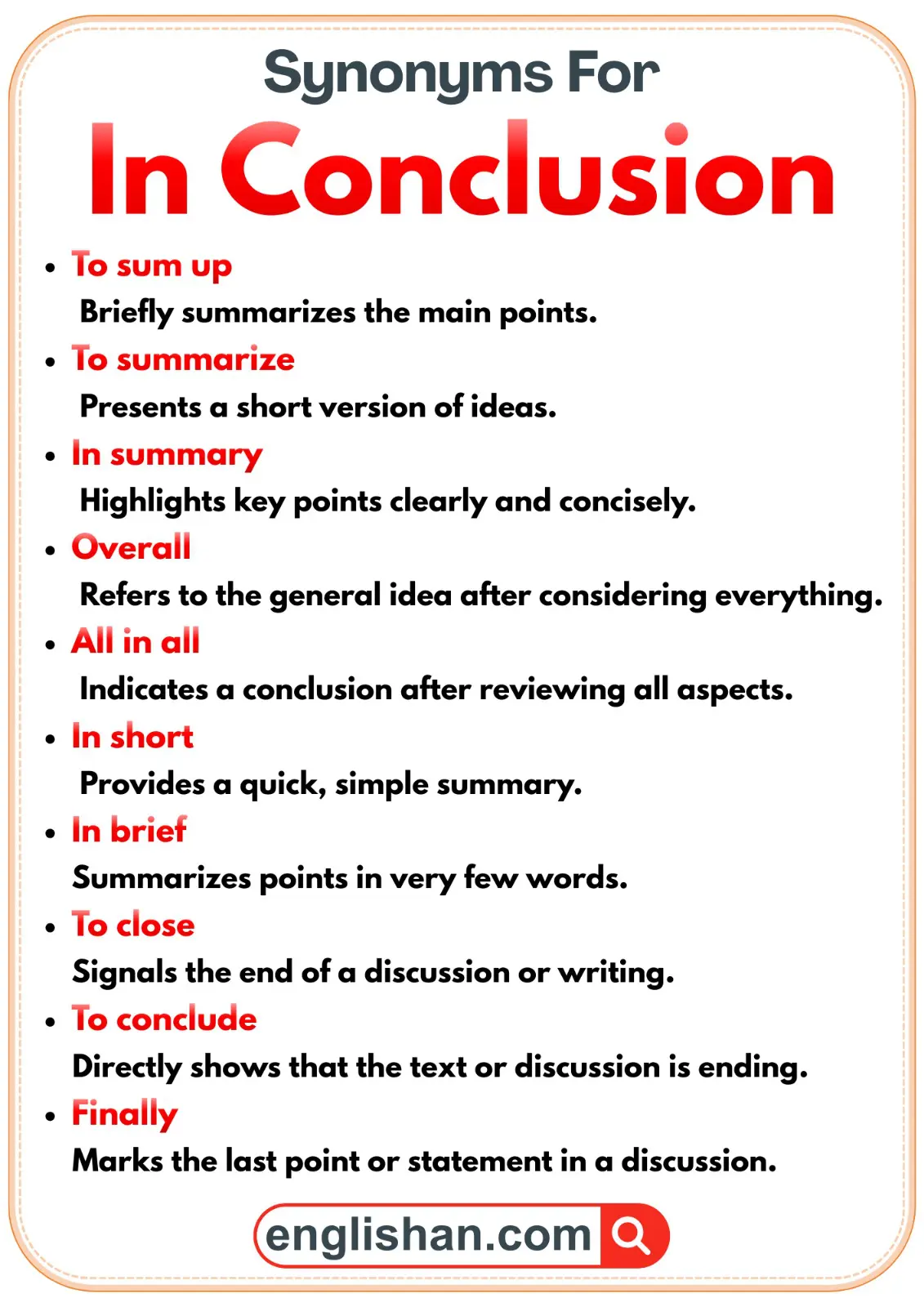
- To sum up – Used to give a brief summary of the main points.
- To summarize – Shows that you are giving a short version of your ideas.
- In summary – Highlights the main points in a clear, concise way.
- Overall – Refers to the general idea or main point after considering everything.
- All in all – Indicates a conclusion after looking at all aspects.
- In short – Used to give a quick, simple summary.
- In brief – Summarizes points in a few words.
- To close – Signals that you are ending your discussion or writing.
- To conclude – Directly shows that the discussion or text is ending.
- Finally – Marks the last point or statement in a discussion.
Common Alternatives to In Conclusion
In this section, we’ll look at some common alternatives to in conclusion that work well in both formal and casual situations.
In Conclusion vs. To Sum Up
Both phrases summarize ideas, but in conclusion is more formal, while to sum up is friendly and easygoing.
Examples:
- In conclusion, investing in renewable energy is crucial for long-term sustainability.
- To sum up, the team agreed to start the project next Monday.
In Conclusion vs. In Summary
In conclusion is usually used to give the final point or judgment at the end of writing, a speech, or a presentation. It shows a clear ending and often carries more weight.
In summary is used to quickly recap the main points. It doesn’t always signal the very end, and it can sound more neutral or straightforward.
Examples:
- In conclusion, teamwork is essential for achieving company goals.
- In summary, the survey results show that employees prefer flexible working hours.
In Conclusion vs. In a Nutshell
In conclusion is formal and used to highlight the main points at the end of a discussion or essay.
In a nutshell is casual and short. It’s perfect for everyday conversations or giving a quick explanation.
Examples:
- In conclusion, eating a balanced diet improves both physical and mental health.
- In a nutshell, the new app makes online shopping much easier.
Synonyms for In Conclusion in Different Contexts
Here are some easy and practical alternatives to in conclusion that you can use in different situations.
In Professional Writing
- To sum up: To sum up, the new policy will improve customer satisfaction.
- In the end: In the end, the project met all the objectives.
- Lastly: Lastly, we need to focus on long-term strategies.
Informal Summaries
- Basically: Basically, that’s how everything went.
- So: So, we’re meeting again on Monday.
- Long story short: Long story short, everything turned out fine.
- To cut it short: To cut it short, we reached our target.
In Daily Conversation
- In a nutshell: In a nutshell, the trip was amazing.
- All in all: All in all, it was a productive day.
- In short: In short, we had a great time.
In Academic Essays
- In short: In short, the results confirm our initial assumptions.
- Overall: Overall, the study highlights the importance of early intervention.
- To recap: To recap, the main factors affecting the outcome were X and Y.
In Presentations
- To finish off: To finish off, let’s review the key takeaways from today’s session.
- Wrapping up: Wrapping up, we’ve covered all the main points.
- Before we end: Before we end, I want to thank everyone for their questions.
In Office Discussions
- To close: To close, I suggest we implement the proposed plan next week.
- In brief: In brief, we need to focus on boosting team efficiency.
- To finalize: To finalize, let’s set deadlines for each task.
Importance of Formal Conclusions
In academic writing, a conclusion is more than just the last paragraph—it’s your chance to wrap up your ideas clearly and leave a lasting impression. A good conclusion helps readers understand the main points, see how your ideas fit together, and recognize why your work matters.
Finally, a conclusion often offers a final thought. This could be a recommendation, a call to action, or just something for readers to think about after finishing your work.
To make your conclusion clear and formal, you can use simple signpost phrases like:
- To summarize
- In summary
- Ultimately
- Upon reflection
Using these phrases helps readers recognize that you’re wrapping up and ensures your conclusion feels polished and complete.
Absolute and Related Synonyms for In Conclusion
Not every alternative to in conclusion works the same way. Some phrases can directly replace it and clearly signal an ending, while others only suggest a wrap-up and depend on the context. Knowing the difference helps you choose the right phrase and end your writing or speech more smoothly.
Absolute Synonyms for In Conclusion
| Synonym | Meaning |
|---|---|
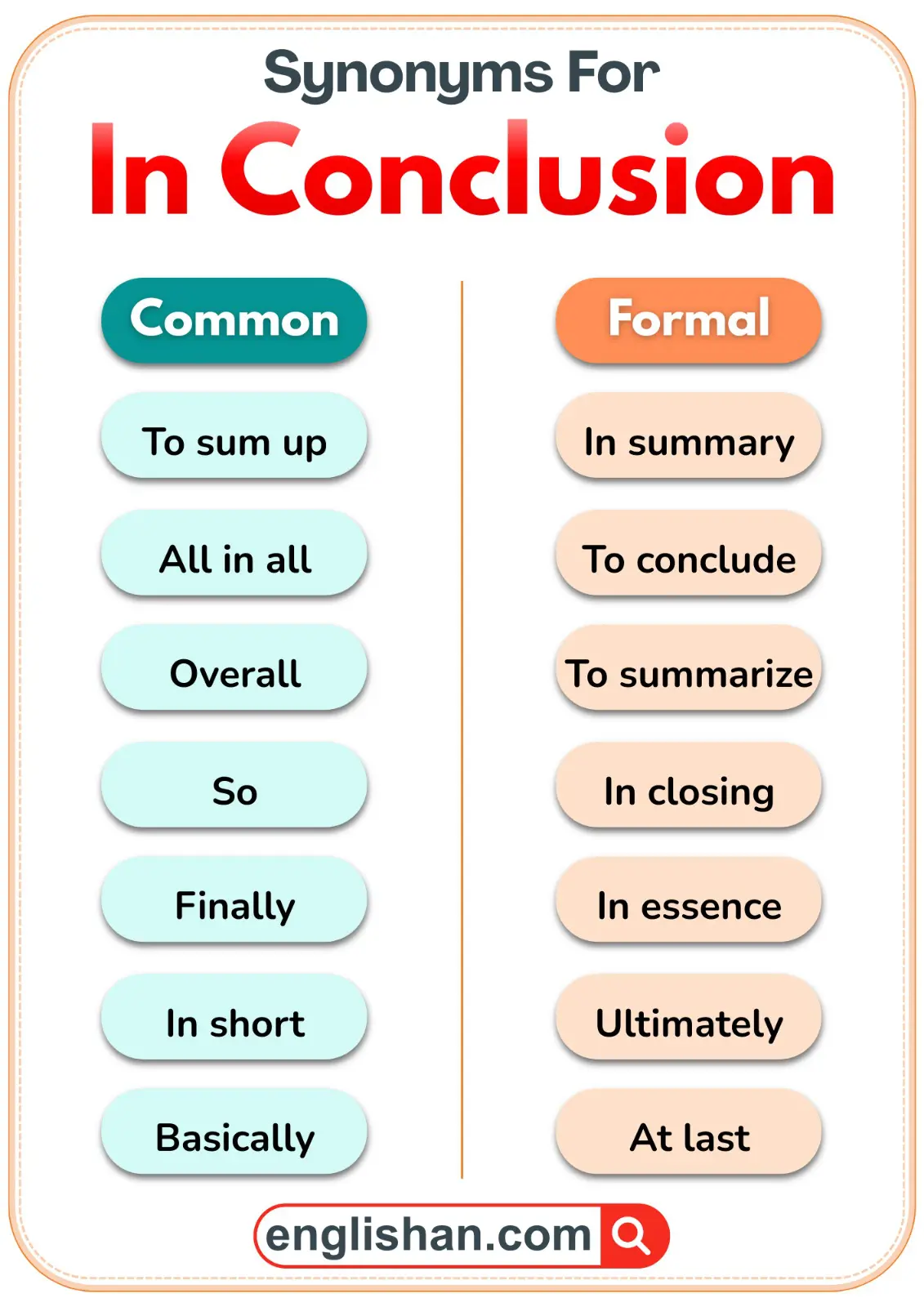
| To conclude | To clearly end |
| In summary | Main points restated |
| To sum up | Short final overview |
| In closing | Signals the end |
| In brief | Short ending summary |
| In sum | Final combined idea |
| Overall | Final general view |
| Finally | Last point |
Related Synonyms for In Conclusion
| Synonym | Meaning |
|---|---|
| All in all | Final opinion |
| In short | Quick summary |
| At the end of the day | Final thought |
| In a nutshell | Very brief summary |
| To wrap up | Informal ending |
| Basically | Simplified ending |
| Long story short | Shortened ending |
| So | Casual wrap-up |
FAQs About In Conclusion Synonyms
In conclusion is a phrase used to show that you are ending your writing or speech. It signals a final summary or closing thought.
• Example: In conclusion, regular practice is the key to improving your English.
Using the same phrase again and again can sound repetitive. Synonyms help your writing feel smoother and more natural, especially in essays, articles, and speeches.
• Examples:
• To sum up, teamwork plays a major role in success.
• In summary, the results support our original idea.
Some commonly used alternatives include:
• to sum up
• in summary
• overall
• in brief
• finally
For academic or professional writing, it’s better to use clear and formal phrases like in summary, to conclude, overall, and in closing.
• Example: In summary, the research highlights the need for further study.
You May Also Like