The closest goal synonyms are aim and objective, and the one you want depends on how measurable the result has to be.
Most wrong swaps put the method where the aim should be. A plan is how you get there, not what you are heading for, so dropping it in flips your meaning.
Work out which meaning you want, then how formal the sentence has to be, and the replacement works in a thesis, a performance review, or a match report.
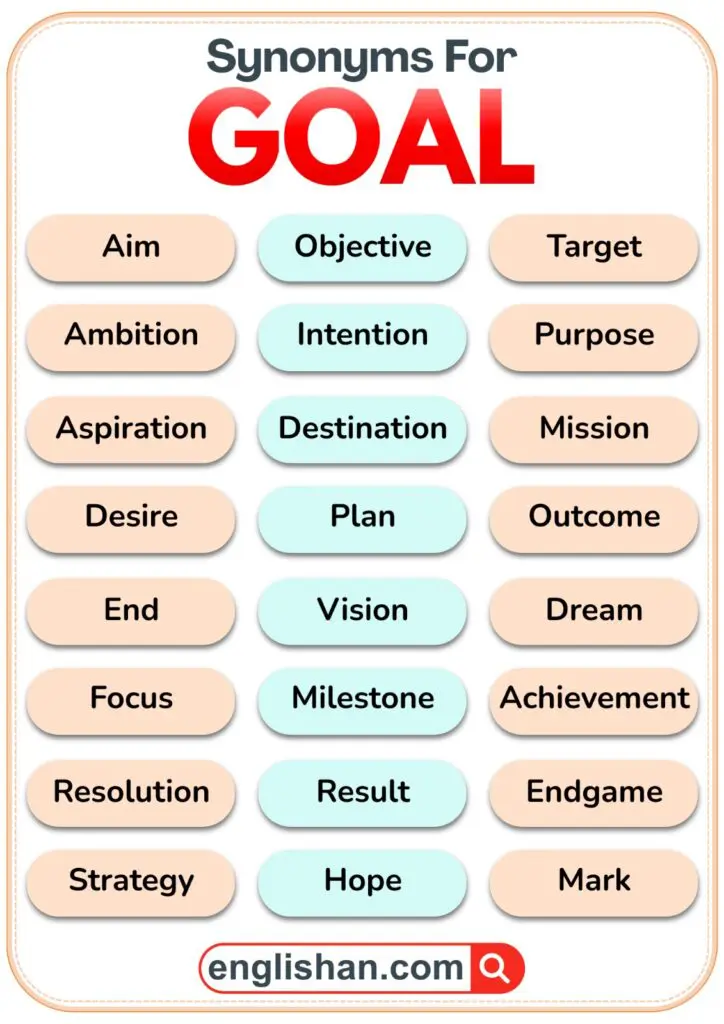
Another Word for Goal
The five strongest replacements for goal are aim, objective, target, purpose, and ambition. Pick by precision: aim for direction, objective for a measurable step, target for a number, purpose for the reason behind the work, and ambition for something you want rather than something you have scheduled.
English uses goal for two unrelated meanings. One is the thing you work toward, which is what a thesis, a business plan, and a New Year resolution all have in common. The other is a score in football, hockey, or lacrosse, and it needs entirely different words. Decide which meaning you want before you open a thesaurus, because no single word serves both.
Goal Synonyms That Mean Aim or Objective
These all name the thing you are working toward. Some are plain enough for a text message and others would look odd anywhere outside a contract.
- Aim: points at a direction without promising a measurable end. Broad enough for essays, letters, and speech. Our aim is to cut delivery times.
- Objective: a specific step you either hit or miss. The word business and academic writing prefer, because it commits you to something checkable.
- Target: an objective attached to a number or a date. The team missed its target by four percent.
- Purpose: answers why the work exists rather than what it produces.
- Intent: a formulated decision to act, common in law and policy. (formal)
- Intention: what you mean to do, stated more loosely than intent.
- End: names the result you are working toward, and normally pairs with the means. (formal)
- Object: slightly old-fashioned in this use, naming an individually chosen aim. (dated)
- Design: implies deliberate planning, with a faint edge of calculation.
- Mark: survives mainly in wide of the mark and hit the mark, where it names the standard you are trying to reach.
- View: what you have in mind, almost always in with a view to.
- Destination: ends a journey, literal or metaphorical.
- Terminus: closes a route or a process. (formal)
- Endpoint: standard in science and medicine for the defined finish of a process. (technical)
- End goal: outranks the smaller aims that lead to it.
- Endgame: borrowed from chess for the outcome a long strategy is built toward.
- Finish line: marks the moment the work is over, warm and visual.
- Bull’s-eye: hits the exact centre of what you were aiming at.
- Ideal: describes what you would reach in perfect conditions.
- Vision: paints the long-range picture that smaller aims serve.
- North star: keeps every decision pointing the same way. Two words, never one. (business)
- Holy grail: everyone in the field chases it and nobody has reached it. (journalistic)
- Be-all and end-all: outranks every other aim in the sentence.
- Name of the game: names what an activity is really for, informally. (casual)
- Desideratum: something needed or wanted, in academic and philosophical prose. (formal)
- Telos: from Greek philosophy, meaning the end something exists to reach. (academic)
- Focal point: draws attention to one place. Two words, and focuspoint is not English.
- Prize: rewards the effort and justifies it.
- Sights: what you have chosen to pursue, in set your sights on.
Related:
Ambition and Aspiration Words for Goal
These describe wanting something rather than scheduling it, which is why personal goals attract them and project plans do not. Some are mild and some are almost desperate, and a hiring manager reads ambition very differently from pipe dream.
- Ambition: runs over years and brings its own drive with it.
- Aspiration: states an ambition with more dignity and less hunger. Common in policy writing.
- Dream: matters emotionally whether or not it is realistic.
- Desire: wanting something, with no plan attached.
- Wish: stops short of any commitment to act.
- Hope: wanting an outcome you cannot fully control. Neighbouring words lean toward optimism rather than intent, and the wider hope words separate them.
- Longing: aches for something absent, and sustains it. (literary)
- Yearning: longing with more emotional force behind it. (literary)
- Craving: feels urgent and almost physical.
- Hankering: softens a craving into something half-amused. (casual)
- Want: plainest of all, and the one speech prefers.
- Appetite: signals readiness for more, common in business writing about risk and growth.
- Thirst: attaches to knowledge, success, or revenge more than to objects.
- Hunger: thirst with more urgency, and the word sports writing reaches for.
- Passion: what you pursue because you care, rather than because it pays.
- Fantasy: you enjoy imagining it and do not expect to reach it.
- Daydream: lighter than a fantasy and briefer.
- Pipe dream: dismisses the aim as impossible. Never a compliment.
- Bucket list: collects experiences to have before you die. (casual)
- Heart’s desire: outranks everything else you want. (literary)
Related:
Measurable Words for Goal in Business and Work
Workplace writing wants a number, not an aspiration. Team goals depend on these words, because each one commits you to something a colleague can verify.
- Benchmark: gives you the reference figure to measure performance against.
- Quota: requires a set amount inside a set period, common in sales and production.
- Threshold: sets the minimum that counts as success.
- Metric: names the measurement itself rather than the level you want.
- KPI: a key performance indicator, the small set of metrics a team is judged on.
- Key result: proves an objective was met, and comes from the OKR method.
- Deliverable: has to be handed over, which is what separates it from an aim.
- Stretch goal: exceeds comfortable reach on purpose.
- Baseline: fixes the starting figure every later number is compared with.
- Standard: fixes an agreed level of quality or output.
- Criterion: tests whether a result passes. Plural criteria, and the singular is misused constantly.
- Yardstick: works as an informal benchmark where the measure is rough.
- Target figure: states the exact number being aimed at.
- Headline number: reduces a whole report to one figure.
- Budget: limits spending and doubles as a planning target.
- Success measure: defines what winning looks like for one project.
- Bottom line: lands at the foot of the accounts, and by extension names the figure that matters most.
- Break-even point: arrives when revenue matches cost.
Mission and Purpose Synonyms for Goal
These name the aim as a duty, a commitment, or a role. Several belong to British institutions and sound wrong in casual American writing.
- Mission: comes with obligation attached, whether you were sent or volunteered.
- Calling: work you feel drawn to rather than assigned.
- Vocation: treats a calling as a lifelong profession.
- Cause: unites a group and depends on belief.
- Remit: defines what an organisation or role is responsible for. (British, institutional)
- Brief: sets out the instructions defining a job. (British, professional)
- Mandate: authority plus the aim it was granted for. (formal)
- Charge: places responsibility on someone. (formal)
- Commission: hands a task formally to a person or body.
- Assignment: arrives without any choice attached.
- Undertaking: something substantial you have agreed to do.
- Endeavour: implies serious, sustained effort. (formal)
- Enterprise: brings risk and ambition into an undertaking.
- Venture: leaves the outcome genuinely uncertain.
- Quest: runs long, meets obstacles, and keeps a hint of romance.
- Crusade: draws its energy from conviction rather than reward.
- Duty: obliges you whether you want it or not.
- Resolution: fixes a decision to act, and normally at a set moment such as New Year.
- Resolve: supplies the firmness behind a resolution.
- Commitment: binds you publicly, which is what raises the cost of quitting.
- Pledge: formalises a public commitment. (formal)
- Vow: adds personal or religious weight to a pledge.
Related:
Milestone and Checkpoint Words for Goal
A milestone is a stage on the way, never the whole aim. Writers swap these in for goal and quietly shrink what they promised.
- Milestone: marks real progress at a stage worth naming.
- Checkpoint: pauses the work to verify progress before continuing.
- Waypoint: guides navigation along a longer route.
- Marker: any point that shows how far the work has come.
- Stage: one defined portion of a longer process.
- Phase: takes its identity from what changes during it.
- Step: names the smallest unit of progress worth tracking.
- Landmark: stays memorable long after the work moves on.
- Turning point: changes the direction of everything that follows.
- Staging post: breaks a long route into shorter runs. (British)
- Priority: ranks one aim ahead of the rest.
- Focus: narrows attention to one aim right now, and the nearby focus words go deeper on the attention meaning.
Formal Synonyms for Goal in Academic Writing
Journals prefer words that commit to something checkable, and goal reads as vague where a reviewer expects precision.
| Word | How formal | Best use |
|---|---|---|
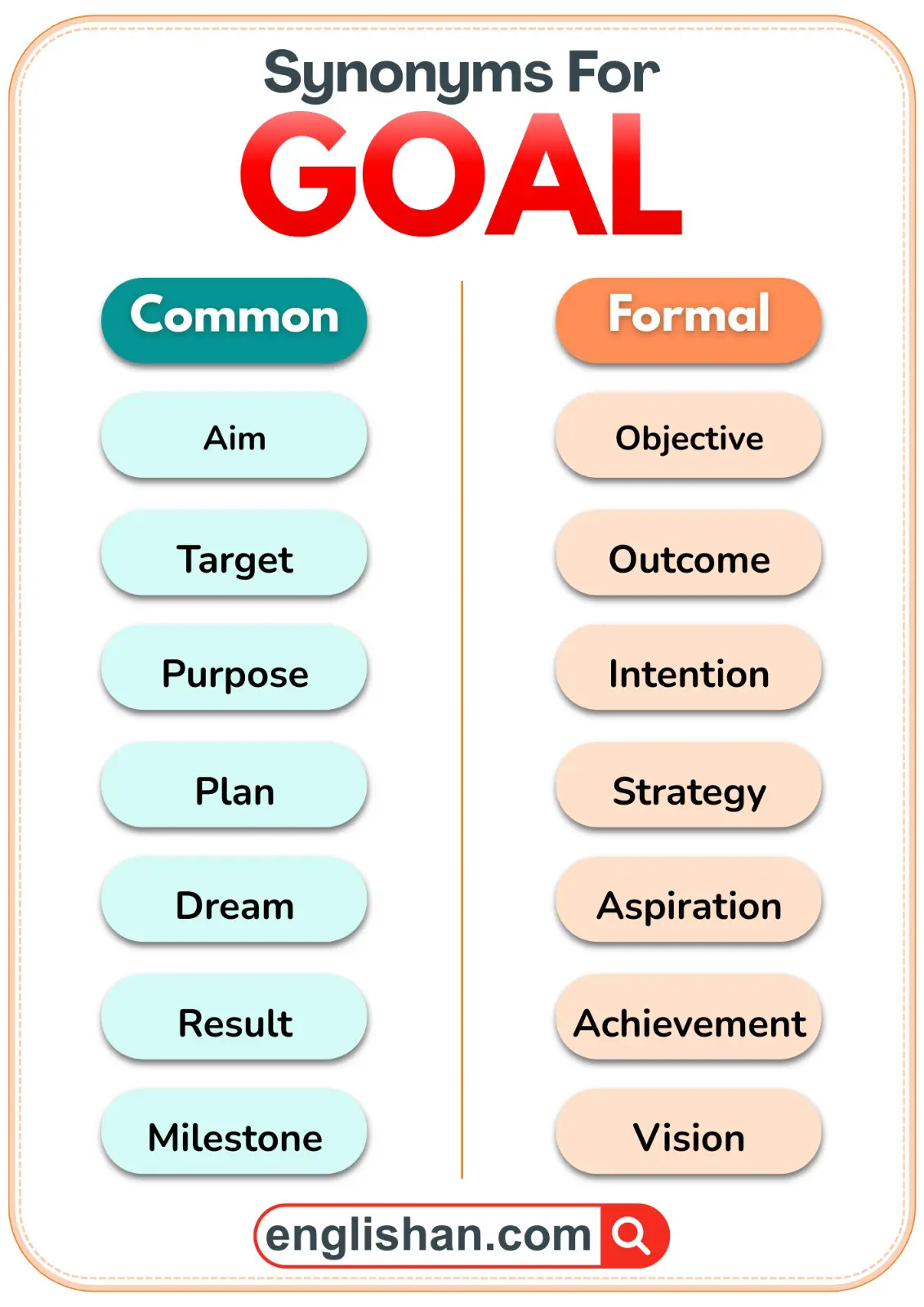
| Aim | Formal, standard | The overall direction of a study |
| Objective | Formal, standard | A specific, testable component of that aim |
| Endpoint | Technical | The defined measurement a trial concludes on |
| Criterion | Formal | The test a result has to pass |
| Benchmark | Formal | The comparison figure for performance |
| Standard | Formal | The agreed level of quality |
| Intent | Formal, legal | A formulated decision, common in policy analysis |
| End | Formal | The result, normally paired with the means |
| Desideratum | Academic | Something the field needs and lacks |
| Telos | Academic, philosophical | The end a thing exists to reach |
Professional Goal Synonyms for Resumes and Interviews
Recruiters read my goal is as filler because every applicant writes it. Replace it with a word that commits to something measurable.
| Instead of | Write | Why it works better |
|---|---|---|
| My goal is to grow | My objective is to lead a regional team by 2028 | Attaches a role and a date |
| Career goals | Career trajectory | Describes movement rather than a wish |
| My goal was to improve sales | I owned a quota of £1.2m | Names the number you carried |
| Team goals | Team deliverables | States what was actually handed over |
| Long-term goal | Long-term ambition | Signals drive without sounding vague |
| Our goal was ambitious | We set a stretch target | Uses the term the industry uses |
| Reaching goals | Meeting key results | Borrows the language your interviewer already speaks |
The same sharpening applies to how you describe what you can do, and the skill words handle that half of the document.
Related:
Casual Ways to Talk About Your Goals
Spoken English drops the institutional words entirely. These are what people actually say.
| Phrase | How formal | When it fits |
|---|---|---|
| What I’m going for | Casual | Explaining an aim without formality |
| What I’m working toward | Casual, warm | Personal plans and study |
| The plan | Casual | Loose, shared aims among friends |
| My thing this year | Very casual | Resolutions and habits |
| Where I want to end up | Casual | Career direction |
| The dream | Casual, light | Something unlikely and enjoyable |
| Name of the game | Idiomatic | The real aim behind an activity |
Related:
Goal Synonyms in Football and Other Sports
This is the second meaning of goal, and it shares nothing with ambition. Here a goal is a score, so the replacements are scoring words rather than aims.
- Score: works across every sport for a successful attempt.
- Point: measures what a score is worth, and the value varies by sport.
- Tally: counts scores across a match or a season.
- Strike: scores from a shot, and football commentary favours it.
- Screamer: flies in from long range and lifts the crowd. (casual, British)
- Equaliser: levels the score.
- Winner: decides the match.
- Brace: two goals by one player in one match.
- Hat-trick: three goals by one player in one match.
- Own goal: goes in against your own team by accident.
- Golden goal: ended extra time on the spot under the old rule. (historical)
- Penalty: follows a foul, naming both the free shot and the goal it produces.
- Header: scores with the head.
- Conversion: adds points with a kick after a rugby try.
- Try: scores by grounding the ball in rugby.
- Touchdown: brings six points in American football.
- Field goal: a kicked score in American football, a shot from open play in basketball.
- Basket: scores in basketball.
- Net: works as a verb for scoring. He netted twice in the second half.
Words That Are Not Goal Synonyms
Every thesaurus mixes these in, and reference works record method, means, and way as antonyms of goal rather than substitutes for it. Three groups cause almost all the trouble.
Methods, not aims: plan, strategy, blueprint, scheme, programme, game plan, approach, tactic, roadmap. Each names how you get there. A goal is what you are heading for, so the two do opposite jobs in a sentence.
Results, not aims: achievement, success, result, outcome, finish, fulfilment, accomplishment, victory. Each names what you ended up with. You cannot be working toward an achievement, because the word means the work is already done.
Traits, not aims: drive, determination, grit, motivation, discipline. Each names the quality that gets you there, not the place you are going.
My strategy this year is to run a marathon. ❌
My goal this year is to run a marathon. ✅
The exception is outcome, which academic writing does use for a stated aim, as in learning outcomes. Outside that convention, keep it for the result.
Goal vs Objective vs Target vs Aim

These four get swapped daily and each commits you to something different. Scope, measurability and timeframe are what actually separate them.
| Word | Scope | Measurable | Typical timeframe |
|---|---|---|---|
| Goal | Broad outcome | Loosely | Months to years |
| Objective | One specific step toward a goal | Yes, by definition | Weeks to months |
| Target | A number or date attached to an objective | Exactly | Fixed deadline |
| Aim | The direction of travel | No | Open-ended |
| Purpose | The reason the work exists | No | Permanent |
| Vision | The future state being built toward | No | Years |
| Ambition | What you personally want | No | Years to a lifetime |
| Outcome | The result once the work is done | Yes, after the fact | Backward-looking |
| Habit | The repeated behaviour that gets you there | By frequency | Ongoing |
| Tactic | One move inside a strategy | No | Days to weeks |
| Requirement | What has to be true for success | Pass or fail | Fixed |
| Threshold | The minimum that counts as success | Exactly | Fixed |
Goal against objective: a goal is what you want; an objective is one checkable step that gets you closer. Grow the business is a goal, sign forty new accounts by June is an objective.
Goal against target: a target is a goal with a number bolted on. Every target is measurable, and no target survives without a deadline.
Goal against aim: an aim points, a goal arrives. You can keep an aim for a decade without ever defining what reaching it looks like.
Goal against purpose and vision: purpose answers why, vision describes the future state, and the goal is the concrete outcome between them.
Goal against outcome: a goal faces forward and an outcome faces back. Swap them and you claim the work is finished before it started.
Goal against habit: a habit is the behaviour you repeat, and the goal is what the repetition is for. Run four times a week is a habit; finish a marathon in April is the goal it serves.
Goal vs Objective vs KPI at Work
These terms form a hierarchy at work, and using the wrong level in a review makes you sound unfamiliar with the process.
| Term | What it names | Example |
|---|---|---|
| Mission | Why the organisation exists | Make regional healthcare affordable |
| Vision | The future state being built | Every district served within thirty minutes |
| Strategy | The chosen route | Expand through partner clinics rather than new sites |
| Goal | The broad outcome wanted | Double patient reach in three years |
| Objective | A specific step toward it | Open twelve partner clinics this year |
| Key result | The measurable proof | Nine clinics live and averaging 200 patients a month |
| KPI | The ongoing metric watched | Patients served per clinic per month |
| Milestone | A stage on the route | Fourth clinic opened |
| Deliverable | The output handed over | Signed partnership agreements |
| SMART goal | A goal written to be specific, measurable, achievable, relevant and time-bound | Open twelve clinics by 31 December |
| Sprint goal | The single outcome one development sprint commits to | Booking flow live for two clinics |
Idioms That Mean Reaching a Goal
English has a set of fixed phrases for pursuing and reaching goals, and none of them substitutes for the noun. Use them where the sentence needs energy rather than precision.
- Hit the mark: achieve exactly what you were aiming at.
- Cross the finish line: complete something long after sustained effort.
- Keep your eye on the prize: stay focused on the outcome while the work drags.
- Shoot for the moon: aim far beyond what looks reachable.
- Go the distance: keep going to the end rather than stopping partway.
- Break new ground: achieve something nobody has done before.
- Move mountains: overcome obstacles large enough to stop most people.
- Climb the ladder: advance through the ranks of an organisation.
- Knock it out of the park: exceed the aim so far that nobody expected it.
- Deliver the goods: produce exactly what you promised.
- Get there in the end: reach the aim eventually, after setbacks.
- See it through: finish what you started when quitting was available.
Verbs That Go With Goal and Its Synonyms
Choosing the right noun only gets you halfway, because each of these takes a different verb. The wrong pairing is the mistake that gives you away fastest, and the wider rules on collocations explain why English fixes these pairings so tightly.
| Noun | Verbs that fit | Example |
|---|---|---|
| Goal | set, achieve, reach, score, miss | She set herself a goal of running daily. |
| Objective | meet, achieve, define, fall short of | The team met every objective this quarter. |
| Target | hit, miss, set, exceed, beat | Sales hit the target two weeks early. |
| Aim | have, pursue, further | Our aim is to reduce waste by half. |
| Ambition | fulfil, harbour, realise, abandon | He fulfilled a lifelong ambition. |
| Dream | realise, chase, live | She realised a childhood dream. |
| Mission | accomplish, carry out, abort | The crew accomplished the mission. |
| Quota | fill, meet, exceed | Every rep filled their quota. |
| Milestone | reach, pass, mark, celebrate | The project reached its first milestone. |
| Benchmark | set, meet, raise | The report set a new benchmark. |
Two pairings go wrong constantly. You achieve a goal but you meet an objective, and you score a goal only when you mean football.
Antonyms for Goal
Opposites define a word faster than more synonyms do, and goal has three sets because it works in three directions.
Against the aim itself: aimlessness, purposelessness, directionlessness, randomness, drift.
Against the endpoint: start, beginning, outset, origin, ground zero, point of departure.
Against a planned intention: accident, chance, impulse, whim, happenstance, spontaneity.
The third set is where the method confusion returns, because reference works record method, means, and way as opposites of goal rather than as substitutes for it.
Related:
Mistakes to Avoid When Replacing Goal
Four errors account for almost every awkward substitution, and each takes one line to fix.
Swapping in a method: writing my strategy this year is to run a marathon replaces the destination with the route. Keep plan, strategy, and approach for the how.
Swapping in a result: I am working toward an achievement breaks, because the word already means the work finished. Use goal while it is ahead of you and achievement once it is behind you.
Downgrading to a milestone: calling the fourth clinic your goal when it is stage four of twelve shrinks what you promised. A milestone marks progress toward a goal, never the goal itself.
Mixing the two meanings: my objective is to score three objectives is nonsense, because the football meaning takes only goal, score, and the words around them. Check which one you are in before you substitute.
FAQs
The closest single replacements are aim and objective. Use aim when you are describing direction and objective when the result has to be measurable. For a number attached to a deadline, target is more precise than either.
A goal is a broad outcome you want, while an objective is one specific step that moves you toward it. Goals are loose and long-range, objectives are measurable and short-range, and most plans pair one goal with several objectives. Grow the business is a goal; sign forty new accounts by June is an objective.
Objective, aim, and end are the standard formal replacements, and academic writing prefers objective because it commits to something testable. In technical and clinical writing, endpoint names the exact measurement a study concludes on. Desideratum and telos work in philosophical prose and read as affected anywhere else.
No. A plan is the method you will follow, and a goal is the outcome you are heading for. Reference works record method, means, and way as opposites of goal rather than substitutes, so swapping plan into a sentence about goals reverses what you meant.
In football the word means a score, so the replacements are score, strike, finish, and conversion rather than aim or objective. Match reports also use equaliser for the levelling goal, winner for the decisive one, and brace or hat-trick for two or three by the same player.
Aimlessness and purposelessness are the direct opposites when you mean intention, while start, beginning, and origin oppose the endpoint meaning. Choose the antonym that matches how you used goal, since the two sets are not interchangeable.
Goal setting is the standard term, and objective setting and target setting are its workplace equivalents. In planning documents you will also see scoping, which means defining the boundaries as well as the aims, and forecasting when the targets are numerical.
The most common are hit the mark, cross the finish line, and keep your eye on the prize, and each describes pursuing or reaching an aim rather than naming one. Shoot for the moon means setting goals deliberately beyond comfortable reach, while go the distance and see it through describe finishing what you started. None of them replaces the noun goal in a sentence.
You May Also Like
- 100 Important Synonyms Words in English
- Synonyms of Important Words
- Synonyms for Amazing
- Synonyms for Beautiful