Dragonflies have been flying for over 300 million years, long before dinosaurs existed, and roughly 3,000 species are alive today. They range from the tiny Eastern Amberwing at barely an inch long to the Giant Darner with a wingspan over five inches. Types of dragonflies split across seven major families, and each one differs in body shape, wing pattern, color, and flight style.
Some families hover low over still ponds. Others patrol rivers at high speed or rest flat on sunlit rocks with their wings spread wide. Colors range from metallic green and electric blue to deep red and pale amber, depending on the species and its age.
Since many dragonflies share similar sizes and overlapping habitats, family-level features are the fastest way to narrow down what you’re looking at. Here, you’ll go through all seven families with representative species, size ranges, color cues, habitat notes, and a dragonfly-vs-damselfly comparison to clear up the most common mix-up.
How Many Types of Dragonflies Are There?
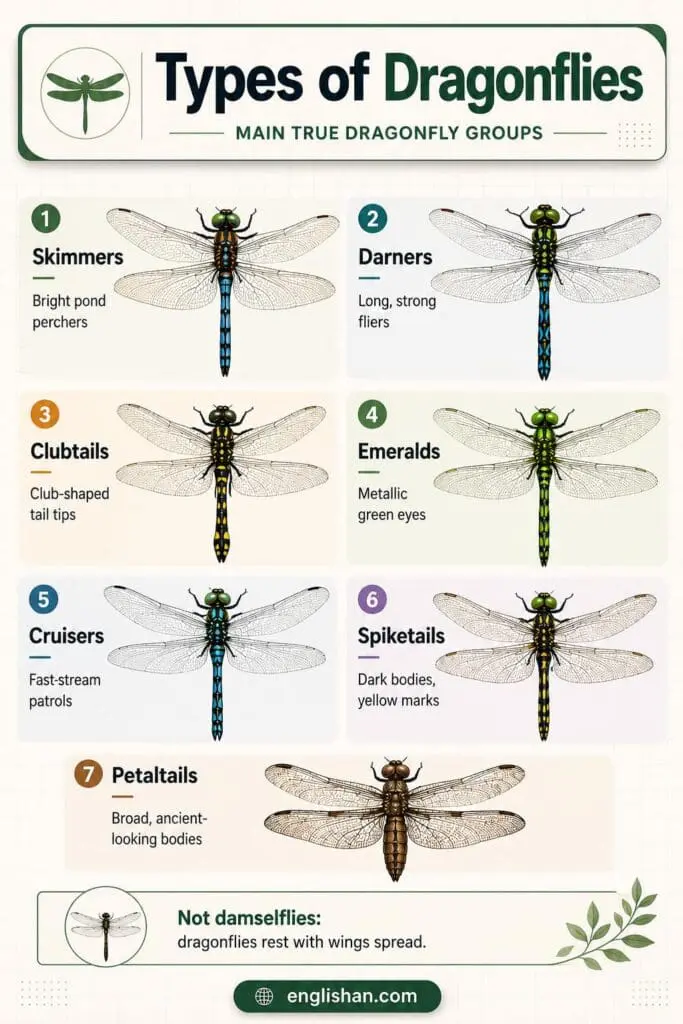
Around 3,000 described dragonfly species inhabit every continent except Antarctica, with the heaviest concentration in tropical and subtropical regions. In North America alone, roughly 350 species have been documented. These species are organized into seven families: skimmers, darners, clubtails, emeralds, cruisers, spiketails, and petaltails. Skimmers (Libellulidae) and clubtails (Gomphidae) account for the majority of species, while petaltails (Petaluridae) represent the smallest and most ancient family with only two North American species and eleven worldwide.
All dragonflies share the infraorder Anisoptera, meaning “unequal wings,” a reference to the broader hindwing compared to the narrower forewing. They are separated from damselflies (suborder Zygoptera) at the suborder level, though both belong to the order Odonata.
Dragonfly vs. Damselfly: How to Tell Them Apart
Dragonflies and damselflies both belong to the order Odonata, but four anatomical differences separate them reliably in the field.
| Feature | Dragonfly (Anisoptera) | Damselfly (Zygoptera) |
|---|---|---|
| Body shape | Robust, stout abdomen | Slender, needle-like abdomen |
| Eyes | Large, touching or nearly touching on top of head | Smaller, separated on each side of head |
| Wing shape | Hindwing broader at base than forewing | All four wings similar in shape, narrow at base |
| Resting position | Wings held outstretched, perpendicular to body | Wings folded along or above body |
One notable exception: clubtail dragonflies (Gomphidae) and petaltails (Petaluridae) have eyes that are distinctly separated, unlike most other dragonfly families. Among damselflies, spreadwings (Lestidae) rest with wings partially open rather than folded, which mimics the dragonfly posture at first glance.
Dragonflies are stronger, faster fliers that patrol open water and territories aggressively. Damselflies flutter and drift close to vegetation, rarely straying far from the water’s edge.
Types of Dragonflies: Quick Reference Table
| Family | Scientific Name | North American Species | Size Range | Key Identification Trait | Preferred Habitat |
|---|---|---|---|---|---|
| Skimmers | Libellulidae | ~105 | 20-55 mm body | Broad, often colorful wings; perch horizontally on tips of vegetation | Ponds, marshes, lakes |
| Darners | Aeshnidae | ~40 | 55-85 mm body | Large eyes touching on head; perch vertically on branches | Ponds, slow streams, marshes |
| Clubtails | Gomphidae | ~100 | 40-65 mm body | Club-shaped abdominal tip; eyes separated | Rivers, sandy-bottomed streams |
| Emeralds | Corduliidae | ~50 | 40-60 mm body | Metallic green or bronze thorax; bright green eyes | Bogs, forested ponds, clean lakes |
| Cruisers | Macromiidae | ~9 | 55-75 mm body | Long spider-like front legs; continuous cruising flight | Rivers, large streams |
| Spiketails | Cordulegastridae | ~9 | 60-80 mm body | Bold yellow and black banding; spike-shaped ovipositor | Forest streams, spring seeps |
| Petaltails | Petaluridae | 2 | 55-75 mm body | Petal-shaped anal appendages; ancient lineage | Boggy seeps, forested streams |
Skimmers (Libellulidae)
Skimmers are the largest and most diverse dragonfly family, with over 1,000 species worldwide and roughly 105 in North America. They earned their common name from the habit of skimming low over the water surface, and they are the dragonflies most people encounter first because they favor still, open water and perch conspicuously on vegetation tips, rocks, and fence posts. Skimmers display the widest range of wing coloration among dragonflies, with many species carrying banded, spotted, or tinted wings that aid field identification instantly.
Blue Dasher
The Blue Dasher (Pachydiplax longipennis) is one of the most widespread dragonflies in North America, found from southern Canada to Mexico near ponds, lakes, and slow streams. Males measure 25-35 mm and develop a powdery blue pruinescence on the abdomen as they mature, paired with metallic green eyes. Females and immature males are brown with yellow lateral stripes. Blue Dashers perch on low vegetation with wings angled slightly forward and launch quick flights to intercept passing insects before returning to the same perch.
Twelve-Spotted Skimmer
The Twelve-Spotted Skimmer (Libellula pulchella) is identified immediately by the twelve dark wing patches, three on each of its four wings. Mature males add white patches between the dark spots, creating a striking alternating pattern. This species measures 50-55 mm in body length, inhabits ponds and marshes across most of North America, and is one of the most photographed dragonflies on the continent due to its bold wing markings and willingness to perch in the open.
Eastern Pondhawk
The Eastern Pondhawk (Erythemis simplicicollis) demonstrates dramatic sexual dimorphism. Females and juveniles are bright green with dark banding on the abdomen, while mature males develop a chalky blue pruinescence that completely obscures the green underneath. This color shift catches many observers off guard, leading them to believe they are looking at two different species. Eastern Pondhawks measure 35-45 mm, patrol the edges of ponds and lakes, and are aggressive predators that routinely take prey as large as other dragonflies.
Globe Skimmer
The Globe Skimmer (Pantala flavescens) holds the record for the longest insect migration documented, with tracked flights exceeding 11,000 miles across the Indian Ocean between India and East Africa. It is the most cosmopolitan dragonfly species on Earth, breeding on every warm-climate continent. Globe Skimmers measure 40-50 mm, have a golden-orange body, and breed in temporary rain pools, rice paddies, and roadside puddles rather than permanent water bodies. Their larvae develop faster than almost any other dragonfly species, completing the aquatic stage in as few as five weeks.
Flame Skimmer
The Flame Skimmer (Libellula saturata) is a large, vivid western species measuring 50-55 mm, found from California to Texas near hot springs, warm ponds, and sun-exposed pools. Males are entirely flame-orange, including the wings, thorax, and abdomen, making them unmistakable in the field. Females are brown with amber wing bases. Flame Skimmers are among the few dragonfly species regularly found near geothermally heated water sources.
Darners (Aeshnidae)
Darners are the powerhouses of the dragonfly world. With over 450 species worldwide and about 40 in North America, they rank among the largest and fastest-flying dragonflies. Their name comes from the needle-like flight pattern that resembles a darning needle stitching through fabric. Darners are recognized by their massive compound eyes that touch broadly on top of the head, their long cylindrical abdomens marked with blue, green, or mosaic patterns, and their habit of hanging vertically from branches when perching rather than resting horizontally like skimmers.
Common Green Darner
The Common Green Darner (Anax junius) is one of the most recognizable dragonflies in North America, measuring 70-80 mm in body length with a wingspan approaching 100 mm. It has a bright green thorax and a blue (male) or purplish-brown (female) abdomen. Common Green Darners are migratory, with populations moving northward in spring and southward in fall across eastern North America in swarms that occasionally number in the thousands. Their nymphs inhabit ponds and marshes and are among the largest aquatic insect predators in freshwater ecosystems.
Giant Darner
The Giant Darner (Anax walsinghami) is the largest dragonfly in North America, reaching body lengths of up to 86 mm (nearly 3.5 inches) with a wingspan exceeding 100 mm. It is primarily a southwestern species found along streams and rivers in Arizona, New Mexico, Texas, and into Mexico. Males are brilliant green and blue with a long, slender abdomen. Giant Darners patrol stream corridors aggressively and are powerful enough to capture butterflies, moths, and even other large dragonflies on the wing.
Blue-Eyed Darner
The Blue-Eyed Darner (Rhionaeschna multicolor) is a western species measuring 60-70 mm, recognized by its vivid blue eyes and blue-spotted abdomen set against a brown-black base. It inhabits ponds, marshes, and slow streams from British Columbia to Central America and is one of the most commonly encountered darners in the western half of the continent. Blue-Eyed Darners fly in long patrols along the margins of water bodies, rarely perching during peak activity.
Clubtails (Gomphidae)
Clubtails are the second-most species-rich dragonfly family in North America, with roughly 100 species. Their defining feature is the widened tip of the abdomen that forms a club shape, though this enlargement varies from pronounced to subtle depending on the species. Unlike most dragonflies, clubtails have widely separated eyes, a trait they share only with petaltails. Their earth-toned coloring of greens, browns, and yellows provides effective camouflage against sandy riverbanks and muddy substrates where they prefer to perch flat on the ground or on rocks rather than on vegetation.
Clubtails are notoriously difficult to observe. They tend to perch low, flush quickly, and rarely return to the same spot, making them among the most challenging dragonflies for photographers and field naturalists.
Common Sanddragon
The Common Sanddragon (Progomphus obscurus) measures 45-55 mm and inhabits sandy-bottomed streams and rivers across eastern North America. It is pale green to brown with darker abdominal markings and spends much of its time perched directly on sand or gravel bars, where its coloring makes it nearly invisible. Its nymphs are burrowers, digging into sandy substrates and ambushing prey from concealment.
Russet-Tipped Clubtail
The Russet-Tipped Clubtail (Stylurus plagiatus) measures 50-60 mm and is found along rivers and large streams in the southern and central United States. It is named for the rusty-orange coloring on the terminal abdominal segments that form the club. This species perches high on tree branches overhanging rivers, an unusual behavior for clubtails, making it more visible than many of its ground-perching relatives.
Emeralds (Corduliidae)
Emeralds take their name from the brilliant metallic green or bronze sheen on the thorax and the luminous green eyes that define the family. Roughly 50 species inhabit North America, distributed across six genera that include bog haunters, baskettails, shadowdragons, and sundragons in addition to the true emeralds. As a group, emeralds favor northern latitudes, clean water bodies, and forested habitats, with many species reaching peak diversity in boreal Canada and the northern United States.
Emeralds are graceful, continuous fliers that patrol over water without landing for extended periods, which makes them harder to observe up close than perch-and-wait species like skimmers.
American Emerald
The American Emerald (Cordulia shurtleffii) measures 40-50 mm and ranges across Canada and the northern United States near bogs, sedge marshes, and forested lakes. Males display a metallic green thorax and a dark, bronze-tinged abdomen. Females carry a warmer bronze hue overall. This species spends up to two years in the nymphal stage, developing in cool, acidic waters before emerging as an adult for a flying season of just a few weeks.
Hine’s Emerald
The Hine’s Emerald (Somatochlora hineana) is the only dragonfly species listed as federally endangered in the United States. It measures 55-60 mm with brilliant green eyes and a dark metallic body marked by two yellow lateral thoracic stripes. Its habitat is restricted to calcareous spring-fed wetlands and fens in parts of Illinois, Michigan, Missouri, and Wisconsin. Habitat loss from urban development and groundwater extraction threatens the remaining populations. Hine’s Emerald nymphs require three to five years to develop, one of the longest nymphal periods among North American dragonflies.
Cruisers (Macromiidae)
Cruisers are named for their relentless patrol flights along rivers, streams, and roads. With only about nine species in North America and roughly 125 worldwide, they are a small but distinctive family. Cruisers are medium-to-large dragonflies with elongated bodies and noticeably long, spider-like front and middle legs. They prefer lotic (flowing water) habitats and are most often spotted flying rapid, straight-line beats along river corridors rather than hovering or perching.
When cruisers do perch, they hang vertically from branches much like darners. Some species display an iridescent green thoracic sheen, while others have bold yellow markings on a dark body.
Florida Cruiser
The Florida Cruiser (Didymops floridensis) measures 55-65 mm and inhabits sandy-bottomed streams and small rivers across the southeastern United States. It has a brown body with yellow lateral thoracic stripes and clear wings. Males patrol stream corridors tirelessly during peak flight season, rarely landing except in the early morning or late afternoon when temperatures drop.
Illinois River Cruiser
The Illinois River Cruiser (Macromia illinoiensis) measures 65-75 mm, making it one of the larger North American dragonfly species. It ranges across the eastern United States near medium-to-large rivers with moderate current. Males have a dark brown body with a single yellow abdominal spot and luminous green eyes. Their flight is fast and direct, covering long stretches of river before turning and retracing the route.
Spiketails (Cordulegastridae)
Spiketails are large, powerfully built dragonflies recognized by their bold black and yellow banding and the spike-shaped ovipositor on the female’s abdomen, which she uses to drive eggs into soft streambed sediment. With only about nine species in North America, spiketails rank among the least populous dragonfly families on the continent. They prefer shaded forest streams, spring seeps, and cool, clean headwater habitats where they patrol low over the water in slow, methodical flights.
Spiketails have separated eyes like clubtails, but their larger size, bolder patterning, and forest-stream habitat distinguish them quickly in the field.
Pacific Spiketail
The Pacific Spiketail (Cordulegaster dorsalis) measures 65-75 mm and is the most widespread western spiketail, found along forested streams from British Columbia to California. It is marked by yellow spots on a black abdomen and has clear wings with a distinctive yellow costa (leading wing edge). Males patrol stream corridors at low altitude, turning at the same points repeatedly in a predictable beat pattern.
Twin-Spotted Spiketail
The Twin-Spotted Spiketail (Cordulegaster maculata) measures 65-80 mm and is the most commonly encountered spiketail in eastern North America. Its name refers to the paired yellow spots running down the length of the dark abdomen. It inhabits small, shaded forest streams and spring-fed seeps, where its nymphs burrow into leaf litter and fine sediment. Adults emerge in late spring and fly through midsummer.
Petaltails (Petaluridae)
Petaltails are the oldest surviving dragonfly family, with fossil records dating back 150 million years. Only eleven species exist worldwide, and just two are native to North America. They are large, robust dragonflies with separated eyes and distinctive petal-shaped anal appendages at the tip of the male’s abdomen, from which the family name derives. Petaltails are tied to boggy seeps, spring-fed wetlands, and forested stream margins where their nymphs develop in saturated soil and shallow, oozing water rather than open ponds or rivers.
Black Petaltail
The Black Petaltail (Tanypteryx hageni) measures 55-65 mm and is found along the Pacific Coast from Washington to northern California. It has a dark brown-to-black body with yellow lateral thoracic stripes and clear wings. Unlike most dragonflies, Black Petaltail nymphs develop in waterlogged soil and seep areas rather than submerged in open water. Adults bask on sun-warmed trails, gravel roads, and forest clearings near their boggy breeding sites. Males patrol short, low-altitude beats along seeps and are rarely seen far from their emergence habitat.
Dragonfly Types by Habitat
Different water bodies attract different types of dragonflies because each family’s nymphal stage is adapted to specific substrates, flow rates, and oxygen levels.
Pond and Lake Dragonflies
Still, open water supports the highest dragonfly diversity. Skimmers dominate ponds and lakes because their nymphs thrive in vegetated, slow-water environments and the adults depend on perching sites along shorelines. Darners patrol the margins of larger ponds and marshes in long, sweeping flights. Emeralds, particularly baskettails and bog haunters, favor clean ponds surrounded by forest cover. The Common Green Darner, Blue Dasher, and Eastern Pondhawk are the three species most frequently encountered at North American ponds.
River and Stream Dragonflies
Flowing water attracts clubtails, cruisers, and spiketails. Clubtail nymphs burrow into sandy and gravelly riverbeds, emerging along exposed banks. Cruisers patrol medium-to-large river corridors in fast, straight-line beats. Spiketails prefer smaller, shaded forest streams with cool, well-oxygenated water. Rivers with a mix of riffles, pools, and sandy substrates tend to support the greatest clubtail diversity.
Bog and Wetland Dragonflies
Bogs, fens, spring seeps, and calcareous wetlands host specialized dragonfly communities. Petaltails depend on boggy seeps for their entire nymphal development. Emeralds reach peak diversity in boreal bogs and sedge marshes. The endangered Hine’s Emerald is restricted entirely to spring-fed calcareous wetlands. Bog habitats are fragile and support dragonfly species found nowhere else, making them conservation priorities.
Dragonfly Identification by Color
Color is the fastest field identification cue when you spot a dragonfly at a distance. Many species shift color as they age or differ between sexes, so noting the color along with body shape and habitat narrows identification significantly.
- Blue: Blue Dasher, Blue-Eyed Darner, mature male Eastern Pondhawk, Great Blue Skimmer (Libellula vibrans)
- Red/Orange: Flame Skimmer, Cardinal Meadowhawk (Sympetrum illotum), Cherry-Faced Meadowhawk (Sympetrum internum), Eastern Amberwing (Perithemis tenera)
- Green: Common Green Darner (thorax), female Eastern Pondhawk, Hine’s Emerald (eyes), American Emerald (thorax)
- Black/Dark brown: Black Saddlebags (Tramea lacerata), Black Petaltail, Dragonhunter (Hagenius brevistylus)
- Yellow and black banded: Twin-Spotted Spiketail, Pacific Spiketail, most clubtail species
One common surprise: Eastern Pondhawk males start life bright green and gradually turn chalky blue through a process called pruinescence, where waxy particles accumulate on the exoskeleton surface. This means a “green dragonfly” and a “blue dragonfly” at the same pond could be the same species at different stages of maturity.
FAQ
What is the most common dragonfly in North America?
The Blue Dasher (Pachydiplax longipennis) and Common Green Darner (Anax junius) rank among the most widespread and frequently observed dragonflies across the continent. Both species inhabit a broad range of still-water habitats from southern Canada to Mexico and are active throughout the warm-weather months.
Do dragonflies bite or sting?
Dragonflies do not sting and pose no threat to humans. Larger species such as darners can deliver a mild pinch if handled carelessly, but they lack venom glands and their mandibles are designed for crushing small insect prey, not piercing human skin. The folklore names “horse stinger” and “devil’s darning needle” are myths with no basis in dragonfly behavior.
How long do dragonflies live?
The total lifespan of most dragonfly species spans one to five years, but the vast majority of that time is spent underwater as an aquatic nymph. The adult flying stage lasts only a few weeks to a few months, depending on the species. Emerald dragonfly nymphs hold some of the longest development periods, with Hine’s Emerald nymphs requiring three to five years before emergence.
What do dragonflies eat?
Adult dragonflies are aerial predators that catch mosquitoes, gnats, midges, flies, and other small flying insects on the wing. Some larger species, including darners and dragonhunters, take prey as large as butterflies, moths, and even other dragonflies. Nymphs are equally voracious underwater, feeding on mosquito larvae, aquatic insects, worms, tadpoles, and occasionally small fish using a hinged lower jaw (labium) that shoots forward to seize prey in milliseconds.
Are dragonflies beneficial?
Dragonflies rank among the most effective natural mosquito predators at both life stages. A single adult dragonfly consumes hundreds of mosquitoes per day, while nymphs devour mosquito larvae in ponds and wetlands. Their presence near water bodies serves as a reliable indicator of good water quality because dragonfly nymphs require well-oxygenated, relatively clean water to develop. Encouraging dragonfly populations around ponds and gardens reduces mosquito numbers without chemical intervention.
What is the largest dragonfly in the world?
The giant hawker (Tetracanthagyna plagiata) of Southeast Asia holds the record with a wingspan of roughly 163 mm (6.4 inches). In North America, the Giant Darner (Anax walsinghami) is the largest species, reaching 86 mm in body length with a wingspan exceeding 100 mm. The smallest dragonfly on record is the Scarlet Dwarf (Nannophya pygmaea) of Southeast Asia, with a wingspan of just 20 mm.
You May Also Like
- 100 Insects Names In English With Pictures
- Insects Names For Kids With Pictures
- Insects That Start With D In English
- Flying Insects Starting With F
- Flying Animals Names In English With Pictures
- Animals Names In English With Pictures