Fewer than twenty species account for almost every bug a household actually notices, even though the average home shelters around a hundred kinds of arthropod. Matching house insects names to what you just saw comes down to three checks: how big it is, which room it turned up in, and what it left behind. Size does most of the work, because color changes with light and age while length does not.
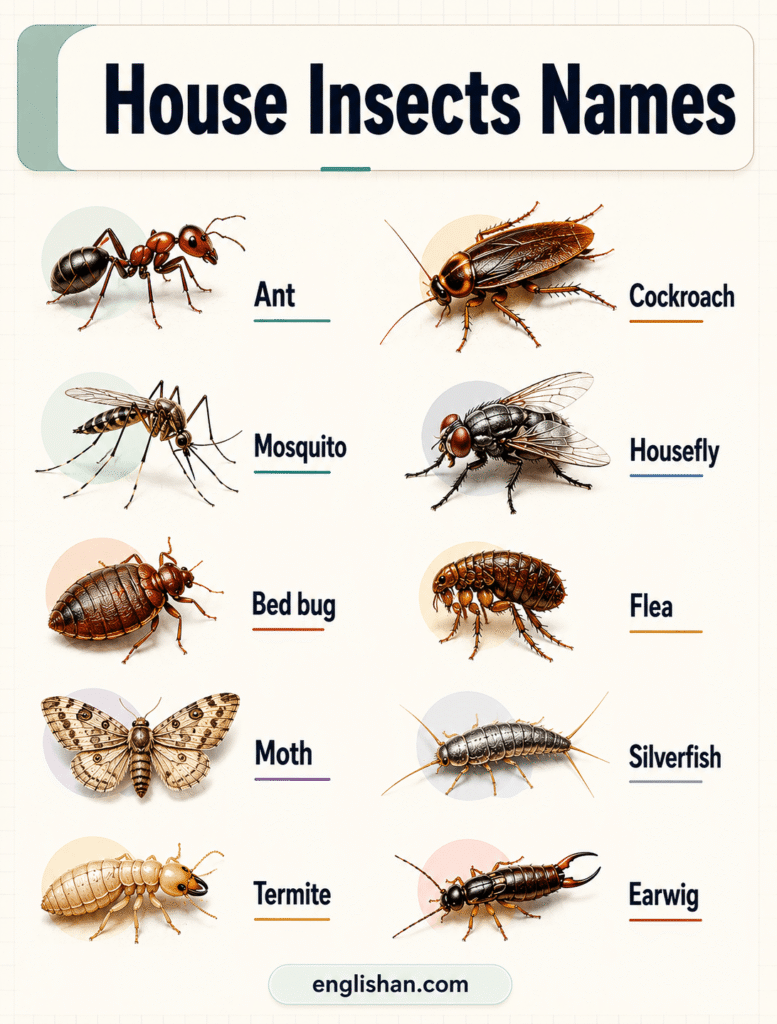
Common House Insects Names With Pictures
| Insect | Size | Where you find it | Risk |
|---|---|---|---|
| German cockroach | 13–16 mm (paperclip) | Kitchen and bathroom, behind appliances | Spreads bacteria |
| American cockroach | 35–40 mm (thumb) | Basements and drains | Spreads bacteria |
| Oriental cockroach | 22–29 mm (AAA battery) | Cellars and floor drains | Spreads bacteria |
| Black garden ant | 3–5 mm (rice grain) | Counters and pantry | Nuisance |
| Carpenter ant | 6–13 mm (rice to paperclip) | Damp wall voids and window frames | Structural damage |
| Fire ant | 2–6 mm (sesame to rice) | Ground floors and doorways | Painful sting |
| Silverfish | 12–19 mm (paperclip) | Bathroom, attic, bookshelves | Damages paper and glue |
| Firebrat | 10–15 mm (paperclip) | Boiler rooms and hot pipe runs | Damages paper and fabric |
| Bed bug | 4–5 mm (apple seed) | Mattress seams and headboards | Bites, feeds on blood |
| Carpet beetle | 1.7–3.5 mm (sesame seed) | Closets, rugs, under furniture | Damages wool and silk |
| Earwig | 12–25 mm (paperclip to house key) | Basements and laundry rooms | Nuisance |
| House centipede | 25–35 mm body (house key) | Bathrooms and basements | Mild venomous bite |
| Millipede | 20–40 mm (house key) | Garages and foundation walls | Nuisance |
| Flea | 1.5–3.2 mm (poppy to sesame) | Carpets and pet bedding | Bites, transmits tapeworm |
| Tick | 1.5 mm nymph, 3–5 mm adult | Bedding, pets, clothing | Transmits Lyme disease |
| Booklouse | 1–2 mm (grain of salt) | Damp walls, books, cardboard | Nuisance, signals damp |
| Springtail | 1–2 mm (pinhead) | Grout lines and drain edges | Nuisance, signals damp |
| Pillbug | 6–12 mm (rice to button) | Basements and garages | Nuisance |
| House cricket | 16–22 mm (thumbnail) | Basements and garages | Noise |
| Housefly | 6–7 mm (rice grain) | Kitchen and bins | Spreads pathogens |
| Blow fly | 8–12 mm (large rice grain) | Windowsills, near dead matter | Spreads pathogens |
| Fruit fly | 2.5–3 mm (sesame seed) | Fruit bowls and drains | Nuisance |
| Drain fly | 2–5 mm (sesame seed) | Sink and shower drains | Nuisance, signals sludge |
| Fungus gnat | 2–4 mm (sesame seed) | Houseplant soil | Damages plant roots |
| Mosquito | 3–6 mm body | Bedrooms, near standing water | Bites, transmits disease |
| Clothes moth | 12–17 mm wingspan | Wardrobes and storage boxes | Damages wool and cashmere |
| Indian meal moth | 16–20 mm wingspan | Pantry and dry goods | Contaminates food |
| Paper wasp | 12–25 mm (house key) | Attics, eaves, wall cavities | Painful repeated sting |
| Stink bug | 12–17 mm (shirt button) | Window frames in autumn | Odor, nuisance |
| Termite | 6–12 mm (rice grain) | Framing, subfloor, skirting | Severe structural damage |
| Powderpost beetle | 3–6 mm (sesame to rice) | Hardwood floors and furniture | Structural damage |
| Rice weevil | 2–3 mm (sesame seed) | Rice, flour, cereal | Contaminates food |
How To Identify A House Insect By Size And Shape
Reach for a size anchor before anything else. A grain of rice measures about 6 mm, a sesame seed about 3 mm, an apple seed about 5 mm, a poppy seed about 1 mm, and a house key runs to roughly 55 mm. Holding the insect against one of those settles half the field immediately, because a 2 mm speck and a 15 mm crawler share no candidates at all.
Shape narrows what remains. Count the legs first: six legs and three body segments make it a true insect, eight legs make it a spider, tick or mite, and anything past ten pairs is a centipede or millipede. Wings come next. Flies have one pair, wasps and moths two, and silverfish, fleas, booklice and bed bugs have none at all. If you want the wider naming set beyond the indoor species, the full 100 Insects Names In English With Pictures names the garden and field groups left out here.
The third check is the one almost nobody uses, and it identifies insects you never see. Residue names the culprit as reliably as the body does. Black pepper specks along a skirting board mean cockroaches. Rusty smears on a mattress seam mean bed bugs. Fine talc under a beam means powderpost beetles, hard six-sided pellets mean drywood termites, and coarse shavings mixed with insect body parts mean carpenter ants. Silk webbing running through a bag of flour means Indian meal moth larvae, and bare patches worn into a wool rug mean carpet beetle larvae.
Crawling House Insects Names
Crawling species make up most of what a household spots, because they move at floor level where the eye already goes. Nearly all of them are nocturnal, which is why a room that looks empty at eight in the evening looks different at two in the morning. Size and residue separate them quickly.
Cockroaches
Three species come indoors, and they split by room. The German cockroach (Blattella germanica) runs 13 to 16 mm, about the length of a paperclip, and wears two dark stripes down the plate behind its head. It stays where warmth, water and food overlap, which means behind the fridge, inside cabinet hinges and under the sink. One female produces up to 300 offspring across her life, so a pair becomes a problem inside a season. The American cockroach (Periplaneta americana) is far larger at 35 to 40 mm, reddish brown, and prefers basements, floor drains and utility rooms. The Oriental cockroach (Blatta orientalis) falls between them at 22 to 29 mm, almost black, and stays lower and damper than either. All three track Salmonella and E. coli across surfaces, and the US Environmental Protection Agency lists cockroach debris among the significant indoor allergen sources.
Ants
Trails give ants away before individual bodies do, because a line of them along a counter edge follows a scent path laid by the first scout. The black garden ant (Lasius niger) measures 3 to 5 mm, shorter than a grain of rice, and works sugar, grease and protein in that order of preference. Carpenter ants (Camponotus species) reach 6 to 13 mm and matter for a different reason, covered under wood damage below. Fire ants (Solenopsis invicta) run 2 to 6 mm and reach ground-floor rooms from nests outside, delivering a sting that raises a white pustule within a day. The elbowed antenna is the ant signature, bent at a sharp angle partway along, and it is the single trait that separates a winged ant from a termite.
Silverfish And Firebrats
Damp, dark and undisturbed describes every place these two settle. The silverfish (Lepisma saccharinum) is wingless, teardrop-shaped and 12 to 19 mm long, coated in scales that give it a metallic sheen, with three bristles at the tail end. It moves in a fast side-to-side wriggle across bathroom tiles and behind bookshelves, feeding on starch: wallpaper paste, book glue, cotton and paper. Silverfish belong to one of the oldest surviving insect lineages, older than any winged insect, and individuals survive up to eight years. The firebrat (Thermobia domestica) is its near twin at 10 to 15 mm, mottled grey-brown rather than silver, and it wants heat instead of cool damp, which puts it near boilers, hot water pipes and airing cupboards.
Bed Bugs
Flat enough to slide into a seam thinner than a credit card, the bed bug (Cimex lectularius) measures 4 to 5 mm, roughly an apple seed, and turns oval and reddish after feeding. Daytime hiding places run well beyond the mattress: headboard joints, bed frame screw holes, the underside of drawers and the gap behind an outlet plate. Feeding happens at night on exposed skin and leaves welts in a rough line or cluster. Females lay 200 to 500 eggs across a lifetime, and the insects travel by luggage, secondhand furniture and laundry bags rather than by walking between homes. The reliable early sign is not the insect but the rusty pinpoint staining left along a mattress seam.
Carpet Beetles
Adults feed on pollen outdoors and do no damage at all. The larvae do all of it. An adult varied carpet beetle (Anthrenus verbasci) measures 1.7 to 3.5 mm, sesame-seed sized, with a rounded back patterned in black, white and orange scales. The larva is smaller, brown and bristled, and it chews wool, silk, cashmere, leather, feathers and dried pet food in closets, under rugs and inside stored clothing boxes. Carpet beetles turned up in every home sampled by the North Carolina State University household arthropod survey, which makes them one of the most widespread indoor insects and one of the least recognized.
Earwigs
Pincers at the tail end make earwigs (order Dermaptera) the most alarming-looking harmless insect in a house. The body runs 12 to 25 mm, dark brown and flattened, and the pincers are curved on males, straight on females. They neither bite nor sting, and the pincers lack the strength to break skin. Damp is what draws them: basements, laundry rooms, the tray under a potted plant, and the gap beneath cardboard stored on a concrete floor. The old story about earwigs entering ears has no basis.
House Centipedes And Millipedes
Speed separates these two before anything else does. The house centipede (Scutigera coleoptrata) has fifteen pairs of long banded legs on a flattened yellow-grey body of 25 to 35 mm, and it crosses a wall fast enough to startle. It hunts cockroaches, silverfish and spiders, which makes it an indoor predator rather than a pest. Its bite is venomous and produces pain similar to a mild bee sting, with no lasting effect. The millipede is slower, rounder and worm-like at 20 to 40 mm, with two pairs of legs per segment instead of one, and it eats decaying plant matter near foundation walls and garage doors. Centipedes run; millipedes trundle and curl.
Fleas
Bites around the ankles, several in a tight group, arrive before the insect does. The cat flea (Ctenocephalides felis) is the species in nearly all household cases, measuring 1.5 to 3.2 mm, laterally flattened, wingless and dark brown. It jumps 50 to 100 times its own body length, which takes it around 20 cm in one hop, and that range is what moves it from carpet to leg. Breeding happens in carpet pile, pet bedding and upholstery rather than on the animal, and one female lays 40 to 50 eggs a day. Fleas transmit tapeworm and, historically, plague.
Ticks
Ticks arrive on a dog, a cat or a trouser leg rather than under a door. Two stages matter, and they differ enough to be mistaken for separate species. The nymph measures about 1.5 mm, the size of a poppy seed, and causes most Lyme disease transmission precisely because it goes unnoticed. Adults reach 3 to 5 mm unfed and swell to the size of a small pea after a blood meal. The brown dog tick (Rhipicephalus sanguineus) and the blacklegged tick (Ixodes scapularis) are the two carried indoors most. Eight legs place ticks with the arachnids, not the insects.
Booklice
Booklice turned up in 98 percent of homes in the North Carolina survey, and almost nobody recognizes them. At 1 to 2 mm they are the size of a grain of salt, pale grey or translucent, soft-bodied and quick across a damp surface. They are not lice and they do not bite. What they eat is microscopic mold growing on damp wallpaper, cardboard, book bindings and old plaster, which makes their arrival a damp reading rather than a pest problem. Drop the humidity below 45 percent and the population collapses.
Springtails
A grey fleck by the shower drain that disappears the instant you look closer is almost always a springtail. At 1 to 2 mm they are pinhead-sized, and the identifying behavior is the jump: a forked appendage under the abdomen releases like a catch and flings the insect several centimeters in a random direction. Springtails gather along grout lines, around toilet bases, in overwatered plant pots and under bathroom mats. They eat decaying organic matter and mold, damage nothing and bite nobody.
Pillbugs
Roll one over and it curls into a tight grey ball, which no insect in a house does. Pillbugs (Armadillidium vulgare) run 6 to 12 mm with a segmented armored back and seven pairs of legs, and they are crustaceans rather than insects, closer kin to a crab than to a beetle. They breathe through gill-like structures, so they die within hours in dry air and only survive along damp basement walls, under garage boxes and beside foundation cracks. Finding several indoors means damp in the wall base.
Crickets
You hear a house cricket (Acheta domesticus) long before you see one. The body runs 16 to 22 mm, light brown with dark bands across the head, and the chirp comes from the male rubbing one wing edge against the other. Basements, garages and the warm gap behind a boiler are the usual spots. Crickets chew paper and fabric in small amounts but cause no structural damage, and the noise is what drives people to look for them.
Flying House Insects Names
Flight pattern identifies a small flying insect faster than its body does, because at 3 mm nobody can see wing venation. Drain flies flutter and drop, fungus gnats hover in one spot, fruit flies track straight lines, and phorid flies zigzag. Watch the movement for five seconds before reaching for a description.
Houseflies
Four dark stripes running lengthwise down the thorax mark the housefly (Musca domestica) apart from every other grey fly in a kitchen. The body runs 6 to 7 mm with large reddish compound eyes. Houseflies taste through receptors on their feet, so every landing on food is a feeding attempt, and they regurgitate to dissolve solids before drinking them back. Research has catalogued over a hundred disease-causing organisms transported on their bodies and in that regurgitate. A full life cycle completes in seven days in warm conditions. Several indoor fly species get confused with this one, and Types Of House Flies In English separates them by name.
Blow Flies
Metallic blue or green bodies make blow flies the easiest indoor fly to name on sight. At 8 to 12 mm they run noticeably larger than a housefly, with a loud low buzz and heavy, clumsy flight that ends in repeated collisions with a window. Several appearing indoors at once, especially in an unused room, come from a dead animal in a wall cavity, a chimney or a loft, because blow flies breed on carrion. One or two in summer means an open window.
Fruit Flies
Red eyes on a tan body at 2.5 to 3 mm identify Drosophila melanogaster, the fruit fly that gathers over a ripe banana within a day of it turning. Breeding happens on fermenting sugars: overripe fruit, a wine glass left overnight, the film inside a recycling bin, and the residue in a drain. A single female lays up to 500 eggs on that surface and larvae mature within a week. Removing the breeding surface ends the population, which is why traps alone rarely finish the job.
Drain Flies
Fuzzy wings held roof-like over the body separate the drain fly (Clogmia albipunctata) from every gnat it gets mistaken for. The insect measures 2 to 5 mm, grey-brown and moth-like, and it flutters a short distance before landing rather than hovering. Breeding happens in the gelatinous biofilm coating the inside of a drain, so a steady population is a plumbing reading, not a hygiene one. Drain flies do not bite. A dozen of them around a shower means the trap needs mechanical cleaning rather than bleach, which slides straight past the film.
Fungus Gnats
Overwatered houseplants produce fungus gnats (family Sciaridae) within about two weeks. Adults measure 2 to 4 mm, dark and delicate with long legs, and they hover close to soil surfaces and drift toward lit windows. Larvae live in the top few centimeters of wet compost, feeding on fungi and fine roots, and a heavy population stunts the plant. Letting the top 2 cm of soil dry between waterings breaks the cycle, because the eggs need constant moisture to hatch.
Mosquitoes
Only females bite, and only because egg production requires a blood meal. The body runs 3 to 6 mm on long legs, with a slender proboscis held forward. Indoor breeding needs standing water and very little of it: a plant saucer, a forgotten vase, a blocked gutter beside an open window. Mosquitoes transmit dengue, malaria, Zika and West Nile virus, which puts them at the top of any household risk ranking despite their size. In tier-one climates the disease risk is low and the sleep disruption is the real cost.
Clothes Moths
Holes in a stored sweater arrive months before anyone sees the moth. The webbing clothes moth (Tineola bisselliella) has a 12 to 17 mm wingspan, golden-buff with fringed wing edges, and it avoids light, which is why it stays inside wardrobes and storage boxes rather than circling a lamp. Adults eat nothing at all. The cream-colored larvae do the damage, digesting keratin in wool, cashmere, silk, fur and feathers. Cotton and synthetics survive untouched, which is the quickest way to confirm the diagnosis from the damage alone.
Indian Meal Moths
Silk webbing running through a bag of flour is the first evidence of Plodia interpunctella, the most widespread pantry moth worldwide. The adult has a 16 to 20 mm wingspan with a distinctive two-tone wing, copper-bronze on the outer half and pale grey nearest the body. Larvae infest flour, cereal, rice, dried fruit, nuts, birdseed and pet food, and they chew through thin packaging to reach it. Adults flying near a kitchen ceiling mean the larvae have already finished feeding somewhere in a cupboard.
Wasps
Paper wasps and yellowjackets build nests in attics, eaves and wall cavities, then reach living space through gaps around window frames and vents. Workers measure 12 to 25 mm with the sharp yellow and black banding people recognize. Unlike honeybees they sting repeatedly, because the sting is not barbed and stays intact. A nest in a wall cavity announces itself as a steady stream of insects entering one fixed point outside, which is more reliable than counting wasps indoors. Venom allergy makes an indoor nest a medical matter rather than a nuisance.
Stink Bugs
Autumn brings stink bugs to window frames in numbers, because the brown marmorated stink bug (Halyomorpha halys) overwinters inside buildings. The shield-shaped body runs 12 to 17 mm, mottled brown, with pale bands on the antennae. It damages nothing indoors and bites nobody. Crushing one releases the defensive compound the insect is named for, and the smell lingers on fabric, so vacuuming or lifting them out on paper works better than swatting.
Wood Destroying House Insects
Three species damage timber, and the damage looks different for each. Reading the residue tells them apart faster than finding the insect, since all three work out of sight for months.
Termites
Termites belong to Blattodea, the cockroach order, and the old classification as order Isoptera has been retired: they are eusocial cockroaches, not a separate lineage. Workers measure 6 to 12 mm, pale and soft-bodied, divided into workers, soldiers and reproductives. Subterranean species build pencil-width mud tubes from soil up a foundation wall to reach timber, while drywood species nest inside the wood itself. Both digest cellulose and work silently inside framing and subfloor. Drywood termite frass is the giveaway: hard six-sided pellets, the color of the wood, that pile beneath a small kick-out hole. The North Carolina survey found termite evidence in 28 percent of homes sampled, which places them well ahead of cockroaches for prevalence.
Carpenter Ants
Carpenter ants eat no wood at all. They excavate it, cutting smooth bare galleries through damp or decaying timber to nest, and pushing the waste out. At 6 to 13 mm and predominantly black, they concentrate in wood already softened by moisture: window frames, porch supports, bathroom subfloor and roof leaks. The frass separates them from termites at a glance, because it is coarse and fibrous, like fine sawdust, and mixed with discarded insect body parts. The leak needs fixing as much as the nest needs treating, since dry timber does not attract them.
Powderpost Beetles
Round exit holes 1 to 2 mm across, scattered over a hardwood floor or a chest of drawers, mean powderpost beetles (subfamily Lyctinae). Adults are slender and reddish brown at 3 to 6 mm and lay eggs in the open pores of hardwood, which restricts them to oak, ash, walnut and hickory rather than pine. Larvae bore through the interior for months, reducing it to a powder as fine as talc that trickles from the holes. By the time the holes are visible the larvae have already emerged, so fresh powder beneath them is the test for an active infestation.
Pantry Insects Found In Kitchen Cupboards
Stored food attracts a distinct set of small beetles, all under 4 mm and all reddish or dark brown, which makes them near-impossible to separate at a glance in a cupboard.
- Rice weevil: unmistakable at 2 to 3 mm thanks to a long downward snout, boring inside whole rice and wheat grains where the larvae develop unseen.
- Flour beetle: flattened and reddish at 3 to 4 mm, moving through milled flour rather than whole grain and leaving it with a musty smell.
- Drugstore beetle: humped and finely ridged at 2 to 3 mm, the widest eater of the four, working through spices, dried herbs, pet food and even paper.
- Sawtoothed grain beetle: named for the six sawlike teeth along each side of the thorax, and flat enough at 2.5 to 3 mm to walk into sealed packaging through a folded seam.
Airtight glass or hard plastic ends all four, because none of them chews through rigid containers. Cardboard and paper sacks do not stop them.
House Spiders And Other Indoor Arthropods
Not everything indoors is an insect, and the three most common indoor arthropods are all outside the group. Spiders, ticks and mites have eight legs and two body segments rather than six legs and three.
Cobweb spiders (family Theridiidae) build the tangled webs in ceiling corners and appeared in every home the North Carolina survey visited, making them the single most universal indoor arthropod. Cellar spiders, the long-legged spiders commonly called daddy longlegs, showed up in 84 percent, hanging beneath their webs in basements and garages. Both hunt the insects listed above and neither bites people in any meaningful sense.
Dust mites measure 0.2 to 0.3 mm and are invisible without magnification. They eat shed human skin, concentrate in mattresses, pillows and upholstered furniture, and cause no bites at all. Their droppings are among the most significant indoor allergen sources, which is why hot-washing bedding does more than any spray. For a gentler naming set to work through with children, Insects Names For Kids With Pictures keeps to the recognizable species without the pest framing.
House Insects By Room
Rooms sort insects by what they supply. A kitchen supplies food and warmth, a bathroom supplies standing moisture, a bedroom supplies skin cells and natural fibers, and a basement supplies dark, cool damp. Match the room to the resource and the candidate list shortens fast.
Kitchen Insects
- Ants: working sugar and grease along counter edges and cabinet seams.
- German cockroaches: nesting in the warm cavity behind the fridge and inside cabinet hinges.
- Fruit flies: breeding on fermenting sugars in fruit bowls, recycling bins and drains.
- Indian meal moths and pantry beetles: inside flour, rice, cereal and dried fruit.
- Houseflies: landing on uncovered food and bin lids between trips outside.
Bathroom Insects
- Silverfish: behind skirting boards and under the bath where humidity stays high.
- Drain flies: breeding in the biofilm lining sink and shower waste pipes.
- Springtails: along grout lines and around the toilet base wherever moisture persists.
- House centipedes: hunting the other three across floors and walls at night.
- German cockroaches: using the warm pipe runs behind the cistern for water access.
Bedroom Insects
- Bed bugs: hiding by day in mattress seams, box springs, headboard joints and nightstand cracks.
- Carpet beetles and clothes moths: feeding on wool blankets, stored garments and closet corners.
- Mosquitoes: entering through damaged screens and feeding on sleepers.
- Dust mites: throughout the mattress and pillows, unseen and unfelt.
- Cobweb spiders: webbing ceiling corners and the gap behind furniture that goes unmoved.
Basement And Garage Insects
- House crickets: chirping from floor-level corners after dark.
- Earwigs: gathered under damp cardboard and beside foundation cracks.
- Pillbugs and millipedes: along the wall base wherever concrete stays damp.
- Cellar spiders: hanging under webs in undisturbed corners and joist spaces.
- Ground beetles: wandering in beneath a poorly sealed garage door and hiding by day.
Harmful vs Harmless House Insects
Most indoor species do nothing to a person or a building. The short list below names the ones that justify action and what to do first with each.
| Insect | Main risk | What to do first |
|---|---|---|
| Bed bug | Bites and rapid spread | Inspect mattress seams for rusty staining before treating |
| Termite | Severe structural damage | Check foundation walls for mud tubes, then call an inspector |
| Cockroach | Bacteria and allergens | Seal food, then trace warmth and water to the harborage |
| Flea | Bites, tapeworm | Treat the pet and wash all bedding at 60 °C |
| Tick | Lyme disease | Remove with fine tweezers, straight out, no twisting |
| Mosquito | Bites, disease vector | Empty every standing water source indoors |
| Carpet beetle | Wool and silk damage | Vacuum under furniture and hot-wash stored garments |
| Clothes moth | Wool and cashmere damage | Freeze or hot-wash affected garments, vacuum the wardrobe |
| Indian meal moth | Food contamination | Discard infested packs, move dry goods to sealed jars |
| Carpenter ant | Structural damage | Find and repair the moisture source in the timber |
| Wasp | Repeated sting, allergy risk | Locate the outside entry point, do not seal it while active |
Everything else named here is a nuisance. Earwigs, silverfish, springtails, booklice, pillbugs, crickets, drain flies, fungus gnats, stink bugs, centipedes and house spiders damage nothing and injure nobody, and three of them actively reduce the insects that do.
House Insects That Look Alike
Six pairs cause almost all indoor misidentification, and getting the pair wrong is how people either panic over a harmless insect or ignore a costly one.
Termite against winged ant. Both swarm indoors in spring and both have four wings. The termite has straight beaded antennae, a thick uniform waist and four wings of equal length. The ant has sharply elbowed antennae, a pinched waist and forewings noticeably longer than the hindwings. Counting wing length settles it:
Four wings of equal length, called a flying ant ❌
Four wings of equal length, that is a termite ✅
Silverfish against firebrat. Both are 10 to 19 mm, wingless and three-tailed. The silverfish is uniformly silver-grey and wants cool damp, so it turns up in bathrooms and cellars. The firebrat is mottled brown and wants heat, so it turns up near boilers and hot pipes. Where you found it names it.
Fruit fly against drain fly. The fruit fly is smooth, tan, red-eyed and flies straight lines over fruit and bins. The drain fly is fuzzy, grey-brown and moth-like, settles with broad wings folded roof-like over the body, and flutters in short hops around a sink. One means fruit, the other means plumbing.
Carpet beetle larva against bed bug. The carpet beetle larva is brown, bristled and tapered, and it stays near wool and rugs. The bed bug is smooth, flat, oval and reddish, and it stays within a few meters of a bed. One leaves bare patches in fabric; the other leaves bites and rusty seam stains.
Cockroach against cricket. Both are brown, fast and roughly the same length. The cockroach is flat, oval and silent, and runs low against a surface. The cricket is cylindrical with oversized hind legs, jumps rather than runs, and chirps.
Centipede against millipede. The centipede has one pair of legs per segment, a flattened body and real speed, and it hunts other insects. The millipede has two pairs per segment, a rounded body, and moves slowly through decaying plant matter. Speed alone separates them across a room.
Which House Insects Live In Almost Every Home
A North Carolina State University survey of 50 homes, published in PeerJ in 2016, catalogued more than 10,000 specimens across 554 rooms and produced the fullest picture available of what actually lives indoors.
Every home sampled contained between 32 and 211 arthropod species, averaging around 100. Only 5 of 554 rooms held none at all.
The prevalence ranking overturns most assumptions about house insects. Cobweb spiders, carpet beetles, gall midges and ants appeared in 100 percent of homes. Booklice reached 98 percent, dark-winged fungus gnats 96 percent, cellar spiders 84 percent, and weevils, mosquitoes, scuttle flies and leafhoppers 82 percent each.
The feared species sat at the opposite end. German cockroaches were recorded in 6 percent of homes, fleas in 10 percent and termites in 28 percent, and bed bugs turned up in none of the 50. The insects sharing your rooms right now are almost certainly the ones you have never noticed, and the ones people dread are genuinely uncommon.
When House Insects Appear Through The Year
Indoor insect activity follows a rough calendar. Spring brings termite and ant swarms, as winged reproductives leave established nests on the first warm humid days. Summer peaks for flies, mosquitoes, wasps and fruit flies, driven by heat, open windows and faster breeding cycles. Early autumn produces the overwintering push, when stink bugs, cluster flies and ladybirds gather on sun-warmed south-facing walls and work their way through gaps into lofts and window frames. Winter narrows activity to the permanent indoor residents, since cockroaches, silverfish, carpet beetles, booklice and bed bugs breed year-round in heated buildings and pay no attention to the season outside.
What Attracts Insects Into A House
Five resources account for nearly every indoor infestation, and each maps to a specific set of species.
- Food residue: crumbs, grease films and open packets bring ants, cockroaches, houseflies and pantry beetles.
- Standing moisture: leaks, condensation and drain sludge bring silverfish, springtails, booklice, drain flies and centipedes.
- Warmth: heated cavities behind appliances and boilers keep cockroaches and firebrats breeding through winter.
- Natural fibers: wool, silk, feathers and leather in storage bring carpet beetles and clothes moths.
- Light at night: unshielded exterior lights near doors pull in moths, blow flies, crickets and wasps.
Sealing gaps around pipe penetrations and door thresholds, fixing leaks, storing dry goods in rigid containers and switching exterior bulbs to warm low-blue lighting removes four of the five without any treatment at all.
FAQs
Ants, carpet beetles, booklice and fungus gnats are the most common house insects by a wide margin, each recorded in over 95 percent of homes in the North Carolina State University survey, alongside cobweb spiders. Houseflies, silverfish, fruit flies and clothes moths follow. Cockroaches, bed bugs and fleas are far less common than their reputation suggests, appearing in under 10 percent of surveyed homes.
Tiny dark specks under 3 mm are almost always carpet beetles, springtails, booklice, fungus gnats or drain flies, and movement separates them. Springtails jump when disturbed, fungus gnats hover in one spot near plants, drain flies flutter and land near sinks, and carpet beetles crawl slowly across rugs and windowsills. Booklice move fast across damp walls and signal humidity above 58 percent.
Rice weevils, flour beetles, drugstore beetles, sawtoothed grain beetles and Indian meal moth larvae are the small brown insects found in kitchen cupboards. All infest stored grain, flour, cereal, spices, dried fruit and pet food. Discarding the infested pack and moving dry goods into rigid airtight containers removes the breeding source, since none of these beetles chews through glass or hard plastic.
Bed bugs, fleas, mosquitoes and fire ants bite or sting people, and wasps sting repeatedly. House centipedes deliver a mild venomous bite only when handled. Silverfish, earwigs, carpet beetles, crickets, booklice, springtails, pillbugs, stink bugs and millipedes do not bite at all, despite several of them looking as though they would.
Most are harmless. Eleven species justify action: bed bugs and fleas for biting, mosquitoes and ticks for disease transmission, cockroaches for bacteria and allergens, termites, carpenter ants and powderpost beetles for structural damage, carpet beetles and clothes moths for fabric damage, and Indian meal moths for food contamination. Everything else indoors is a nuisance or a predator of the pests.
Between 32 and 211 arthropod species, averaging around 100 per home, according to the North Carolina State University survey of 50 homes. Only 5 of the 554 rooms examined contained none at all. The overwhelming majority go unnoticed because they measure under 2 mm, stay active at night, or live inside wall cavities and loft insulation.
You May Also Like
- 100 Insects Names With Pictures
- Insects Names For Kids With Pictures
- Types Of House Flies
- Household Items Names
- Flying Animals Names With Pictures
- Animals Names With Pictures
House Insects Quiz
House Insects
Which insect does the picture show?
The picture shows a silverfish.
Read the picture before reading the options.
The picture shows a silverfish.
What does a silverfish feed on indoors?
Book bindings and wallpaper paste are exactly the diet it wants.
Silverfish damage paper, not people.
Silverfish had grazed the spines of the older books.
Which household insect damages wool and carpets?
The larvae digest keratin; the adults feed harmlessly on pollen outdoors.
Keratin eaters are the ones that damage wool.
Bare patches in the carpet edge suggest beetle larvae.
Name the insect.
The flat, fast-moving insect that hides in warm crevices and scatters from light is the ___.
A flattened body lets it into gaps a few millimetres wide.
Flat and fast, and gone the moment a light goes on.
Cockroaches need warmth, moisture and a crevice.
Why do ants appear indoors in trails rather than singly?
A scout marks the route back, and the trail strengthens as more ants use it.
Wiping the trail matters as much as removing the food.
The line vanished once the pheromone trail was cleaned away.
Three of these are insects. Which is not?
Eight legs and two body sections make it an arachnid.
The commonest indoor arthropod is usually not an insect at all.
House spiders are arachnids.
What are the small knobs behind a fly's wings?
They are the reduced second wing pair, vibrating to sense rotation in flight.
Flies have one pair of wings and one pair of gyroscopes.
Halteres are why a fly can turn so sharply.
Turn on JavaScript for the interactive quiz. The full practice set is shown above.