Someone misses a shift, and AWOL slips into an email or a chat, leaving you unsure how strong the word sounds. It comes from the military and stands for absent without leave, used in the Army and Navy for leaving duty without permission. From there, it moved into work and school talk for someone who disappears without notice.
In this article, we explain AWOL meaning first, then how people use it in workplace email, group chat, captions, and casual talk. We also show how tone changes between formal settings and everyday use, followed by short examples so the sense is easy to read before you say it.
What Does AWOL Mean?
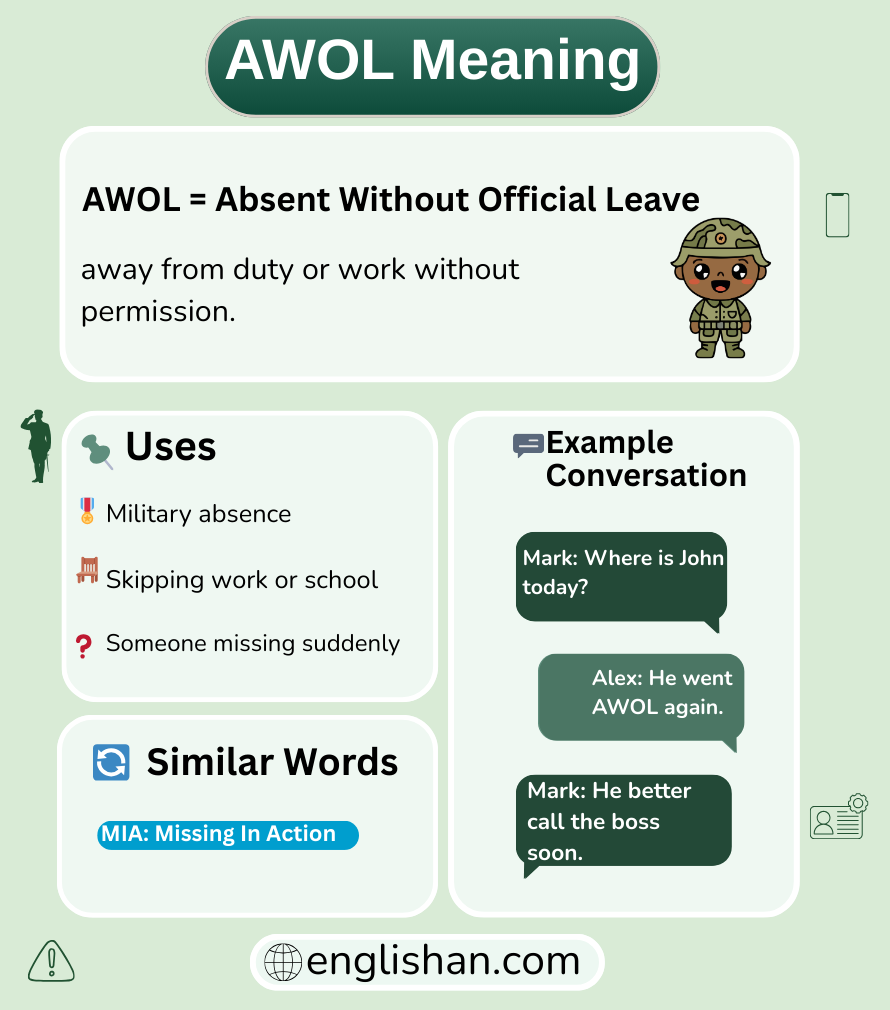
The acronym AWOL functions as a serious label for being absent without permission. It indicates that a person has left their post, job, or social obligation without notifying anyone. Writers use it to describe someone who has vanished from a situation where they were expected to be present.
What Does AWOL Stand For?
This four-letter acronym stands strictly for Absent Without Leave. It grammatically functions as an adjective or an adverb, describing the status of the missing person. While originally a military designation, it has evolved into a common word pronounced as “A-wall.”
How AWOL Is Used
People use this term to describe unexplained disappearances in daily life. It implies that the person had a duty or a plan to attend but failed to show up without calling. It carries a tone of irresponsibility or concern, suggesting the person has “gone rogue.”
AWOL In The Military
In its official context, AWOL is a criminal offense under military law. It describes a service member who leaves their unit or fails to report for duty without authorization but does not intend to desert permanently. This status can lead to severe disciplinary action, including discharge or confinement.
AWOL In The Workplace
In a professional setting, an employee is considered AWOL if they pull a “no call, no show.” It refers to skipping work without informing a manager or submitting a sick leave request. Being labeled AWOL in this environment is often grounds for immediate termination.
AWOL In Texting And Social Media
In digital communication, the term is synonymous with ghosting. If a friend suddenly stops replying to messages in the middle of a conversation or leaves a group chat without a word, peers might say they went AWOL. It highlights the abrupt and confusing nature of their silence.
AWOL Example Conversations
These dialogues demonstrate how the term is used to describe missing soldiers, employees, and friends.
Jason: Has anyone heard from Private Miller today?
Mike: No, he missed roll call this morning.
Jason: If he doesn’t report in an hour, we have to mark him AWOL.
Sarah: Did the new guy show up for his shift?
Emily: No, he has been AWOL for two days now.
Sarah: The boss is probably going to fire him.
David: I thought Jessica was coming to the movies with us?
Jessica‘s Friend: She went AWOL right after dinner and stopped answering texts.
David: That is so like her to just disappear.
Origin Of AWOL
The specific phrase “Absent Without Leave” was used during the American Civil War to track soldiers. However, the acronym itself became prominent during World War I and was officially pronounced as a word (A-wall) by the time of World War II. It transitioned from strictly military jargon to civilian slang during the late 20th century.
Common Confusions With AWOL
A frequent mix-up occurs with the similar acronym MIA (Missing In Action). While both refer to missing people, AWOL implies the person left on purpose, while MIA implies they are missing due to external circumstances like combat. Additionally, some users confuse the spelling with “Awall” or “Owl” due to the pronunciation.
AWOL Vs MIA
The distinction lies in intent and control. A soldier who goes AWOL has made a choice to leave their post without permission. A soldier who is MIA is missing during battle, and their status (captured, injured, or deceased) is unknown to their unit.
Synonyms Of AWOL
- Truant: Missing from school.
- Deserted: Left a post permanently.
- Ghosting: Disappearing from communication.
- Derelict: Failing to do one’s duty.
Other Related Slang Words
These terms also describe disappearing or leaving.
- MIA: Missing In Action. Used for unknown whereabouts.
- Ghost: To stop replying.
- Irish Goodbye: Leaving a party without saying bye.
- Bailing: Canceling plans last minute.
Key Takeaway
We define this acronym as a military and slang term standing for “Absent Without Leave,” referring to someone who is missing without permission. In the military, it is a serious offense involving a soldier leaving their post. In civilian life, it describes an employee skipping work (“no call, no show”) or a friend who stops replying to texts (“ghosting”). Readers should distinguish it from MIA, as AWOL implies the person vanished voluntarily and negligently.
FAQs
In the military, yes, it is a punishable offense.
It is pronounced as the word “A-wall.”
Yes, metaphorically, by skipping work or events.
No, desertion implies the intent to never return.
Yes, it is usually written as AWOL or awol.
You May Also Like